
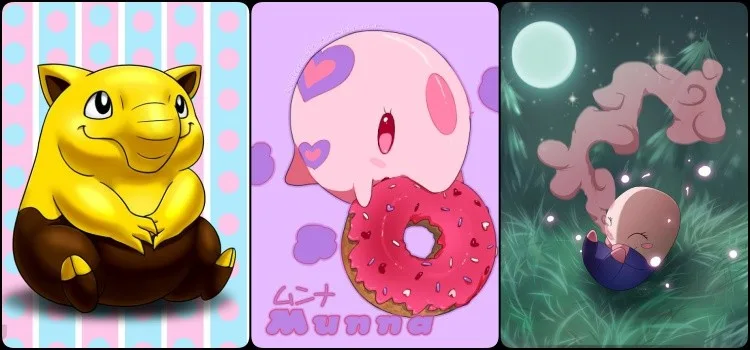
Have you noticed the similarities between the Pokémon Drowzee, Munna, and Musharna? There is a reason these three Pokémon resemble the tapir, a hoofed mammal from the rainforests of Southeast Asia, and share powers tied to sleep and dreams!
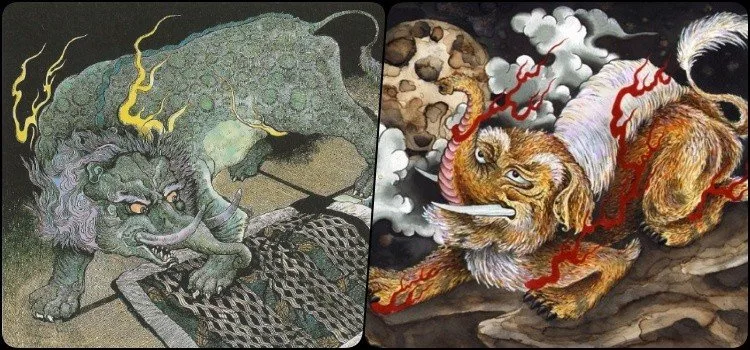
Where did the inspiration to create these three Pokémon come from? From a youkai called "Baku" (獏), a monster that devours people's dreams and is usually pictured with a tapir's body. But how did the tapir gain this fantastic power? The story behind it begins in China. In a preface to a painted screen, the Tang poet Bai Juyi (772–846) described the baku with an elephant's trunk, rhinoceros's eyes, an ox's tail and tiger's feet, and in China images and hides of the baku were used to keep illness and evil away. When the legend reached Japan, that protective creature became the baku that eats bad dreams.
How did the Youkai Baku come about?
In ancient times, in an era without the internet, photographs and airplane travel, knowledge about animals and distant places took time to reach other countries, and when it did, it was often wrapped in legends and mysteries. Europeans believed in unicorns for a long time and were astonished when they saw elephants or rhinoceroses, animals very different from those they knew.
This also happened in Japan. Geographically isolated in the Japanese archipelago, the inhabitants of the country received stories about animals and plants from distant places, but as the saying goes, a story grows in the telling, and the Japanese ended up with fantastic legends from overseas countries. The kirin, a Japanese monster somewhere between a giraffe and a unicorn, and the baku are examples of this process.
From a simple tapir, the Baku became a fantastic animal that devours dreams. The real Malayan tapir lives in the rainforests of Southeast Asia, mainly in Thailand, Malaysia and Sumatra, and was unknown in Japan for a long time. Because it looks so much like the baku, the modern Japanese word baku refers to both the legendary creature and the real tapir. But what does the baku of legend actually do?
According to the writer Lafcadio Hearn (1850–1904), who lived in Japan during the Meiji era, anyone who wakes up in the middle of the night because of a nightmare can call the baku, and it will devour the bad dream. However, invoking the baku should be done with great caution, because the animal is hungry and may also devour the dreams and hopes of the one who called it. Thanks to this power over nightmares, pillows and talismans bearing the image of the baku were common, especially in the Edo period (1603–1868).
Drowzee's Pokédex entry goes further and calls it a descendant of the legendary animal baku, a Pokémon that nourishes itself by eating dreams. With that history in mind, it is easy to see where the appearance and the sleep-related powers of Drowzee, Munna and Musharna come from.
References in Japanese works
Beyond the three Pokémon above, the baku also appears in other works:
- Hypno, Drowzee's evolution, uses its pendulum to put opponents to sleep;
- The Digimon Tapirmon, whose Japanese name Bakumon comes from the baku, lives at the Fortuneteller Village in Digimon Frontier;
- In Naruto Shippuden, the character Danzō Shimura summons a giant baku;
- In Kamen Rider Black, the hero fights a Tapir Mutant of the Gorgom organization;
- Doremy Sweet from the Touhou games is a baku who rules the Dream World and can create and eat dreams;
The old remedy against a bad dream was simple: a child who wakes up at night repeats three times, "Baku-san, come eat my dream," and the baku comes to swallow it. The creature first described on a Chinese screen now lives on in games and anime, where Pokémon like Drowzee still eat dreams.



Community
Comments
0 comments
There are no published comments in this language yet.
Send comment