
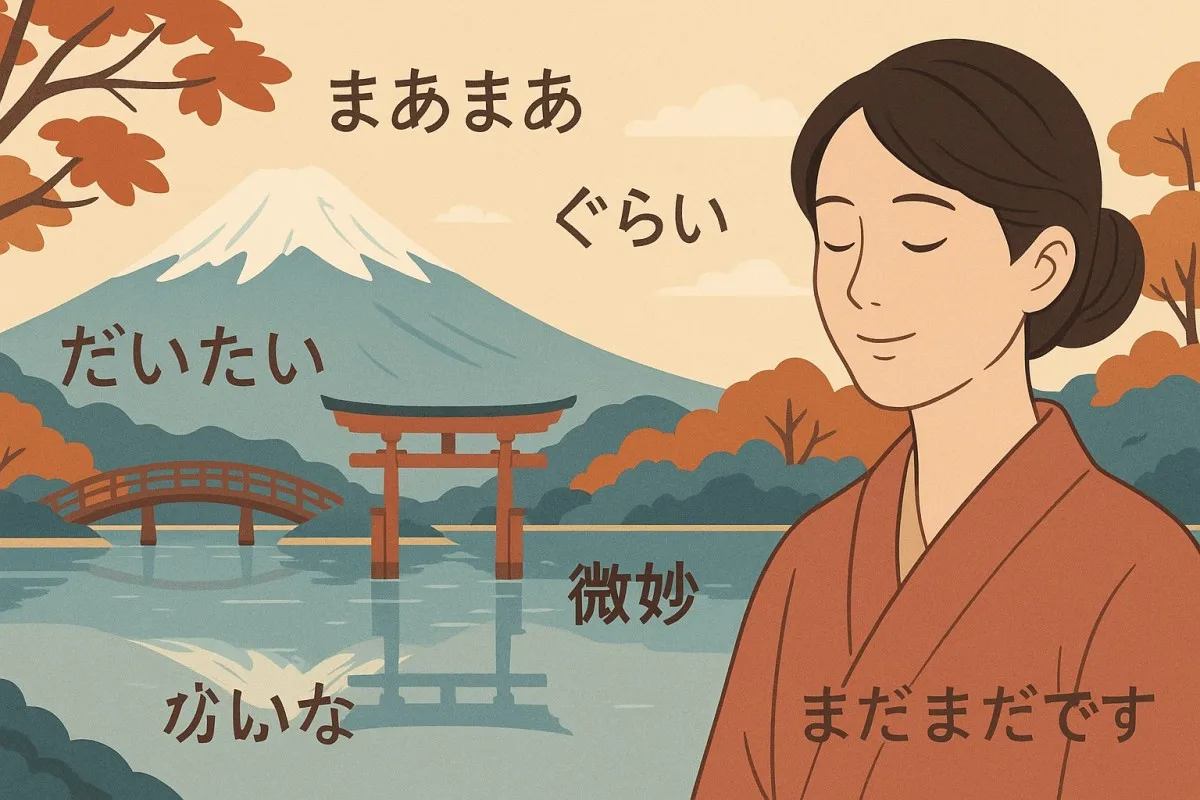
Have you ever wondered how to express “more or less” in Japanese? There are several ways such as mā mā, daitai, gurai, sonna kanji, bimyō, mada mada desu… and each one conveys a different nuance.
In this article, we will understand the meaning of each one, their variations, and, mainly, when to use each of them to sound natural in Japanese. Nothing too technical, just what really works in everyday conversations.
Table of Contents
1. まあまあ (mā mā): “more or less” in a neutral sense
まあまあ is that response that neither praises nor criticizes. It serves when something was “ok”, “mediocre”, “acceptable”. It is the most used option when you want to respond without committing.
It is perfect for quick opinions about movies, food, bad or good days, or anything where the judgment is not extreme. Japanese people use it a lot to soften responses and avoid sounding too negative.
まあまあだったよ。
Mā mā datta yo.
→ “It was more or less.”
2. だいたい (daitai): “more or less” of approximation
Daitai does not speak of opinion; it speaks of estimation. Use it when you want to express something that is not exact: time, quantity, number, distance. It is the natural equivalent of “approximately”.
It is very common in quick responses when the person does not need the exact number — just a general idea.
だいたい3時間かかる。
Daitai san-jikan kakaru.
→ “It takes more or less three hours.”

3. 〜くらい (kurai / gurai)
This is practically a sister of daitai, but even more colloquial. You hear くらい/ぐらい in any conversation among Japanese people, especially when talking about price, time, weight, age, or any approximate number.
30分くらい待った。
Sanjuppun kurai matta.
→ “I waited about 30 minutes.”
4. そんな感じ (sonna kanji) “kind of that”
This form is great when you want to express slight uncertainty, like when you remember “more or less” the time or the feeling of something. It conveys the idea of: “it’s around there”, “more or less that”, “something in that sense”.
Japanese people use it when they don’t want to be exact or when they want to keep the conversation more relaxed.
7時…そんな感じ。
Shichi-ji… sonna kanji.
→ “Around seven… more or less that.”
5. 微妙 (bimyō) nuance of “meh”
Here we have an important expression: bimyō does not simply mean “more or less” — it expresses something kind of bad, “meh”, “didn’t like it much, but I don’t want to say it openly”. It is that response that shows discomfort, uncertainty, or slight disapproval without being rude.
It is common when someone asks your opinion about something you didn’t like much, but you also don’t want to criticize directly.
微妙だった。
Bimyō datta.
→ “It was kind of… more or less (bad).”
6. まだまだです (mada mada desu)
This form appears a lot when someone compliments you. まだまだです literally means “there’s still a long way to go”, but in practice it sounds like “more or less… I’m still far from being good”.
It is typical Japanese modesty, not self-deprecation. Almost every Japanese person uses it when receiving a compliment about skill, especially language, music, sports…
いえ、まだまだです。
Ie, mada mada desu.
→ “Not at all, I’m still far from it.” / “More or less…”

Leave a Reply