

If you are a Japanese student, you must have noticed that it does not use spaces between words in most sentences. However, in some texts, you can indeed notice spaces between some words or phrases, leaving you a bit confused. In this article, we will understand why the Japanese do not use spaces in their language and when they do.
Table of Contents
Why does Japanese not use spaces?
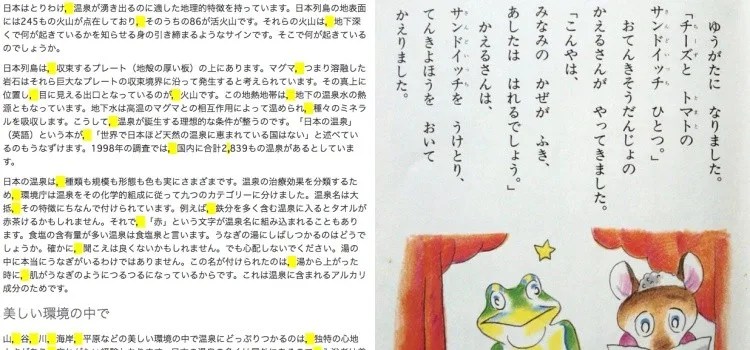
The fact that Japanese is a language formed by syllables and has 3 different writing systems makes spaces unnecessary. In addition, particles, verb endings, and expressions make it easy to understand sentences and separate words without the need for spaces. Japanese sentences tend to always have a pattern, which helps in the separation of words.
Another factor that contributes to the lack of space in the Japanese language is that many kanjis and words are quite short. If they used spaces to separate words, it would be very strange to read something like this: 私 は ケビン です。When it is very easy to read and separate the words in this sentence 私はケビンです。Also, note that the space on the Japanese keyboard is larger than in other languages.
The biggest difficulty of the lack of spaces in Japanese is the particle は (wa) which can rarely end up being the beginning of a word and leave you totally confused. The lack of spaces is yet another reason to understand the importance of Kanji in the Japanese language. In any case, spaces in Japanese are unnecessary because the separation of words is already quite obvious. Of course, for those who are learning, it can be confusing.
When does Japanese use spaces?
The Japanese language usually only uses spaces when it is the end of a sentence separated by a comma or period. Sometimes, spaces are used to separate clauses, especially when punctuation is left out.
Spaces are also used in texts made for children or written only with hiragana or katakana. Sometimes, you may find rare spaces in manga, novels, and some textbooks. You may also find spaces in karaoke or movie subtitles, but in that case, it is due to pauses. There may be a space between the first name and the family name.
Curiosities regarding space
- It is not necessary to leave a space after a comma, parentheses, brackets, or punctuation. On the Japanese keyboard, these characters are already written with a space;
- The word space in Japanese came from English スペース (supēsu). Do not confuse it with the word for outer space, which in Japanese is 宇宙 (uchuu);
- Some foreign students tend to put a space after the particle to help avoid confusing words with particles;
- Instead of a space, in some cases, a black dot (・) in the center called nakaguro (中黒) is used to separate one complicated word from another. This dot has various uses such as separating lists, titles, names, etc.;
Thus, you do not need to worry about space in the Japanese language. With time and practice, you will be able to understand and separate words easily. What do you think about this subject? Does the lack of space make Japanese more difficult for you? We look forward to your opinion in the comments and your possible sharing.
Leave a Reply