

Whether you want to play chess with Japanese opponents online, follow a Japanese broadcast of a tournament, or simply expand your gaming vocabulary, learning the right terms makes every match easier to understand. In Japanese, Western chess is called チェス (chesu). Because the modern international game was imported to Japan, most names for pieces and special moves are Katakana loanwords borrowed directly from English. At the same time, players and commentators rely on traditional board-game terms like 駒 (koma, piece) and 手 (te, move) that chess shares with Shogi and Go.
This reference guide organizes the most important Japanese chess vocabulary into logical groups: board fundamentals, piece names, in-game moves and special rules, and match phases with strategic analysis. Romaji pronunciation guides accompany each entry to assist language learners.
Contents 7
Basic Board and Game Terminology
Before moving any pieces, you need basic words to describe the playing environment, player turns, and equipment. The word 駒 (koma) is central to conversation, appearing in essential verbal phrases such as koma o ugokasu (to move a piece) and koma o toru (to capture a piece).
| Japanese | Romaji | English Meaning |
|---|---|---|
| チェス | chesu | Chess (Western chess) |
| チェス盤 | chesu-ban | Chessboard |
| チェスボード | chesubōdo | Chessboard (Katakana loanword) |
| 駒 | koma | Piece, chess piece |
| 手 | te | Move, ply |
| 手番 | teban | Player's turn to move |
| 対局 | taikyoku | Match, game between two players |
| ルール | rūru | Rules of the game |
| 白 | shiro | White (white pieces or White player) |
| 黒 | kuro | Black (black pieces or Black player) |
| マス | masu | Square on the board |
| 配置 | haichi | Placement or initial setup of pieces |
Names of Chess Pieces in Japanese
All six pieces in Western chess use Katakana loanwords adapted from their English names. When watching commentary on Japanese streaming channels or reading game summaries, these terms will be immediately recognizable.
| Piece | Japanese | Romaji | Role and Characteristics |
|---|---|---|---|
| King | キング | kingu | The primary piece; the target of checkmate |
| Queen | クイーン | kuīn | The most powerful piece on the board |
| Rook | ルーク | rūku | Moves horizontally and vertically across open ranks and files |
| Bishop | ビショップ | bishoppu | Moves diagonally along squares of its own color |
| Knight | ナイト | naito | Moves in an L-shape and can jump over other pieces |
| Pawn | ポーン | pōn | The fundamental foot soldier and backbone of pawn structure |
While Japanese literature occasionally translates piece roles descriptively, competitive tournaments, federation rulebooks, and digital gaming apps exclusively use these Katakana designations.
In-Game Moves, Checks, and Special Rules
Crucial vocabulary arises during active play, particularly when kings come under attack or when special maneuvers like castling and en passant take place.
| Japanese | Romaji | English Meaning |
|---|---|---|
| チェック | chekku | Check (attack on the king) |
| チェックメイト | chekkumēto | Checkmate (decisive end of the game) |
| キャスリング | kyasuringu | Castling (special double move of king and rook) |
| アンパッサン | anpassan | En passant (capturing an adjacent advancing pawn) |
| プロモーション | puromōshon | Pawn promotion upon reaching the eighth rank |
| 昇格 | shōkaku | Promotion (formal Japanese synonym) |
| ステイルメイト | suteirumeito | Stalemate (draw when no legal move exists and king is not in check) |
| 引き分け | hikiwake | Draw, tie game |
| ドロー | dorō | Draw (common gaming loanword) |
| 交換 | kōkan | Piece exchange or trade |
| 取る | toru | To capture a piece |
| 取り返す | torikaesu | To recapture a piece |
The announcement チェック (chekku) corresponds directly to calling "check." Players familiar with traditional Japanese board games may also recognize 王手 (ōte), which serves the same functional purpose in Shogi. Similarly, checkmate is チェックメイト, whereas Shogi uses the term 詰み (tsumi).
Match Phases, Tactics, and Game Analysis
When analysts evaluate a match or study tournament records, the language transitions from Katakana loanwords to classical Japanese strategic vocabulary. These concepts are used across chess, Go, and Shogi.
| Japanese | Romaji | English Meaning |
|---|---|---|
| 序盤 | joban | Opening phase of the match |
| 中盤 | chūban | Middlegame phase |
| 終盤 | shūban | Endgame phase |
| 戦術 | senjutsu | Tactics (concrete short-term combinations) |
| 戦略 | senryaku | Strategy (long-term positional plan) |
| 局面 | kyokumen | Board position or general state of play |
| 攻撃 | kōgeki | Attack or offensive action |
| 反撃 | hangeki | Counterattack |
| 展開 | tenkai | Development of pieces into active squares |
| 棋譜 | kifu | Written game record or score sheet |
Every complete game progresses through three distinct stages: 序盤 (opening), 中盤 (middlegame), and 終盤 (endgame). Describing the overall balance of advantages relies on the word 局面 (kyokumen), while algebraic notation or game scores are recorded as 棋譜 (kifu).
Practical Spoken Phrases for Chess Matches
If you play over the board with Japanese club members or chat during casual online games, a few polite, practical phrases will help you communicate clearly:
- チェックです。 (Chekku desu.): Check.
- ナイトを取ります。 (Naito o torimasu.): I capture the knight.
- キャスリングをします。 (Kyasuringu o shimasu.): I am castling.
- この局面は難しいですね。 (Kono kyokumen wa muzukashii desu ne.): This position is quite tricky.
- 終盤に入りましたね。 (Shūban ni hairimashita ne.): We have entered the endgame.
- 良い手ですね。 (Ii te desu ne.): That was a very good move.
- ありがとうございました。 (Arigatō gozaimashita.): Thank you for the game.
Tips for Memorizing Japanese Chess Vocabulary
The most efficient way to commit these words to memory is by grouping them logically. Start with the six piece names, since their Katakana pronunciations closely mirror English. Next, focus on match announcements such as チェック and チェックメイト, followed by the three game phases: 序盤, 中盤, and 終盤.
To reinforce your retention, search Japanese gaming videos using targeted search queries such as チェス 駒の動かし方 (how chess pieces move) or チェス 序盤 定跡 (chess opening theory). Integrating these practical terms into effective study routines for learning Japanese helps solidify both the Kanji characters and their spoken readings naturally.
Differences Between Western Chess and Shogi
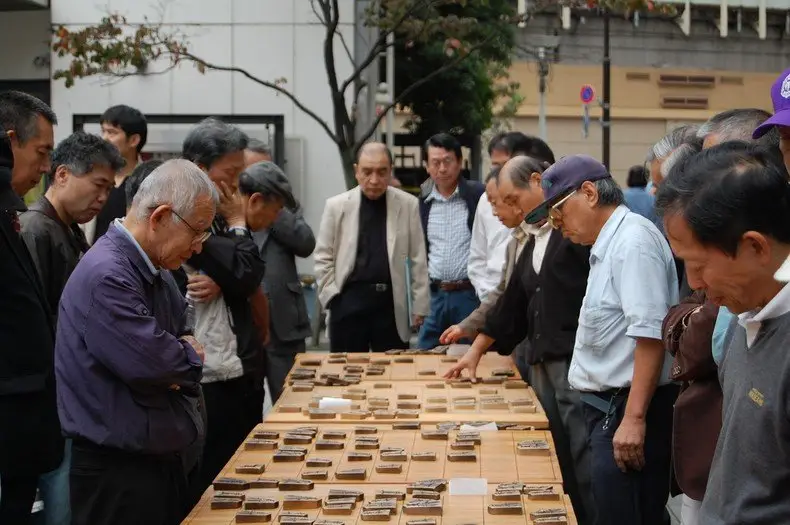
While Shogi is frequently referred to as Japanese chess, the Japanese language maintains a clear, rigorous distinction between both traditions. Western chess is consistently called チェス (chesu) or occasionally 西洋将棋 (seiyō shōgi). In contrast, the native Japanese game is known simply as Shogi (Japanese chess).
Both games share historical ancestry and general terms like 駒 (piece) and 手 (move), yet their fundamental rules diverge significantly. In Shogi, captured pieces are retained by the capturing player and can be dropped back onto the board as friendly reinforcements. Furthermore, most Shogi pieces can promote to gain new movement powers. Piece designations such as キング and クイーン, alongside maneuvers like キャスリング, belong exclusively to Western chess.
Equipped with this structured terminology, you can comfortably navigate Japanese chess software interfaces, follow game analyses in Japanese, and enjoy matches with players across Japan.




Community
Comments
0 comments
There are no published comments in this language yet.
Send comment