
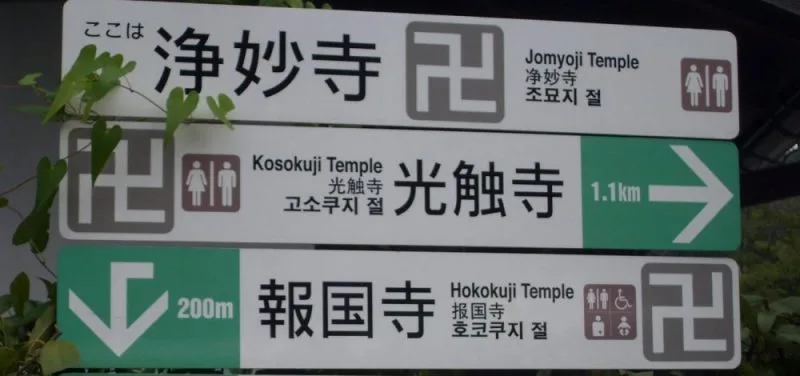
Many Westerners do not know that the swastika is not something exclusive to Nazism. There are various types of swastikas, each with its meaning. Do you know the difference between the Nazi swastika and the Buddhist swastika?
In the West, the swastika gained a very negative aspect due to its popularization through the flag of the Nazi Party that ruled Germany from 1933 to 1945.
The Nazis used this symbol on their flag to represent the identity of the Aryan Race and, as a result, this symbol was stigmatized in Europe and the Americas, being considered a symbol of racism and hatred.
However, even before the Nazis used the swastika, this symbol had already been used in Asia for over 5,000 years. It was primarily used in India, in the Hindu religion. It was also used in Jainism and in Buddhism.
The swastika was so popular that it was used in Nordic culture to represent the energy of Thor’s hammer. It has even been used in cathedrals and ornamental clothing to represent the Cross of Christ. It has even been used in the USA by indigenous tribes.
Table of Contents
What is the origin of the Swastika?
It is not known which people used the swastika for the first time, but its origin is quite ancient, dating back to 3,000 BC. It is considered one of the oldest symbols in the world. This symbol has been found in various parts of the world, used both clockwise and counterclockwise. All had positive meanings!
The name “swastika” is derived from the Sanskrit word (the ancestral language of India) “Savstika,” which basically means “well-being.”
In Asia, the swastika has always been linked to Indian religions, and the use of this symbol spread throughout Asia thanks to Buddhism, as it represented fortune, long life, and was even a representation of the Buddha himself.
On these occasions, the swastika has another meaning. In Buddhism, the symbol of the swastika is considered an auspicious footprint of the Buddha. It is an iconic symbol for the Buddha in many parts of Asia and a counterpart to the wheel of dharma. The shape symbolizes eternal cycling, a theme found in the Buddhist doctrine of samsara.
The intention of the article is precisely to explain that the swastika did not originate in Nazism and that it already had a meaning even before Nazism existed. In Japan, this symbol is called Manji (万字).

Manji – The Swastika in Buddhism
In Buddhism, the swastika is almost always clockwise. It signifies auspiciousness and fortune, as well as the footprints of the Buddha and the heart of the Buddha. The Buddhist swastika is said to contain the entire mind of the Buddha and can often be found printed on the chest, feet, or palms of images of the Buddha.
The manji represents the balance of opposites, universal harmony, good luck, and eternity. Each axis of the Buddhist swastika signifies something:
- Vertical axis – Represents the junction of heaven and earth;
- Horizontal axis – Represents the connection of yin and yang;
- Four arms – Represent interaction, movement, and the rotational force of the elements;
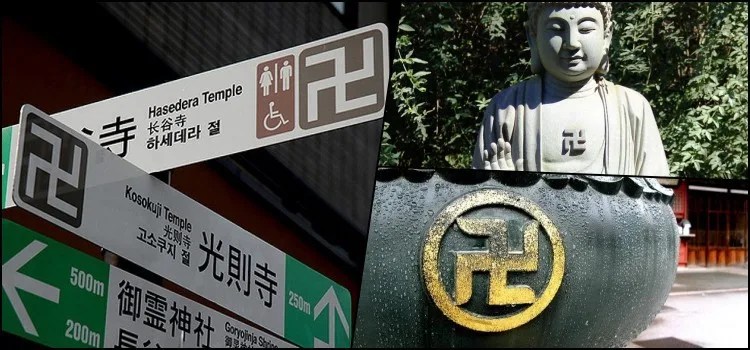
The symbol of the Buddhist swastika is common in the esoteric traditions of Buddhism, along with Hinduism, where it is found with Chakra theories and other meditative aids. The clockwise symbol is more common and contrasts with the counterclockwise version common in the Tibetan Bon tradition, locally called yungdrung.
It is also the first of the 65 auspicious symbols in the Buddha’s footprint. The swastika was also used to mark the beginning of Buddhist texts. In China and Japan, the Buddhist swastika has been seen as a symbol of plurality, eternity, abundance, prosperity, and long life.
If you access Google Maps in Japan, you will find this symbol in various places identifying the location of a Buddhist Temple.

The Buddhist swastika is used as an auspicious mark in Buddhist temples and is especially common in Korea. It can often be seen on decorative edges around paintings, altar cloths, and banners. In Tibetan Buddhism, it is also used as clothing decoration.
In addition to this definition, the symbol when turned to the left also represents love and mercy. And when turned to the right, it represents strength and intelligence. The most common in Japan is to find the sign turned to the left.
The Swastika in Nazism
The swastika was widely used in Europe in the early 20th century. It symbolized many things for Europeans, with the most common symbolism being good luck and auspiciousness. Amid widespread popular use, in post-World War I Germany, the newly formed Nazi Party formally adopted the swastika as the symbol of Nazism.
The Nazi swastika was adopted as an Aryan symbol indicating racial purity and superiority. The Nazi swastika is usually black, turned 45º to the right with the corners pointing upwards.
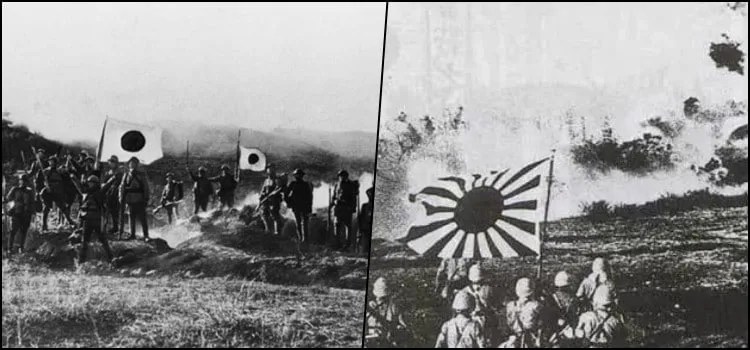
The Nazi Party adopted the swastika in 1920; the red of the flag represented socialism, while the white represented nationalism. It is incredible how the Nazis tarnished the name of a symbol that is over 5,000 years old in just 30.
There may also be a connection with the magical connections of the swastika. Hitler and other Nazi leaders were interested in the occult. The Nazi swastika is counterclockwise. The worst part is that it becomes easy to associate the swastika found in Japan when we remember Nazism.
The Swastika written in Japanese
Throughout the article, we can see several differences between the two swastikas, but to be a little more technical, shall we study a bit about the writing in Japanese?
In the Japanese language, any swastika is called manji, with the traditional one referred to as hidarimanji [左卍] and the inverted one as migimanji [右卍]. It is worth noting that neither of the two is Nazi.
In fact, the Nazi Swastika does not represent anything negative, only the inverted swastika slightly turned at a 45-degree angle that becomes Nazi.
The Nazi swastika is called Hakenkreuz [ハーケンクロイツ] or Kagi-juuji [鉤十字]. The Japanese do not usually have the stigma, even though they had participation in Nazism; for them, it is simply a common religious symbol.
The Stigma Post-World War II
Due to its use by Nazi Germany, the swastika has been widely associated with Nazism since the 1930s. After the Second World War, it was considered a symbol of hate in the West, or of white supremacy in many Western countries.
As a result, all its use is prohibited in some countries, including Germany. Because of the stigma attached to the symbol, many buildings that used the symbol as decoration had the symbol removed.
Nowadays, it is hard not to see the Buddhist swastika on Google and not remember Nazism. How can a symbol of peace remind us of something so dark?

The Misinterpretation of the West Regarding the Use of the Swastika
Since the late 20th century, confusion has occurred when consumer goods bearing traditional Jain, Buddhist, or Hindu symbols were exported to the West. Eventually, it was interpreted by consumers as having a Nazi symbol. This resulted in many of these products being boycotted or taken off the shelves.
When a ten-year-old boy in New York bought a set of Pokémon cards imported from Japan in 1999, two of the cards contained the left-turned Buddhist swastika. The boy’s parents misinterpreted the symbol as the Nazi swastika and filed a complaint with the manufacturer.
The American branch of Nintendo announced that the cards would be discontinued. The branch explained that what was acceptable in one culture was not necessarily so in another.
In 2002, Christmas cookies containing toy pandas with swastikas were taken off the shelves after complaints in Canada. The manufacturer stated that the symbol was presented in the traditional sense and not as a reference to the Nazis.
Even today, people can misinterpret this symbol. It was even suggested to change the symbol used in Japan to avoid confusing people at the 2020 Olympics, but they decided to keep one symbol and leave notices explaining its true meaning.
Did you know the true meaning of the swastika? What did you think of the article? If you liked it, share it with your friends and leave your comments.
The Meaning of the Character 卍 in Manga and Writings
It is common to find the character 卍 written in dialogues of manga or in other places. What is the meaning of the Buddhist swastika in writing?
Most of the time, it is slang used by teenagers that basically means nothing, synonymous with yabai, which also means nothing.
A popular example is in the phrase maji-manji [マジ卍], which is practically the same as majiyabai, used as an exclamation when encountering something amazing, exciting, or even terrible, usually used by high school girls.

The swastika is more present in Japanese culture than you might imagine. We recommend reading the article below that shows the swastika in Japanese culture, anime, and manga.
Leave a Reply