

You have met a Japanese person you would like to get to know better, and you are not sure how dating in Japan actually works. You are not alone. Dating in Japan comes with its own set of cultural habits, conventions, and unspoken expectations, and it is easy to misread the signals if you only have your home culture to lean on.
This article walks you through the cultural context you should know about before you make a move, the dating apps people in Japan actually use, how a first date usually unfolds, and the signals that tend to come before a kokuhaku (a formal confession of feelings). The advice is written for English-speaking readers, but it is intentionally gender-neutral: women reading this who want to understand how Japanese men tend to approach dating can simply reverse the framing. We have a separate article on getting to know Japanese men for that angle.

Contents 8
Cultural foundations worth knowing first
Before the practical tips, an important disclaimer: no person is the same as another. This article is not a recipe, and it is not meant to feed stereotypes. Many readers get frustrated with dating guides because they read them as checklists that reduce whole groups of people to a handful of traits.
What this article actually does is describe how dating in Japan tends to work in practice, which customs still shape behavior, and how to act in a way that is respectful, clear, and appropriate. We use phrases like "how to date a Japanese person" because that is what people search for, not because a nationality tells you anything reliable about a specific individual.
Worth keeping in mind: many people of Japanese heritage who grew up outside Japan do not share those cultural habits in the same way. Someone who grew up in São Paulo, Toronto, or Sydney is simply not going to navigate dating the same way as someone who grew up in Tokyo or Osaka. Treat cultural context as background, not as a script.
Finally, a lot of what you read below will apply just as well to someone who is not Japanese at all. The point is to give you a clearer picture of how Japanese dating culture tends to operate, so you can communicate better and avoid silly misunderstandings. You will still need standard human judgment on top of that.
What Japanese shyness around dating actually looks like
The single biggest cultural factor that catches foreigners off guard is shyness, especially around direct romantic or physical expression. Many Japanese people are taught from a young age to be cautious about how they show feelings in public, and that habit tends to carry into dating.
As a result, relationships in Japan often move more slowly than you might be used to. Openness, teasing, and direct flirting that feels normal in Brazil, the US, or much of Europe can come across as too much, too fast. Pacing matters.

Public affection is also more restrained than in many other countries. Kissing, hugging, and even holding hands in public can be uncomfortable for some couples, especially at the start. None of this is a rule, and you will absolutely see affectionate couples in Tokyo or Osaka. It is just a cultural default that takes time to relax for many people.
There is also a real range of personalities. You will meet outgoing Japanese people who say exactly what they think, and you will meet people who only feel comfortable being physically close once the relationship is well established. You will also find people who only feel ready for intimacy after marriage, with no religious reason behind it, simply because that is what feels right to them. None of these positions are a default for the whole country.
It is also worth knowing that Japan has a long list of subcultures that shape how people present themselves in daily life: moekei, tsundere, burikko, kigatsuyoi, gyaru, and many others. Each comes with its own dating expectations. Add regional differences on top of that, and a person from Osaka can be very different from a person from Tokyo or Okinawa. The honest, unglamorous tip is this: get to know the person in front of you, show steady interest, and be a friend first. That is the part that actually travels well.
Common myths about Japanese relationships
One of the most persistent myths is that Japanese women are cold. It is one of the most stubborn stereotypes out there, and it does not hold up. What outsiders often read as coldness is usually a mix of shyness, restraint in public, and a habit of putting others first that gets taught early in life.
In a relationship, that often means your partner will not easily blow up, raise their voice, or make a scene. You will need to pay attention to small signals to understand what they are feeling. None of that means the feelings are not there. And, again, plenty of Japanese people are very direct, so do not overcorrect and assume shyness is a universal rule.

Another common myth is that you have no chance with a Japanese person just because you are not Japanese. That idea is outdated. Mixed relationships are common in Japan, and many Japanese people are openly interested in foreign partners, sometimes precisely because cross-cultural dating comes with a different, more open communication style.
It is also true that some Japanese parents are conservative about their children dating foreigners, but most parents care more about whether the partner is stable, employed, and respectful than about nationality. Being polite and acting with integrity tends to do most of the work.
Finally, public affection is rarer in Japan than in places like Brazil, but it is not banned and it is not hidden. You will see couples kissing or holding hands, especially in big cities. The difference is one of degree, not of rules.
First-date conventions in Japan
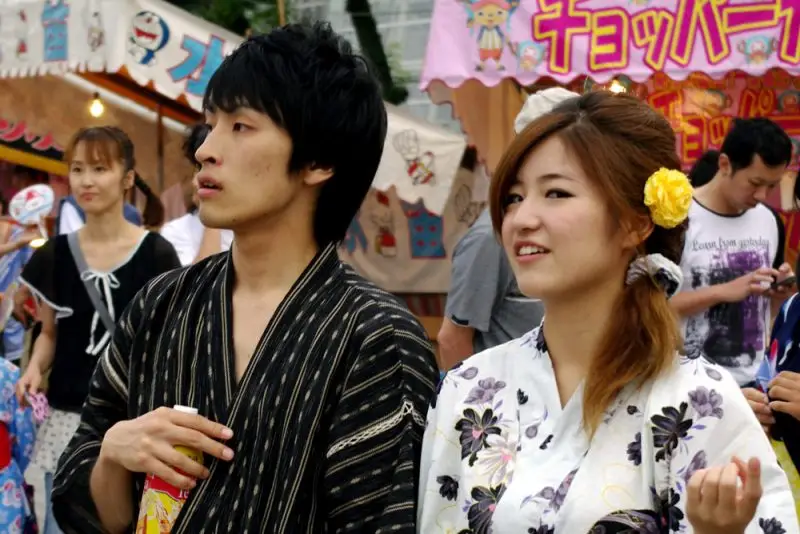
Japanese dating has a few conventions that are worth picking up before you suggest meeting up. None of them are hard rules, and the strictness varies a lot by city, age, and personality, but they are common enough to be worth knowing.
Punctuality is non-negotiable. Being on time, or a few minutes early, is read as basic respect. Arriving late without a heads-up, even by five or ten minutes, can sour the mood before the date has even started. If you are running late, message as soon as you know.
The bill is often handled carefully. On a first or second date, the person who suggested the outing will frequently insist on paying. Declining politely, or offering to split, is fine, but a flat refusal can come across as awkward. As the relationship progresses, splitting or alternating becomes more normal, and many long-term couples simply share costs without ceremony.
Choose a low-pressure activity. Coffee, a walk in a nice neighborhood, a casual izakaya, a museum, or a seasonal event like a hanami (cherry-blossom viewing) all work well. Loud, crowded bars or very long, expensive dinners can be too much for a first meeting. Quiet, walkable settings make conversation easier and put less pressure on both of you.
Keep physical contact minimal at first. Even a small, polite gesture like a light touch on the arm can be too much for someone who is not used to public affection. Wait for clear signals before initiating contact. A good rule of thumb is to mirror the other person's comfort level, not your own.
Follow up afterward. A short message after the date, saying you had a good time and suggesting a next step, is read as confident and considerate, not as pushy. Silence, on the other hand, tends to be read as a lack of interest.
One more thing worth knowing: certain times of year carry extra weight in Japanese dating culture. The end of the school or fiscal year (March in Japan), Valentine's Day on February 14, and Christmas Eve are all treated more like couple holidays than family holidays. A date around those moments can mean more than a random weekday, but it also raises the stakes, so do not use them as a shortcut to skip the getting-to-know-you phase.
Dating apps people in Japan actually use
Most of the advice above assumes you already know someone. If you do not, dating apps are the most common way to meet new people in Japan, especially in big cities. A few apps are particularly popular.
Pairs (ペアーズ) is the most widely used dating app in Japan. It is designed for serious relationships, has strong verification features, and is very popular with people in their twenties and thirties. Most profiles are in Japanese, so basic reading ability helps, but the interface is straightforward.
Tinder is widely used in Japan as well, but its reputation is closer to "Tinder everywhere else": a mix of casual dating, new friendships, and the occasional serious relationship. It is a reasonable starting point if you are in Tokyo, Osaka, or another major city, especially if you already have some Japanese or English language skills.
Bumble works in Japan similarly to how it works in the US or Europe. In heterosexual matches, women message first, which can take some of the guesswork out of the early stages. It is a solid option if you prefer that dynamic.
Omiai (おみあい) and Tapple (タップル) are also popular. Omiai leans toward marriage-minded users, while Tapple is more casual and skews younger. Both are useful, but they sit a bit below Pairs in terms of overall reach.
A few practical tips apply across all of these apps. Photos matter, but so does a complete profile. A short, honest bio in English (and, if you can manage it, a sentence or two in Japanese) goes a long way. Be patient with pacing. Matches do not always translate into quick conversations, and conversations do not always translate into quick dates. Be clear about what you are looking for, whether that is something casual, a long-term relationship, or marriage. Many Japanese users filter aggressively by intent, and a vague profile tends to get skipped.
Finally, be aware that app availability, pricing, and feature sets change over time. Check the current terms on the official site for the app you want to use before paying for a subscription.
Signals of interest and the role of kokuhaku
Reading signals is one of the most asked-about parts of dating in Japan, so it is worth spending a moment on it.
Common, low-key signals of interest include: consistently replying quickly and at length, asking you follow-up questions about your day, remembering small things you mentioned earlier, making time to see you on short notice, and introducing you to friends or coworkers. None of these are guarantees, but they tend to add up.
On the other hand, polite warmth is not the same as romantic interest. Japanese politeness is real and consistent, and it can easily be misread. Accepting an invitation is not automatically a yes to a relationship. Saying yes to coffee can simply mean saying yes to coffee. The clearest signal is sustained, repeated effort over weeks, not a single enthusiastic moment.
When interest is mutual and the relationship is moving forward, the next step in Japan is usually a kokuhaku (告白), which literally means "confession." A kokuhaku is a direct, usually verbal, statement of romantic feelings, and it is the cultural moment when a relationship becomes official. It can feel surprisingly formal if you are used to relationships drifting into shape on their own, but it is the standard way to clarify that you are no longer just friends.
You do not need to wait for the other person to make the first move. If you feel confident that the interest is mutual, you can propose a kokuhaku yourself. Pick a quiet moment, ideally in person rather than over text, be honest about how you feel, and be ready to accept the answer gracefully either way. The clarity is what makes the moment feel respectful on both sides.
Valentine's Day, White Day, and Christmas in Japan
A few holidays in Japan carry dating weight that is easy to miss if you are coming from outside the country.
On Valentine's Day (February 14), the traditional custom is for women to give chocolates to men. It is often split into giri-choco (obligation chocolate, given to coworkers, bosses, and friends) and honmei-choco (real-feeling chocolate, given to a romantic interest). Modern Japan is more flexible than the stereotype suggests, but the holiday is still a noticeable moment in the dating calendar.
White Day (March 14) is the reciprocal holiday. Men who received chocolate on Valentine's Day are expected to return the gesture, usually with a gift that is at least as valuable as what they received. If you are dating a Japanese woman and she gives you something on February 14, plan ahead for March 14.
Christmas Eve in Japan is, somewhat unexpectedly, treated as a couple's holiday, similar in spirit to Valentine's Day. Christmas dinner for two at a restaurant, illuminations, and an exchange of small gifts are common. Christmas itself, on December 25, is more of a family or commercial holiday.
None of this is mandatory, but missing a White Day reciprocation, or treating Christmas Eve as a regular weekday, can come across as not paying attention. A small, thoughtful gesture is usually enough.
A short checklist before you make a move
To wrap up, here is a tight summary of the points that actually matter. Use it as a quick mental check before suggesting a date or a kokuhaku, and adapt it to the person in front of you.
- Be yourself, and let the other person be themselves too.
- Keep your expectations reasonable and your judgment flexible.
- No one, Japanese or otherwise, fits a single template.
- Shyness is common, especially early on, and is not a sign of disinterest.
- Family approval matters less than stability, respect, and clear intentions.
- Many Japanese partners will not show strong feelings openly; learn to read small signals.
- Respect cultural habits, and do not treat them as trivia or party tricks.
- Learning at least the basics of Japanese, greetings, and manners goes a long way.
- Find out what the other person actually likes, and pay attention to those things.
- Move at a comfortable pace; rushing tends to backfire.
- Small, consistent gestures matter more than grand romantic moves.
- If interest is mutual, do not be afraid of a clear kokuhaku.
- Spend real time together and build a friendship, not just a romance.
- Avoid pressuring the other person, especially in front of friends.
- Mark the dates that matter, especially Valentine's Day, White Day, and Christmas Eve.
- Do not try so hard that you end up making the other person uncomfortable.
Dating across cultures always involves a little translation work, and dating in Japan is no exception. The mechanics, the apps, and the conventions are easy to learn. The harder, more interesting part is paying real attention to the specific person in front of you. That part is the same in Tokyo, Toronto, or São Paulo.





Community
Comments
0 comments
There are no published comments in this language yet.
Send comment