
Choosing which suit to wear in Japan goes far beyond whether it is expensive or beautiful. In Japan, clothing functions as a silent code. It signals whether you understand the context, whether you respect the environment and, most importantly, when not to draw attention to yourself.
Talking only about mofuku or reifuku still gives an incomplete picture. Japan works with several suit categories, each tied to a specific social function: mourning, ceremonies, office life, job interviews, weddings, and even seasonal policies such as Cool Biz.
Once you understand this system, you avoid embarrassing mistakes and you change completely how you are perceived in Japan.

Contents 5
Why dress code matters in Japan
In the Japanese mindset, the suit is not an extension of personality. It is a social tool. The question is never "does this suit match me?", but rather: does it match this situation?
That is why there are clear distinctions between mourning attire (mofuku), ceremonial attire (reifuku), corporate suits (business suit), interview suits (shūkatsu suit) and more modern variations worn in flexible environments.
Each category has its accepted colors, fabrics and combinations. Mixing them is the most common mistake foreigners make, and the most visible one.
Mofuku (喪服): mourning clothes and funerals
Mofuku is just one of the categories, but by far the most rigid. It stands for absolute mourning and is worn at funerals, wakes and memorial ceremonies.
Everything about it signals sobriety: matte black, simple cut, white shirt, plain black tie. There is no room for interpretation, and no space for personal style.
That is exactly why mofuku works almost like a cultural signal. Anyone who sees it understands the occasion at once. Outside of mourning events it feels out of place, even at a festive wedding.
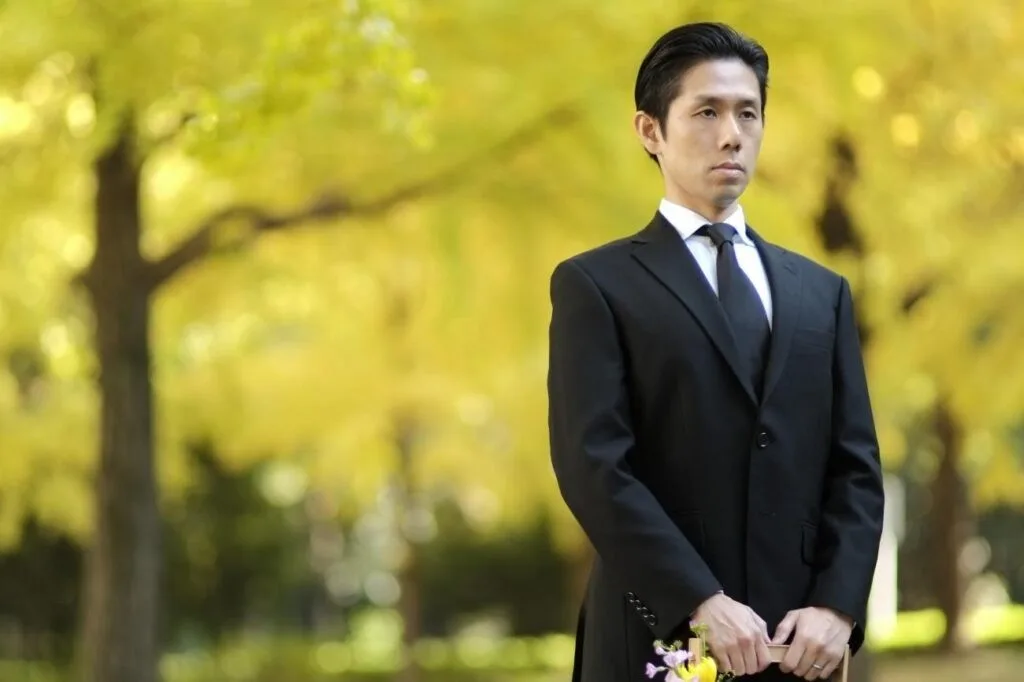
And here lies the real trap: at Japanese weddings, black can easily read as ambiguous. Depending on the combination, it can look just like mofuku. That is why many guests switch to navy or gray. Anyone who still wears black pairs it with lighter accessories and livelier fabrics, to make it clear that the occasion is a celebration. The unspoken rule is simple: do not look as if you are heading to a funeral.
Reifuku (礼服): formal attire for ceremonies
Where mofuku is tied to loss, reifuku is tied to positive solemnity. It appears at formal weddings, official events, institutional ceremonies and other highly protocol-driven occasions.
Visually, it can still be black, but the reading changes. Finer fabrics, more elegant cuts and lighter accessories make it clear that this is a celebration, not mourning.
The difference is not only in the color, but in the intention being communicated. A Japanese person picks that up in seconds.
The business suit in office life
The Japanese work suit does not usually carry a specific traditional name, but it follows very clearly defined rules. Navy and gray dominate. Black exists, but it has to be worn carefully so it does not accidentally look like mourning attire. Light shirts and discreet ties complete the look.
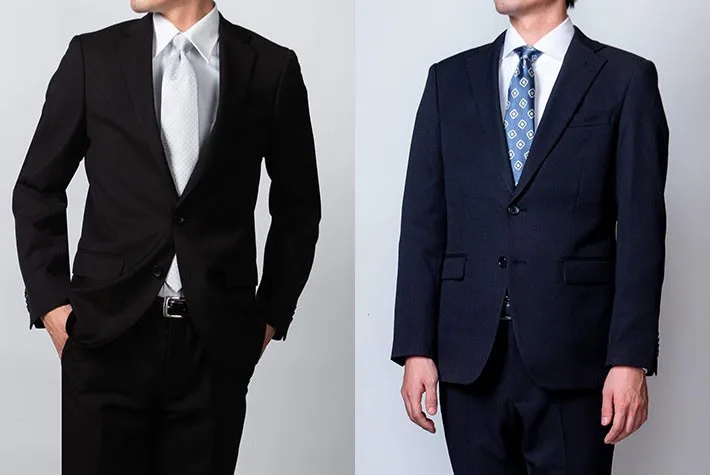
The goal is simple: do not draw attention. In the Japanese workplace, a good suit is one nobody comments on, because it does its job perfectly.
A special variant is the shūkatsu suit, the interview suit worn by students and recent graduates during recruiting. It works almost like a social uniform: simple cut, conservative colors, no flashy elements. The logic is collective. The recruiter is supposed to evaluate posture, behavior and reasoning, not personal style. Standing out visually in this context is read as a lack of social awareness.
In the warmer months, many companies also apply Cool Biz, a policy that allows more flexibility: no tie, sometimes no blazer, lighter fabrics. That does not turn the office into a casual place. Jeans, t-shirts and sneakers remain out of place in most traditional offices. Cool Biz is a climatic adjustment, not a cultural break.

Starter rules for foreigners
Mofuku, reifuku, business suit, shūkatsu suit and wedding attire do not compete with each other. They are parts of the same system, and they all answer the same question: what is the social role of this moment?
Once you understand that, choosing which suit to wear in Japan stops being confusing. You stop thinking about fashion and start thinking about context. In Japan, that shift in mindset is what makes the difference.


Community
Comments
0 comments
There are no published comments in this language yet.
Send comment