
Today we are presenting a small review of the anime Haikyū!! (ハイキュー!!, also written Haikyuu) written by our friend Leonardo Fragozo from the blog leojapanesequest. A shōnen series of 25 episodes that he tore through in five days — “whoa for me,” as he put it — about a sport he had never shown much interest in: volleyball.
That mismatch is part of the charm. The approach is dynamic without turning every rally into a superpower contest, and the court still feels packed with personality. If you came for fireworks alone, you might miss the quieter pleasure: watching a team learn how to move as one.
Contents 4
Characters who work as a team, not as invincible heroes
Haikyū!! carries plenty of familiar shōnen ingredients — long inner monologues, big feelings, rivals who become partners — yet the cast stays human. There are no “berserk mode” miracles that erase every problem for Karasuno High. What the show keeps teaching, match after match, is how much group work matters: strengths, flaws, timing, and trust all share the same court.
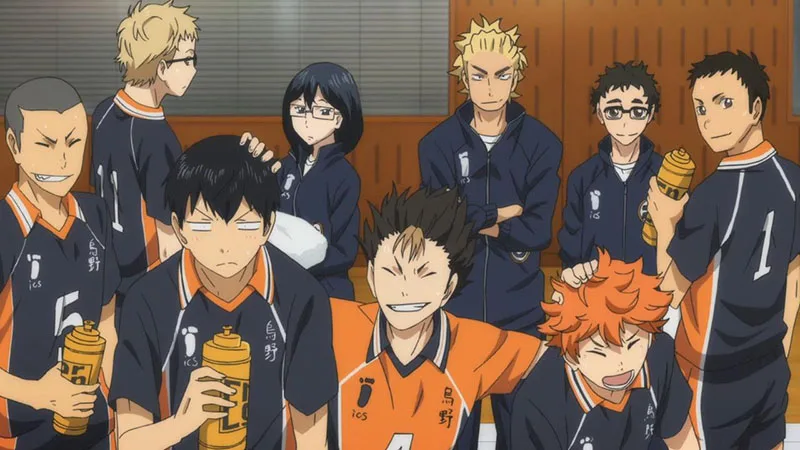
Hinata Shōyō and Kageyama Tobio are the spark everyone remembers, but the review’s original point still holds: the series thrives on variety of personality. Tanaka’s noise, Daichi’s steady captaincy, Tsukishima’s dry edges, and the rest of the club give the gym a social texture that pure ace-vs-ace stories often skip. The anime can be funny in one beat and technical in the next, sometimes treating volleyball patterns a little like a chess game — pieces moving, space opening, one set deciding a whole rally.
It is a sports anime for viewers tired of empty “supaaaaahhh attackus” hype, without becoming shallow. Character chemistry is the real spike.
Animation, music, and the tension of a single point
Production I.G keeps the ball and bodies legible even when the pace jumps. The animation is fluid; the physics clearly enjoy poetic license, and the occasional “monster faces” land as part of the show’s comic toolkit rather than a flaw to apologize for. Those stretched expressions sit next to careful footwork, sweat, and the small pauses before a serve — details that make a fictional match feel tactile.
The soundtrack matches that pulse. The first opening, “Imagination,” sketches the world the way Hinata and Kageyama first step into it: wide eyes, raw ambition, the gym as a new universe. Later, “Ah Yeah!!” rides the shift toward real teamwork and competition — less pure daydream, more court confidence. Fast, upbeat tracks fit the “tension” any real volleyball player (or anime fan living every rally) recognizes when a set hangs in the air.
What the series became after the first season
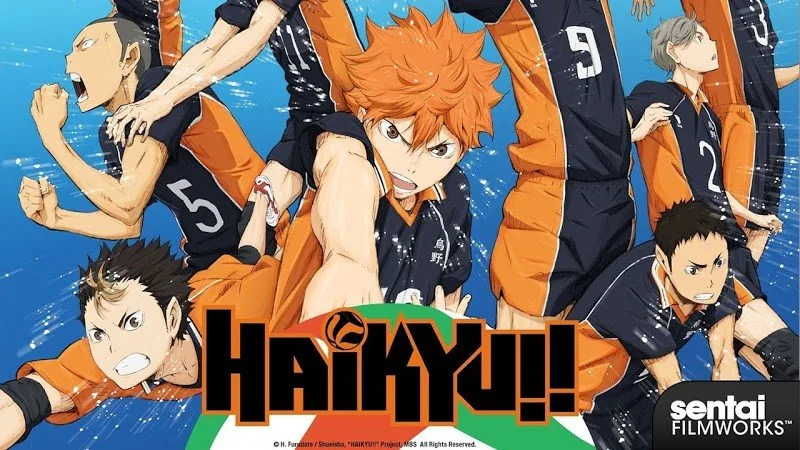
When this guest review first landed, the anime was still early in its run and a second season was already on the horizon. The full television adaptation, produced by Production I.G from Haruichi Furudate’s manga in Weekly Shōnen Jump, grew into four TV seasons (85 episodes in total across the run that aired from 2014 to 2020), plus OVAs and compilation films. The story of Karasuno’s climb continues on the big screen with the Haikyū!! Final films — including The Dumpster Battle (2024) — while further film chapters remain scheduled in the franchise roadmap.
So if you finish the first 25 episodes and feel that familiar hunger for “just one more practice match,” the path is long and consistent: same studio language, same obsession with team play, higher stakes as the court gets stronger.
Quick court notes: Season 1 is the doorway (25 episodes). Seasons 2–4 push inter-high pressure, rival schools, and sharper volleyball IQ. You do not need real-life volleyball knowledge to follow the drama — the show explains plays through character eyes.
Who should watch Haikyū!!
Watch it if you want a sports anime that still cares about ordinary effort: short stature, bad first impressions, perfect tosses that fail until trust exists. Skip it only if pure court focus for episode after episode sounds exhausting; almost everything orbits volleyball, and that is the point.
Leonardo’s take remains a solid entry pulse for season one: bingeable, character-rich, and unexpectedly persuasive even for people who never chose volleyball as “their” sport. From there, streaming options have long included Crunchyroll for international viewers, and the manga by Haruichi Furudate is the complete playbook if you want every practice and set beyond the screen.
If Haikyū!! hooks you and you want more high-energy court stories, our guide to volleyball animes like Haikyū!! is a natural next stop.




Community
Comments
0 comments
There are no published comments in this language yet.
Send comment