
Bimbo yusuri (貧乏ゆすり / binbō yusuri) is the Japanese name for that unconscious bounce of a knee or foot while you are sitting. The words line up roughly as “poor person’s shake” — not “person over agitation,” and not a medical diagnosis. It is a social label for a tiny habit that most people barely notice in themselves.
In many places, a restless leg is just noise under the table. In Japan, the same motion can read as impatience, nerves, or weak self-control — especially in meetings, on trains, or across from a client. The twist is that the habit is often automatic: you may already be doing it while someone else has already formed an opinion.
Contents 3
What bimbo yusuri signals in Japan
Japanese manners still treat conspicuous fidgeting as rude more often than polite. Shaking a leg in front of a customer, a manager, or someone you are waiting for can suggest that you want to leave, that you are anxious, or that you are not fully present. The judgment is not always fair, but it is common enough that visitors and long-term residents both get warned about it.
It looks harmless. It can still leave a mark on how you are read at work or in social life, because the people around you may file you under “impatient” without saying a word. Japanese conversational culture often avoids direct confrontation: few people will ask you to stop. They may simply ignore the movement — and quietly keep the impression.
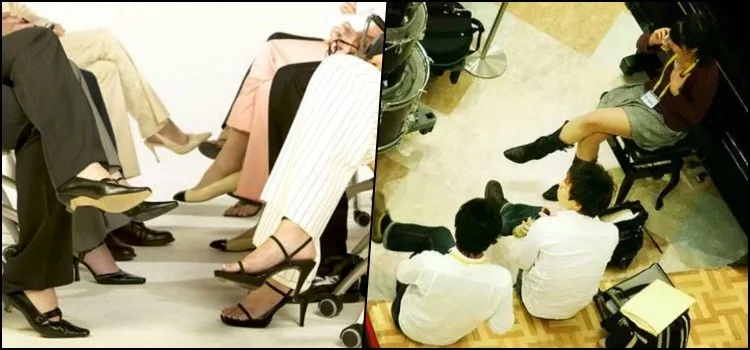
If you catch yourself mid-bounce, a practical fix is simple: uncross and recross your legs, plant both feet, or change posture until the urge passes. The point is not to freeze like a statue for hours. It is to notice the habit before a formal room does it for you. At home or alone at a desk, the social cost is near zero; in shared spaces, the cost is mostly about how others read your self-control.
Does leg shaking help your health?
Outside the etiquette debate, research on fidgeting is less dramatic — and more interesting — than old blog claims. Small leg movements while sitting can raise local blood flow and energy use a little compared with sitting completely still. That is useful context for long desk days, not a license to bounce through every meeting in Tokyo.
One much-cited line of evidence comes from the UK Women’s Cohort Study: among women who sat for long stretches, those who reported fidgeting a moderate amount or a lot did not show the same rise in mortality risk linked to long sitting as women who said they barely fidgeted. That is an association, not proof that “bimbo yusuri prevents heart attacks.” It also does not mean non-fidgeters face a fixed “30% higher chance of a heart attack,” as some older summaries implied.
Later laboratory work on leg fidgeting during prolonged sitting points in a similar direction: light, repeated movement can support circulation and even post-meal blood-sugar handling in some groups. Still, fidgeting is not a substitute for walking, standing breaks, or real exercise. The honest takeaway is narrower: if you sit a lot, tiny movement may be better for your legs than pure stillness — and in Japan, you still choose when that movement is socially wise.
Where the term bimbo yusuri comes from
Nobody has a single certified birth certificate for the phrase. Dictionaries define 貧乏ゆすり as unconsciously shaking or tapping the legs while seated. Folk explanations cluster around poverty imagery: one common theory links the wording to people who once shivered or shook to stay warm in the cold, so the motion got stuck to the idea of being “poor.”
Another layer comes from older superstition. In Edo-period folklore talk, habits associated with restlessness could be tied to poverty spirits (貧乏神, binbōgami) — the idea that certain behaviors invited hard luck. Whether or not anyone still believes that literally, the word itself keeps the social sting: the shake is not only “annoying,” it carries a class-tinged metaphor.
Romanization varies — binbō yusuri, binbou yusuri, or the older online spelling bimbo yusuri — but the written Japanese stays clear: 貧乏 for poverty, ゆすり / 揺すり for the shake. Learning the word is less about collecting trivia and more about reading the room: Japan names the habit because the culture has long treated it as visible self-control, not a private nervous tic.

So the useful rule of thumb is double-sided. Physiologically, a little movement can be kinder to a sedentary body than a frozen posture. Socially, in Japanese formal and semi-formal spaces, the same bounce can cost more than it gives. Watch the context, watch your knee, and save the full fidget for places where nobody is judging your manners — or your luck.




Community
Comments
0 comments
There are no published comments in this language yet.
Send comment