
Have you ever imagined that a wooden slab would tell you the weather for tomorrow night? Touch the wood and the forecast shows up. Leave it alone and the slab looks like a plain board again.
Contents 8
A wooden panel for the weather
mui Lab, a company in Kyoto, builds that slab and calls it the mui Board. At rest it is a piece of natural wood. A hand across the surface brings a display up on the wood itself, with the weather, a handwritten message, music, and controls for lights or speakers already connected in the house. The company still sells it as a niche product for a home that already has connected lights and speakers.
The pocket calculator
Do you remember the last time you calculated something by hand? For a quick sum, a lot of people now open the phone. The machine that put a calculator in a pocket was the Busicom LE-120A, sold as the HANDY-LE. Nippon Calculating Machine Corporation, later called Busicom, announced it in January 1971 and put it on sale that June. It showed 12 digits on a red LED, ran on four AA batteries, and was a little over 20 millimeters thick. The price was 89,800 yen, above the monthly starting pay of a new university graduate, about 46,500 yen then.
Larger calculators already added and divided. Museums point to the LE-120A when they mean a model you could carry in a pocket. It was also among the first handheld calculators to run on a single chip, the Mostek MK6010, developed with Busicom.
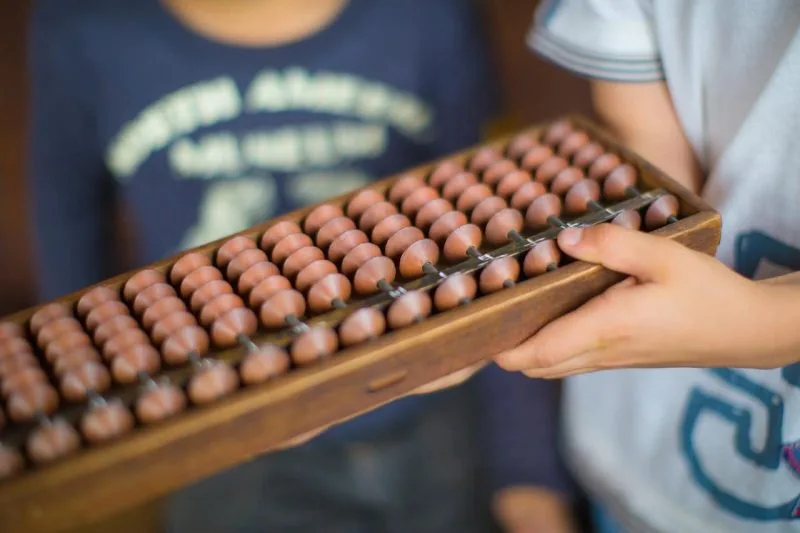
Long before that chip, fast sums in Japan often moved across a soroban, the Japanese abacus. The beads are a frame you learn with your fingers. The pocket calculator is what made the same four operations easy to carry.
Humanlike robots
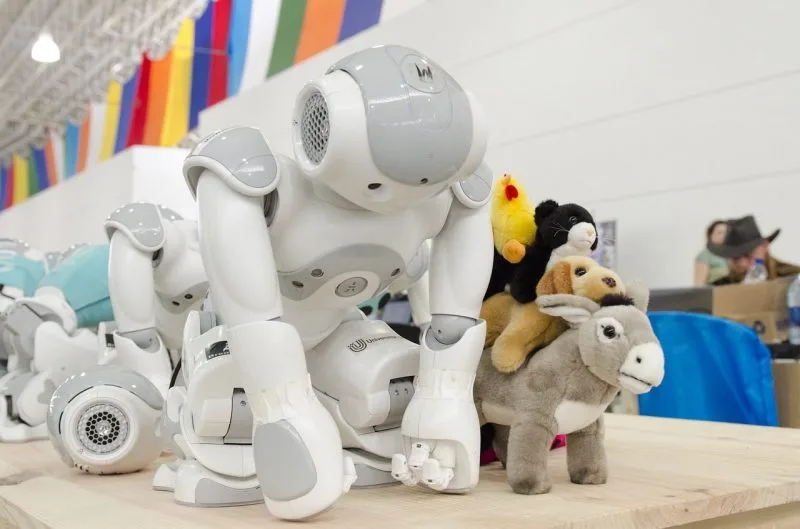
In November 2003, Osaka University and the company Kokoro unveiled the Actroid at the International Robot Exhibition in Tokyo. The face was modeled on a young woman, the skin was silicone, and the robot could blink, speak, and shift its chest so that it appeared to breathe. On display it sat, or it stood with support behind it. In January 2004 a related model, the Repliee Q1, was developed at Osaka University. Both belonged to exhibitions and research labs.
The hotel was a separate project. In July 2015 the Henn-na Hotel opened at Huis Ten Bosch in Sasebo, Nagasaki Prefecture, and presented itself as a place run mostly by robots. The machine staff grew to 243. Dinosaurs stood at the front desk. An assistant in the room, named Churi, answered guests. Carriers tried to take the luggage to the room.
By early 2019 the hotel had taken more than half of those robots out of service. Churi treated snoring as a spoken request and woke people to ask them to say it again. The dinosaurs could not copy a foreign passport unless a person helped. The luggage carriers reached only a small share of the rooms and had trouble in the rain. Hideo Sawada, who ran the hotel, said that using the robots showed where they were unnecessary and where they annoyed guests. The hotel kept robots only for the jobs they could still do.
The electric rice cooker
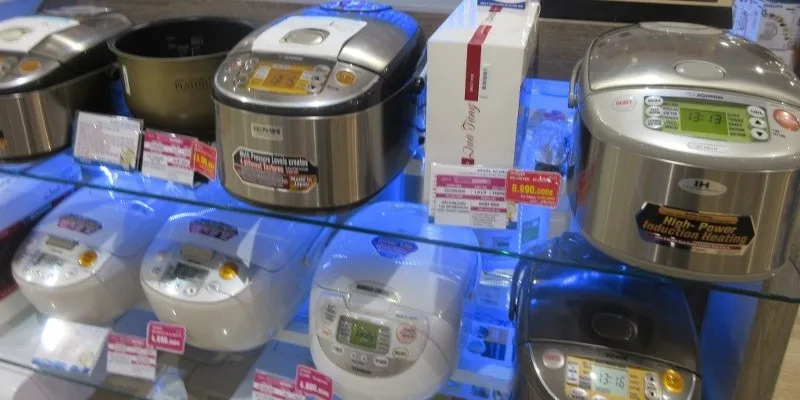
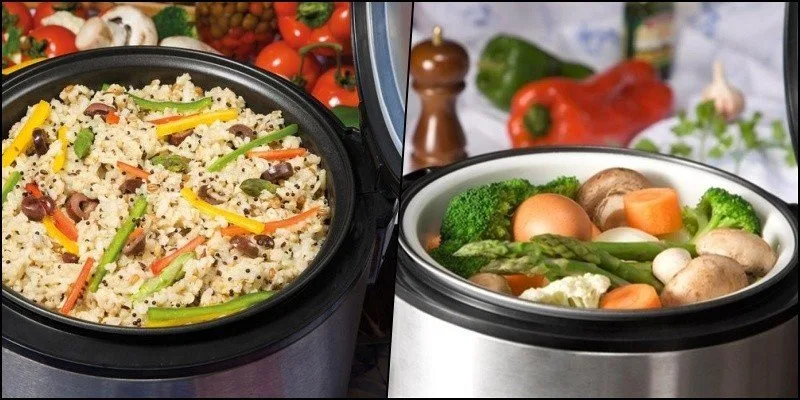
We all know the struggle when rice becomes sticky or dry. A cooker on a Japanese counter is a bowl, a heater, and a thermostat. The models sold now hold the rice warm, keep the bottom from scorching, and the inner pot lifts out for washing.
Toshiba's ER-4 is the cooker that made the automatic pot normal in Japan. The company calls it Japan's first automatic electric rice cooker, and it went on sale on 10 December 1955. Yoshitada Minami worked out the heat with Toshiba's engineers: the pot ran for about 20 minutes and then switched itself off. It cost 3,200 yen, around a third of an average monthly salary, and the first weeks were slow. Toshiba sent people out to cook with it in front of customers. After those demonstrations, the pot spread through Japanese homes because nobody had to stand and watch.
That is still the reason to keep a suihanki in the kitchen. The rice stays hot, the grains stay even, and you can leave the pot alone until the cycle ends.
Karaoke
During the shows, customers wanted to sing along with the musicians and have fun together on stage. Daisuke Inoue was the drummer in that kind of band in Kobe. In 1971 he and some friends leased eleven boxes to bars in the city: taped songs, an amplifier, a microphone, and a coin slot. A customer could sing on a night when the band was off.
Inoue did not patent the box. Larger firms built the industry, and the money from those first leases stayed small. In 1999 Time magazine placed him on its list of the most influential Asians of the century, for the way karaoke changed a night out.
Four years earlier, in 1967, Shigeichi Negishi had a coin-operated Sparko Box built at his electronics workshop in Tokyo, around an 8-track deck and a microphone. A few people in Japan reached a similar machine on their own. Inoue's boxes are the ones bars in Kobe could rent and copy. People also sing in small rented rooms. Karaoke in Japan often means one of those rooms, booked by a small group.
Emoji
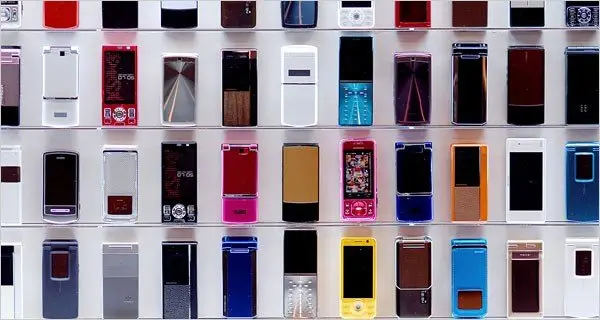
Emoji joins two Japanese words, e for picture and moji for character. The first mobile phone to ship a set was the J-Phone SkyWalker DP-211SW, released on 1 November 1997. It carried about 90 symbols, including the famous poop symbol.
The drawings other companies copied came from NTT DoCoMo. In February 1999 Shigetaka Kurita drew 176 emoji inside a grid of 12 by 12 pixels for the i-mode mail service. A short message had little room, so a weather mark, a heart, or a face had to carry part of the meaning. In 2016 the Museum of Modern Art in New York acquired that original set. The yellow faces in the picture are a later keyboard sheet. Kurita's 1999 drawings were 12 pixels across. Japanese emoji later picked up meanings well beyond that mail set.

The blue LED
Red and green LEDs were already lighting indicators and displays while a bright blue diode was still failing in the lab. White lamps need that blue. Isamu Akasaki and Hiroshi Amano produced blue light from gallium nitride at Nagoya University in 1986. Shuji Nakamura, then an engineer at Nichia in Tokushima, developed the bright blue LED in the early 1990s and had a high-brightness device by 1993. He did the work as a researcher at that Japanese company. Years later he became a U.S. citizen and a professor at the University of California, Santa Barbara.
On 7 October 2014 the Nobel Prize in Physics went to Akasaki, Amano, and Nakamura for efficient blue LEDs, which made bright white lamps practical. Those lamps waste less electricity as heat than the incandescent bulbs they replaced. The prize that October honored work finished in the 1980s and early 1990s.
What stayed
You can cook rice, book a room to sing, and send a picture character without knowing any of these names. The mui Board still does one narrow job, weather and a message on a piece of wood. The Actroid still blinks on a stand. At the Henn-na Hotel, copying a passport and carrying bags went back to the human staff after the robots had been tried on both.

Community
Comments
0 comments
There are no published comments in this language yet.
Send comment