
In various cultures around the world, we always see different stories about "Heaven" and "hell." Since the Egyptians, there are accounts of souls being taken somewhere. In Japan, for example, Yomi [黄泉] is nothing more than the land of the dead.
We do not know if it can be compared to the river Styx, to Tartarus, or to any other type of underworld. The clearest similarity is that normally, the souls of the dead are taken to these places. The Japanese word can also be specifically used to refer to Hades or hell, but its Japanese meaning is unique.
But anyway, we can leave the comparisons for later; now let's deal with Yomi. After all, a "hell" is as important and even more well-known than a "Heaven" in some cultures. Of course, not all cultures, but that doesn't make it any less important. But anyway, let's get to the point.

Contents 3
Yomi – Land of the dead
Yomi, in Japanese mythology and in Shintoism, denotes the land of the dead; apparently, it is there that the dead go. One cannot say how long a dead person will stay in this place. After all, this information is just a death away from being discovered. Furthermore, we have no idea what they go through there.
This place has its doors guarded by terrible creatures. Creatures whose appearance we can hardly imagine, if it is even possible to imagine such a thing. An interesting thing is that these creatures, in theory, guard the exit of Yomi. After all, many must want to leave this place, but few want to enter.
Once the dead person falls there to be fed, they are taken to the center of Yomi. After entering, the dead are not permitted to leave and visit the land of the living. They only have the option to draw parallels between Yomi and Hades, the God of the underworld, or with hell itself.
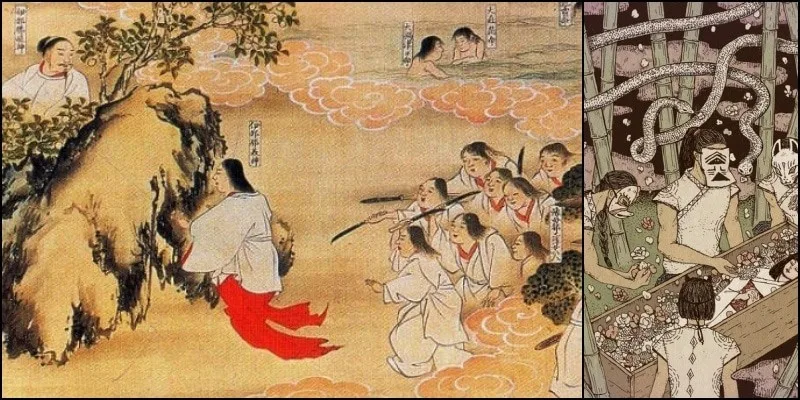
Yomi is ruled by Izanagi no Mikoto, who is the great Deity of the land of the dead. According to Kojiki, the door that leads to Yomi is located in the province of Izumo. The door is said to have been sealed by Izanagi no Mikoto.
Since the dead cannot leave Yomi for any other place, except for parallels, the door has been permanently blocked by a huge stone, which is called Chibiki no iwa.
After Izanagi returned to Ashihara no Nakatsu Kuni, he noticed that Yomi was a "polluted land"; translating to Japanese, it was kegareki kuni. And this observation demonstrates the traditional association of Shintoism between death and pollution.
Opinions about Yomi
Many scholars believe that the image of Yomi is derived from ancient Japanese tombs. In which the bodies were left for some time for decomposition. One can already take from that the purpose of Yomi.
For a basic explanation, the land of the dead tends to leave the dead "waiting" in darkness for some time. At least until their moment arrives; now the question is, "moment of what?" This question remains unanswered for now; no soul has returned to answer.
When Buddhism arrived in Japan, Yomi also began to be considered one of the hells of Buddhism. Just like Kakuri, a hell led by Enma.

But one thing that intrigues us is that, apparently, this realm of the dead has a geographical continuation in the mortal world. However, with that, it also cannot be compared to hell. Because in hell, the dead tend to suffer for the sins committed in the past.
Indeed, each of these places has its own differential. In Yomi, it does not matter what the dead person did in the past, whether it was good or bad. The "soul" will simply enter a world whose existence will follow the path of darkness, decay, and melancholy.
Ready to travel?
After a while, you become increasingly interested in these subjects. Especially in these beliefs that in themselves already bring a certain attraction. Many are interested in mysteries like these, in knowing what life after death is like and everything else. Well, who hasn't wanted to know what it must be like, right? Probably interesting and frightening.
But anyway, is there any land of the dead from another culture that you like? It can be any, from any culture or place, just leave it in the comments. Also, don't forget to share the site on social media; it helps a lot.






Community
Comments
0 comments
There are no published comments in this language yet.
Send comment