
Yakudoshi [厄年] literally means critical or calamitous years. It is a long-standing custom in Japan to treat certain ages as especially fragile: periods when people are thought to be more exposed to misfortune, illness, or sharp turns in life.
In Buddhist imagery, those hard stretches are sometimes compared to the knots of bamboo. The knot looks like a stop, but it is also what lets the stalk keep growing with strength. In the same spirit, yakudoshi years are framed less as pure doom and more as thresholds that demand attention.
The ages often map onto Chinese yin/yang ideas of change and maturity. One practical detail confuses many outsiders: traditional charts frequently use kazoedoshi (数え年), the old age reckoning in which a newborn is already one year old and everyone gains a year on New Year’s Day — not only on a birthday. That is why a “42” on a shrine poster may not match the Western birthday age you hold in your head.
Contents 4
List of calamitous years - bad ages
The years of misfortune can be seen in the tables below and may vary by region and local custom. Around each critical age, the cycle is usually described as Maeyaku (前厄, the year before), Honyaku (本厄, the main unlucky year), and Atoyaku (後厄, the year after).
Honyaku is the core “great calamity” year. Many people also treat Maeyaku and Atoyaku carefully, turning the belief into a three-year window rather than a single birthday.
For men [男性], the calamitous years are commonly listed as:
| Maeyaku [前厄] | Honyaku [本厄] | Atoyaku [後厄] |
| 24歳 | 25歳 | 26歳 |
| 41歳 | 42歳 | 43歳 |
| 60歳 | 61歳 | 62歳 |
For women [女性], they are commonly listed as:
| Maeyaku [前厄] | Honyaku [本厄] | Atoyaku [後厄] |
| 18歳 | 19歳 | 20歳 |
| 32歳 | 33歳 | 34歳 |
| 36歳 | 37歳 | 38歳 |
Among these, the ages watched most closely are the daiyakudoshi (大厄) or great-calamity years: 42 for men and 33 for women. Regional lists can differ, and some communities treat 61 with a different tone — historically a retirement threshold as much as a danger year.
Why do the Japanese believe in yakudoshi?
Japan has many layered superstitions, and yakudoshi is one of the ones that still appears on shrine notices and family conversations. Popular explanations for particular ages include:
- 42 [四十二] can be read in a way that echoes “shi-ni” [四二], close to the sound of “to death” (死に).
- 33 can be linked to “sanzan,” a word that can mean “terrible” or “disastrous.”
- Some people also frame 25 (men) and 19 (women) as thresholds out of youth, and 61 and 37 as later adult turning points — less “curse math,” more life-stage folklore.
Anthropologists note that folk etymology is only part of the story: the custom also tracks social pressure, body-and-life-stage talk, and older Chinese-influenced calendrical thinking. Whether someone fully “believes” or simply follows the ritual for family peace, the pattern is still visible enough that shrines keep answering it every winter.
If you want a broader map of luck and taboo talk in Japan, see our guide to Japanese superstitions — bad luck and good luck.
How do the Japanese avoid these years?
Many people answer yakudoshi with small, concrete habits rather than panic. Common responses include:
- Family and friends hold a gathering around the unlucky birthday, and the person often returns the hospitality the following year;
- Visits to shrines or temples known for protection — local spots as well as famous ones such as Chiba Shrine, Nishiarai Daishi, Aoyagi Daishi, Myohoji, and others;
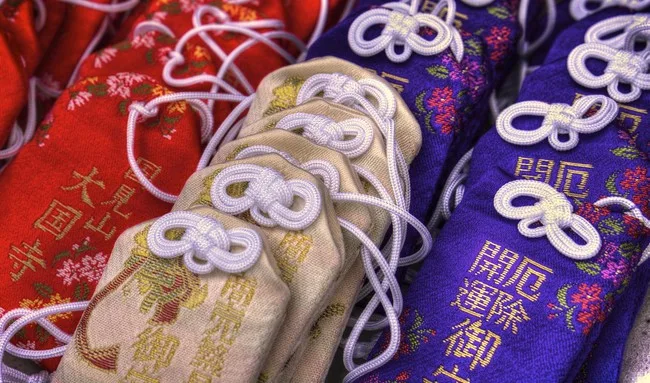
- Carrying or displaying amulets and lucky objects through the year (see also omamori, Japanese protection amulets);
- Older rites involving sake and plum trees at temples; today, prayer with sake in a gourd is still remembered in some places;
- Receiving an ofuda charm to keep at home, then returning it after the dangerous year with thanks when nothing serious happened.
Timing matters: many people go early in the calendar year, often between New Year and Setsubun, when shrines are busiest with purification requests. Some also prefer to delay major life jumps — marriage, a move, a career leap — until the three-year window feels calmer. That choice is cultural caution, not a legal rule.
Yakudoshi was never only a joke about unlucky numbers. For a long stretch of everyday Japan it sat next to family calendars, temple fees, and quiet worry. Modern life is less uniform, but the charts still hang on shrine walls every winter — which tells you the custom never fully left.
Yakubarai - ceremony to ward off suffering
The ceremony most people look for is yakubarai (厄払い), a purification meant to sweep away misfortune that has already pressed close. Related practices of yakuyoke (厄除け) lean more toward prevention and protection. In practice, both sit under the same winter pilgrimage rhythm of prayer, offering, and a priest-led rite.
Yakubarai is often sought in Maeyaku, preferably in the early months of the year, and again in Atoyaku as thanks for getting through the stretch. Friends and family may join, turning the visit into both ritual and reunion.
In Honyaku — especially the daiyakudoshi years — many men and women still treat a shrine visit, a formal purification, and a modest celebration as the practical answer. The priest may recite a prayer and wave a haraegushi over the person; visitors often leave with an amulet for home or for the bag.
Nobody can pin a single origin story on yakudoshi with total certainty. Parts look Chinese and calendrical; parts look local and social. What remains clear is the human side: ages that feel vulnerable get a name, a chart, and a ceremony — and Japan still keeps the paperwork for that anxiety on shrine corkboards every January.


Community
Comments
0 comments
There are no published comments in this language yet.
Send comment