
The Great Wave off Kanagawa is part of the ukiyo-e called 36 Views of Mount Fuji. The famous painting of the waves is present everywhere in different formats when talking about Japan. What is the story and meaning of this famous piece?
The Great Wave off Kanagawa is called in Japanese Kanagawa oki nami ura [神奈川沖浪裏]. It is a famous woodblock print by the Japanese master Hokusai and was published in 1830 in the series we mentioned. Ready to get to know them?
Contents 9
Ukiyo-e - Portraits of the Floating World
Before we talk about The Wave off Kanagawa, the 36 Views of Mount Fuji or its author Katsushika Hokusai, we need to understand what Ukiyo-e is, the portraits that Hokusai and many other Japanese artists from the Edo Period created.
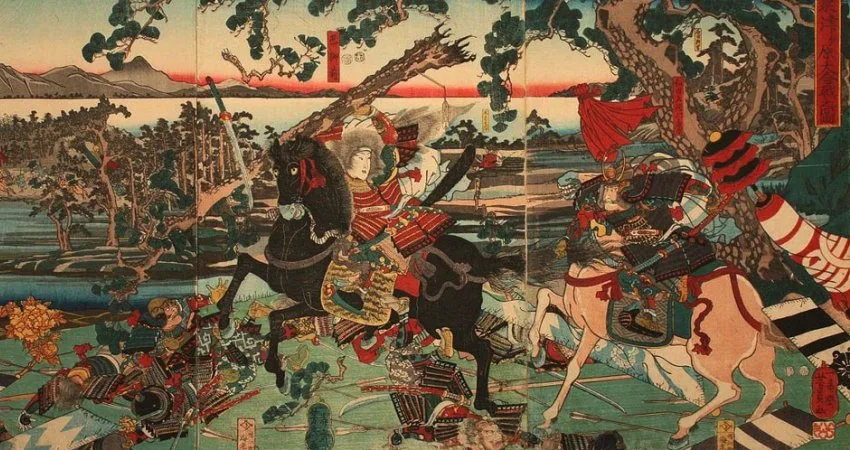
Ukiyo-e [浮世絵] can be literally translated to portraits of the floating world, it is a Japanese print, a painting that often shows feminine beauty, kabuki theater, sumo wrestlers, historical scenes, legends, landscapes, fauna, and flora of Japan.
These prints emerged around the 17th to 20th centuries and initially addressed serious and sad themes. The prints were usually carved into wooden blocks with a hollowed-out space to make reprints of the original art.
In other words, they are not rare paintings that are somewhere; several versions were made of the original print. Nowadays, many paintings are indeed rare and valuable. The artists had no limits; many of these prints were erotic.
The Thirty-Six Views of Mount Fuji
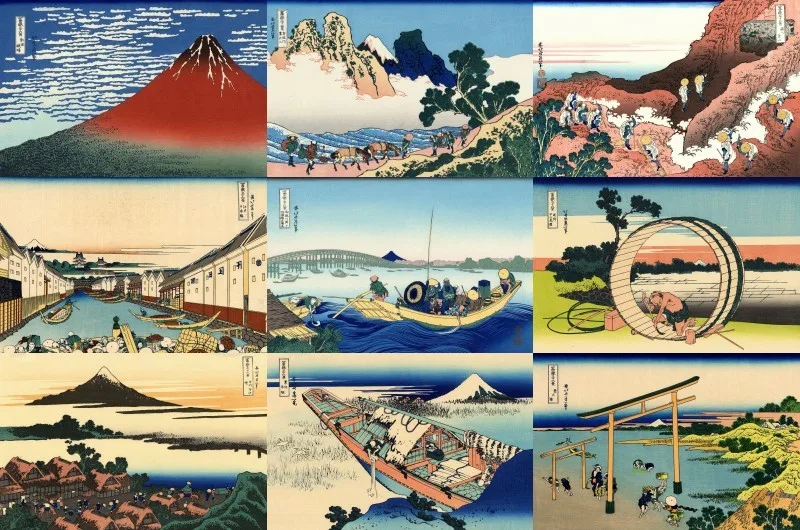
Despite the name, the series Fugaku Sanjū-Rokkei [富嶽三十六景] has 46 woodblock prints, with 10 added later. These works by Katsushika Hokusai depict Mount Fuji in different seasons, weather, locations, and distances.
The woodblock prints date from 1831 to 1834 and were printed by Nishimuraya Yohachi, the main woodblock print publisher of the time. The woodblock printing technique of ukiyo-e allowed for the expansion and popularity of the paintings.
At the end of this article, you will find a list with the names of the 46 prints from the 36 Views of Mount Fuji series. Here are briefly some prints made by Katsushika Hokusai that will also be scattered throughout the article:
Who was Katsushika Hokusai?
Katsushika Hokusai was the artist behind the Great Wave off Kanagawa and the 36 Views of Mount Fuji. It is believed that he was born in Tokyo in 1760 and died in 1849 at the age of 89. Besides landscapes, the author also created erotic prints.
In his time, he was one of the leading experts in Chinese painting in Japan, gaining recognition in the West due to The Great Wave off Kanagawa. He painted all kinds of natural phenomena and produced over 30,000 works during his lifetime.
Katsushika Hokusai had a long history; on his page in the Japanese Wiki, we can see that he had aberrant behaviors, despite his skills he was poor, had problems with foreigners, warriors, and Kabuki actors.
It is interesting to see his thoughts and decisions throughout his life, how he revolutionized and even exported his prints to the world. Another curious fact is that Hokusai changed homes 93 times but ended up finishing his life in his hometown, Tokyo.
At the end of the article, you will also see a book with illustrations by the author called Hokusai Manga, in addition to the possibility of purchasing his print of The Great Wave off Kanagawa. Before he died, Hokusai wrote a Haiku Poem that says:
Responsive Table: Scroll the table sideways with your finger >>
| Now as a spirit I must cross the summer fields. | Hitodama de yuku kisan jiya natsu no hara | 悲と魂で ゆくきさんじや 夏の原 |
The Great Wave off Kanagawa
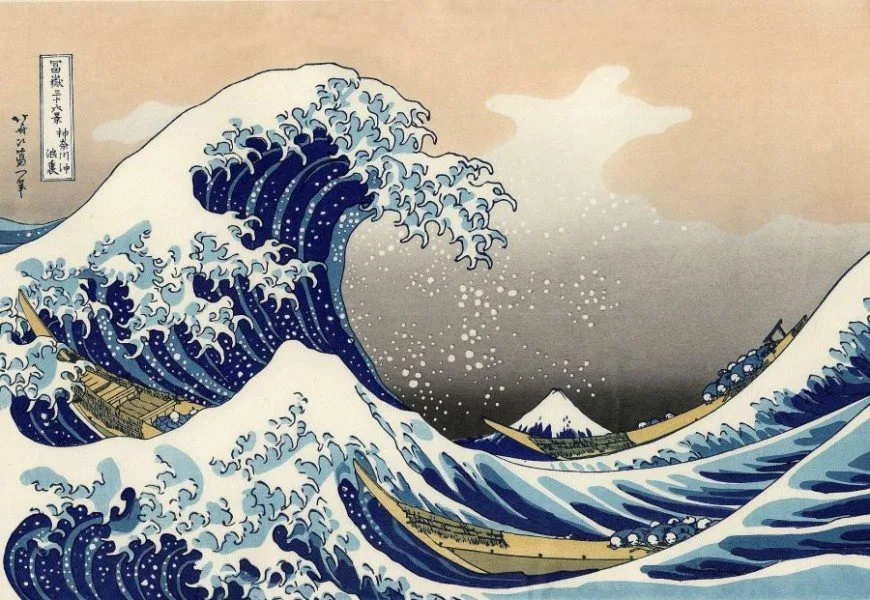
In Hokusai's print, The Great Wave off Kanagawa depicts a Great Wave threatening a fishing boat in Kanagawa Prefecture, with Mount Fuji visible in the background. Despite its size, it is not a tsunami, but a normal wave created by the effect of wind and tides.
This painting is believed to have been made around 1820, being the first of the series Fugaku Sanjū-Rokkei and also Hokusai's most popular painting. From the mold used, thousands of copies were made and distributed among collectors worldwide.
This print is of the yoko-e type, meaning it is landscape-shaped and has an ōban size of 25 cm in height by 37 cm in width. The landscape consists of three elements: the sea stirred by a storm, three boats, and a mountain.
This painting became very famous already in the 19th century, where many artists from other places ended up buying a copy and spreading it around the world. Today, it is possible to find this woodblock print in various museums such as the British Museum and the National Library of France.
Hokusai even influenced famous artists like Van Gogh and Claude Monet.
Mount Fuji
Mount Fuji is a great sacred symbol of beauty and national identity, the main protagonist of Hokusai's 36 paintings. The magnificent Mount Fuji is drawn small in the background in contrast to the Great Waves.
The dark colors near the horizon and the appearance of snow-covered peaks well illuminated suggest that the sun rises on the observer's side and it is morning. Although it is not raining, the clouds in the sky indicate a storm.
The 3 Boats
Three boats battered by the great waves are drawn on the canvas. This boat was an oshiokuri-bune used to transport live fish at that time.
Each boat has eight rowers gripping the oar, two or more passengers can be seen at the bow, and about 30 people are in the image. The people remain stiff in the boat, contrasting with the dynamic waves.
The Great Wave
The sea is furious, showing the moment when the crest of the wave breaks. The curve of the wave draws an arc and forms a composition centered on Mount Fuji in the background. The splashes of the waves spread in front of the waves are like snow falling on Mount Fuji.
The height of the wave is almost the same as that of the boat in the back, the length of the wave is generally from 12 to 15 meters, and as Hokusai extends the vertical scale by 30%, the height of the wave can be estimated between 10 to 15 meters.
This wave is sometimes interpreted as a tsunami. This interpretation is from the 1960s onwards; before that, it was interpreted as a normal wave. No major tsunamis occurred in Kanto and Kansai during Hokusai's lifetime. The waves in this painting have a short wavelength and cannot represent a tsunami.
Hokusai Manga and Wave Print
In 1814, the great artist Katsushika Hokusai published the first volume of his sketches: Hokusai Manga. Originally conceived as a reference for his students, it exceeded all expectations and became a bestseller to this day.
You might have the chance to buy 3 volumes on Amazon Brazil for a low price, without worrying about import bureaucracy. Don't miss the chance to see over 4,000 images of the great Hokusai. You can also purchase the painting The Great Wave off Kanagawa below:
List of the 46 Prints of Fugaku Sanju Rokkei
If we were to place the 46 large images in this article, it would weigh quite a bit, so let's leave just a list with a thumbnail image. I hope you enjoy the list below:
Responsive Table: Scroll the table sideways with your finger >>
| Number | Portuguese | Japanese | Romaji |
| 1 | The Great Wave off Kanagawa | 神奈川沖浪裏 | Kanagawa-oki nami-ura |
| 2 | Mount Fuji with Clear Weather (also known as Red Fuji) | 凱風快晴 | Gaifū kaisei |
| 3 | Thunderstorm Below the Peak | 山下白雨 | Sanka hakū |
| 4 | Fuji Seen from Mannen Bridge in Fukagawa | 深川万年橋下 | Fukagawa Mannen-bashi shita |
| 5 | Fuji Seen from Mishima Pass | 東都駿台 | Tōto sundai |
| 6 | The Coast in Kamakura | 青山円座松 | Aoyama enza-no-matsu |
| 7 | Senju in Musashi Province | 武州千住 | Bushū Senju |
| 8 | The Tama River in Musashi Province | 武州玉川 | Bushū Tamagawa |
| 9 | The Inume Pass in Kai Province | 甲州犬目峠 | Kōshū inume-tōge |
| 10 | View of Fujimi Field in Owari | 尾州不二見原 | Bishū Fujimigahara |
| 11 | Asakusa Honganji Temple in Tokyo | 東都浅草本願寺 | Tōto Asakusa honganji |
| 12 | Tsukada Island in Musashi | 武陽佃島 | Buyō Tsukuda-jima |
| 13 | Shichiri Beach in Sagami | 相州七里浜 | Soshū Shichiri-ga-hama |
| 14 | Umegawa in Sagami | 相州梅沢庄 | Soshū umezawanoshō |
| 15 | Kajikazawa in Kai Province | 甲州石班沢 | Kōshū Kajikazawa |
| 16 | Mishima Pass in Kai | 甲州三嶌越 | Kōshū Mishima-goe |
| 17 | Lake Suwa in Shinano | 信州諏訪湖 | Shinshū Suwa-ko |
| 18 | Ejiri-juku in Suruga | 駿州江尻 | Sunshū Ejiri |
| 19 | The Fuji from the Mountains of Totomi | 遠江山中 | Tōtōmi sanchū |
| 20 | Ushibori in Hitachi | 常州牛掘 | Jōshū Ushibori |
| 21 | Sketch of the Mitsui Store on Suruga Street in Edo | 江都駿河町三井見世略図 | Kōto Suruga-cho Mitsui Miseryakuzu |
| 22 | Sunset on the Ryogoku Bridge from the Sumida River Bank at Onmayagashi | 御厩川岸より両国橋夕陽見 | Ommayagashi yori ryōgoku-bashi yūhi mi |
| 23 | Sazai Hall - 500 Rakan Temples | 五百らかん寺さざゐどう | Gohyaku-rakanji Sazaidō |
| 24 | Tea House in Koishikawa. The dawn after a snowfall | 礫川雪の旦 | Koishikawa yuki no ashita |
| 25 | Shimomeguro | 下目黒 | Shimo-Meguro |
| 26 | Watermill in Onden | 隠田の水車 | Onden no suisha |
| 27 | Enoshima in Sagami | 相州江の島 | Soshū Enoshima |
| 28 | Coast of Tago Bay, Ejiri-juku in Tokaido | 東海道江尻田子の浦略図 | Tōkaidō Ejiri tago-no-ura |
| 29 | Yoshida in Tokaido | 東海道吉田 | Tōkaidō Yoshida |
| 30 | The Maritime Route of Kazusa Province | 上総の海路 | Kazusa no kairo |
| 31 | Nihonbashi Bridge in Edo | 江戸日本橋 | Edo Nihon-bashi |
| 32 | Village of Sekiya on the Sumida River | 隅田川関屋の里 | Sumidagawa Sekiya no sato |
| 33 | Noboto Bay | 登戸浦 | Noboto-ura |
| 34 | Lake Hakone in Sagami | 相州箱根湖水 | Sōshū Hakone kosui |
| 35 | The Reflection of Fuji on Lake Kawaguchi, Seen from the Misaka Pass in Kai | 甲州三坂水面 | Kōshū Misaka suimen |
| 36 | Hodogaya in the Tokaido Region | 東海道保ケ谷 | Tōkaidō Hodogaya |
| 37 | Honjo Tatekawa | 本所立川 | Honjo Tatekawa |
| 38 | Nakahara in Sagami | 従千住花街眺望の不二 | Senju Hana-machi Yori Chōbō no Fuji |
| 39 | Tokaido Shinagawa | 東海道品川御殿山の不二 | Tōkaidō Shinagawa Goten'yama no Fuji |
| 40 | Soshu Nakahara | 相州仲原 | Sōshū Nakahara |
| 41 | Sunset in Isawa in Kai | 甲州伊沢暁 | Kōshū Isawa no Akatsuki |
| 42 | The Slope of Fuji from the Minobu River | 身延川裏不二 | Minobu-gawa ura Fuji |
| 43 | Ono Shinden in Suruga | 駿州大野新田 | Sunshū Ōno-shinden |
| 44 | The Tea Plantation of Katakura in Suruga | 駿州片倉茶園の不二 | Sunshū Katakura chaen no Fuji |
| 45 | The Fuji of Kanaya-juku in the Tokaido Region | 東海道金谷の不二 | Tōkaidō Kanaya no Fuji |
| 46 | Climbing Fuji | 諸人登山 | Shojin tozan |



Community
Comments
0 comments
There are no published comments in this language yet.
Send comment