
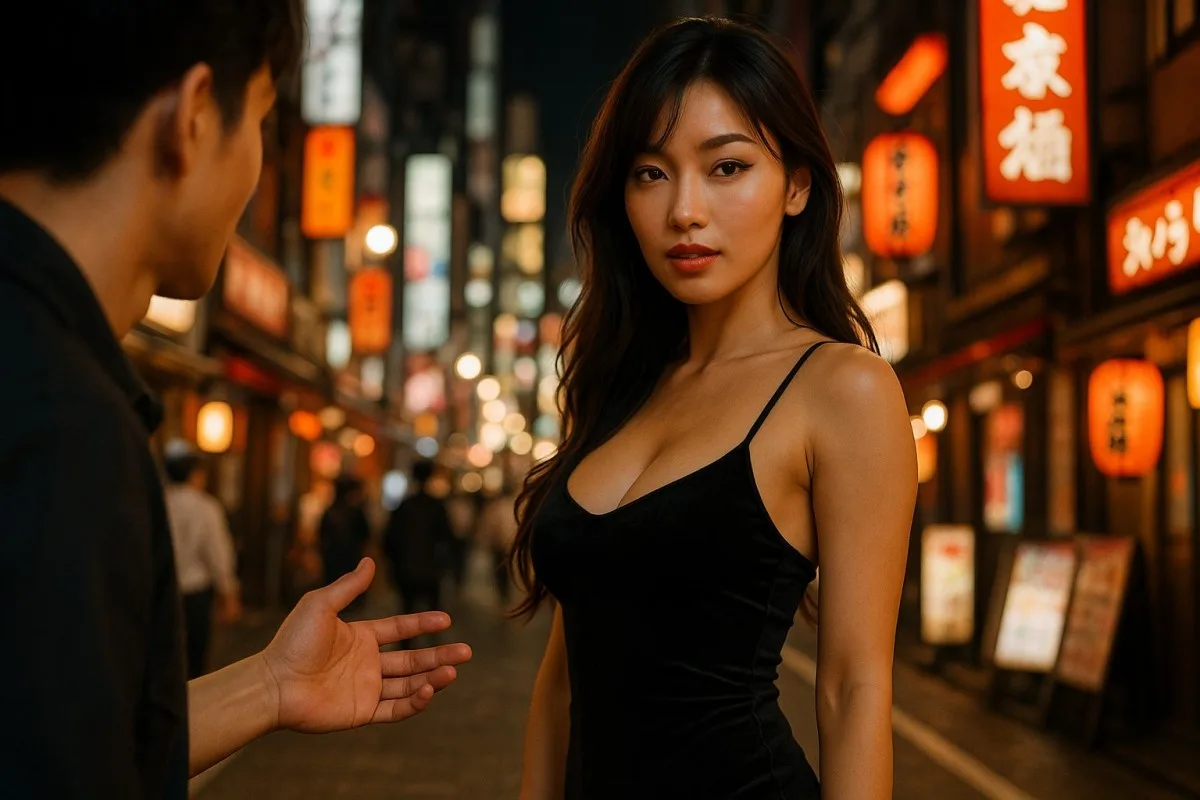
You probably know that in Japanese culture we do not have the habit of complimenting women with hot terms like sexy, hot, or delicious. Using these compliments can sound rude and not work, but if you still want to insist and call a Japanese woman sexy? What terms to use?
In this article, we go beyond kawaii, kirei, and bijin and we will teach spicy, sensual, and shameless terms and phrases for you to push the limits of Japanese culture. Ready to conquer or suffer the consequences?
Table of Contents
Understanding the Risks
Japan is a country where direct compliments about appearance, especially in a sensual way, can sound invasive. Society values subtlety. Therefore, those phrases that work in other parts of the world, like “You are very sexy,” rarely go over well there.
In fact, you will rarely see a Japanese person complimenting someone in public so directly. It’s not just a matter of shyness; it’s respect. If you exaggerate, you can even be misinterpreted.
Compliments That Work in Japan
Now, that doesn’t mean that complimenting a sexy Japanese woman is an impossible mission. But focus on words that express admiration in a delicate, never invasive way. Here are some examples that work well:
- Kirei (綺麗): means “beautiful” or “pretty.” A classic, neutral, and safe choice.
- Oshare (おしゃれ): means “stylish” or “fashionable.” A compliment about the outfit or the way of dressing, without being too direct.
- Kawaii (可愛い): can be translated as “cute” or “charming.” Although it sounds innocent, it is common and can sound captivating.
- Suteki (素敵): something like “wonderful” or “stunning.” It has an elegant and sophisticated tone.
Avoid using words like “sexy” (セクシー, sekushii) in Japanese directly to the person, unless the relationship is already intimate or there is clear trust. Among friends or strangers, it can sound heavy or vulgar.
Now that you understand the risks, let’s throw out the formalities, speak openly, and detail each spicy and indecent term you can use to compliment a Japanese woman in a “shameless” style. Ready? Let’s go:

Eroi (エロい)
If you want to say that a Japanese woman is “hot” or that she fills your head with ideas, eroi (エロい) is the word that comes closest to that meaning. Using “eroi” in a conversation is practically admitting that you’re thinking naughty thoughts, and you’re not hiding anything:
Anata, chotto eroi yo.
あなた、ちょっとエロいよ
You are a bit erotic, huh
You can throw in a little smile at the end to lighten the mood, but everyone will understand that the conversation is hot. If the conversation is already tense, you can even intensify it with:
Eroi sugiru!
エロいすぎる
Too sexy!
But again: it only works if the atmosphere is already flirty.
When the Japanese woman has that innocent air, but at the same time awakens desires, the term ero-kawaii (エロかわいい) fits like a glove. This compliment has a provocative tone, but with a certain lightness. It serves to play and provoke a smile — if you know how to balance the bold side with a touch of charm.
Eroppoi (エロっぽい)
The word eroppoi is almost a joker for those who want to provoke. It carries the idea of something “looking erotic,” but it’s not always explicit. Using eroppoi is not just saying that the person is sexy; it’s insinuating that there is an aura of desire, a light naughtiness, as if just the way of looking gives that shock of excitement. You know that person who doesn’t even need to show anything, just by existing makes the imagination run wild? That’s it: it’s the “vibe” more than the body.

Sekushii (セクシー) – Sexy
This term is imported, but it has already become Japanese at heart. Sekushii is the classic “sexy,” that compliment that can range from chic to vulgar depending on the tone of voice and the look. It can be said in the middle of a party, after a few drinks, or in that daring conversation at dawn.
It can be used lightly, but it also serves to drop a bomb: “You are sekushii today” can be both an invitation for a kiss and a compliment from someone who is just admiring.
It’s versatile, works in various contexts, and doesn’t usually scare as much as eroi — but it’s also not something you say to just any coworker.
Ecchi (Indecent)
Ecchi (エッチ) is a term that means indecent, often represented by the letter H. This term is used to refer to things inappropriate to be written here, but you can read the differences between Ecchi and Hentai.
The most common is the adjective ecchi na (エッチな), like “ecchi na fuku” (naughty clothes), “ecchi na hanashi” (perverted conversation). It serves both to make jokes among friends and to start a hot conversation with someone you already have freedom with. In the internet vibe, this root quickly becomes a meme.
There is also the term ecchi suru (エッチする), which is the informal equivalent of “to have sex,” used only among intimate people, boyfriends, or very close friends, usually in a playful context or cheeky invitation.
We recommend reading: Vocabulary and phrases about sex in Japanese
Echiechi (エチエチ)
If in Brazil people use “naughty,” “perverted,” or “hot,” in Japan the meme is echiechi. It is derived from the letter “H” (for “hentai”), but it has become a light and fun slang for everything that is a bit spicy, provocative, suggestive. It can be used to compliment a daring look, a meme, or even a post. Among young people and in the internet vibe, echiechi is the password to say “you’re making me think of things” — but without sounding like a creepy old man.
H na Onna (Hな女)
Now, if the idea is to go all out, using H na onna is naming names. “H woman,” in Japan, means someone sexually bold, unafraid to admit desires. It’s explicit and heavy, a compliment that requires a lot of intimacy. It’s not just recognizing sensuality — it’s declaring that the person drives you crazy. Using this expression is stepping directly into the red zone of Japanese flirting.

Other Spicy Terms in Japanese
See below other terms that we couldn’t cover much, but that are important:
Bijin (美人)
Although translated as “beautiful woman,” bijin carries a more sophisticated charm. The word brings an idea of admirable beauty, but when used in the right context, it gains a touch of intense admiration, almost as if saying “besides being beautiful, you command respect.” If you want to heat things up, you can combine it with another term, like “eroi bijin,” and then it changes the picture — it goes from princess to tempting goddess.
Motemote (モテモテ)
This term shifts the focus a bit because it’s not directly sexual, but plays with the idea of someone being irresistible. When someone is motemote, they attract glances, provoke sighs, are the target of envy and desire. Saying this to someone is like saying: “You’re so amazing that everyone wants to get with you.” It sounds fun, charming, and can indeed turn into an invitation for something more if the context allows.
Iroppoi (色っぽい)
Iroppoi leans towards the more artistic side of sensuality. It’s the kind of beauty that hypnotizes, touches the senses in a refined way. It can be a voice, a way of walking, a look full of intention. It’s not vulgar, but rather magnetic. When someone gives off an iroppoi, they are usually talking about that charm that’s hard to explain — almost as if the person exudes desire effortlessly.
Nikkanteki (肉感的)
Nikkanteki goes straight to the physical. It means “fleshy,” “curvy,” something visually attractive because it overflows with bodily sensuality. It’s usually used to describe bodies with curves, thighs, hips, bust — all that draws attention for its volume and texture. There’s nothing subtle about it; it’s that word that says the body is, literally, mouthwatering.
Mizupoi (水っぽい)
Now, mizupoi can be confusing. Literally, it means “watery” or “moist,” but it has become slang to describe something or someone that has a sexy vibe like a “hostess,” those women from nighttime entertainment bars. It evokes a glamour, a somewhat artificial sensuality, sometimes exaggerated, but still irresistible. It can be used in situations where the person is well put together, heavily made up, wearing tight clothes, that thing that looks like it came out of a pop music video.
Leave a Reply