
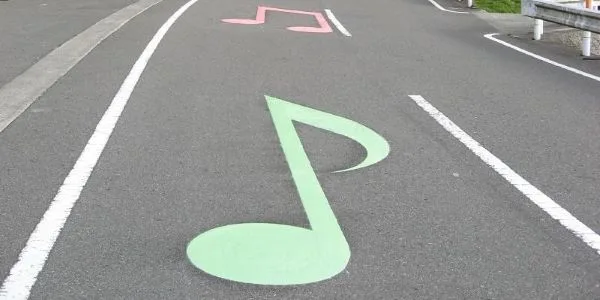
In Japan, some stretches of asphalt literally hum a tune when tires roll over them. They are called Melody Roads (メロディーロード): grooves cut into the pavement that turn the car itself into part of the instrument.
Keep a steady speed and the vibrations travel from the tires into the cabin as a recognizable song. Miss the right pace and the same stretch becomes a muddy buzz. It is acoustic engineering with a tourism smile — and a quiet nudge to stay alert on rural roads.
There is no speaker under the asphalt. The music comes from spacing and depth of the grooves: closer cuts raise the pitch, wider gaps lower it. Depth is often only a few millimeters of surface cut, and many Japanese stretches are designed so that around 40 km/h the melody locks into place. Closed windows help; the cabin becomes the sounding board.
Japan did not invent the first musical road in the world — that credit usually goes to Denmark’s experimental Asphaltophone — but it is the country that turned the idea into a network of named stretches, from Hokkaido down to Okinawa. Similar projects also appear in South Korea, the United States, China, Hungary, and elsewhere, sometimes for safety, sometimes for spectacle.
If you care how Japanese music is built, the same ear for pitch shows up in scales such as the hirajoshi scale and in everyday musical vocabulary in Japanese.
Contents 4
How did music-playing streets come about?
The earliest widely cited musical road is the Asphaltophone in Gylling, Denmark, created in 1995 by artists Steen Krarup Jensen and Jakob Freud-Magnus. Raised markers on the pavement produced an arpeggio in F major when cars passed over them.
In Japan, the story takes a more accidental turn. Civil engineer Shizuo Shinoda noticed that irregular scrapes and tractor marks on road surfaces produced sequences of sound. Engineers in Hokkaido, already researching ways to alert drivers about hazards and drowsiness, refined the idea into deliberately spaced lateral grooves.
The first full Japanese Melody Road installations appeared in the mid-to-late 2000s. A well-known early stretch sits on Highway 272 between Kushiro and Shibetsu in Hokkaido and plays the pop song Shiretoko Ryojō when you hold the right speed. From there the concept spread across prefectures that wanted tourism, local pride, and a playful way to keep drivers near the intended pace.
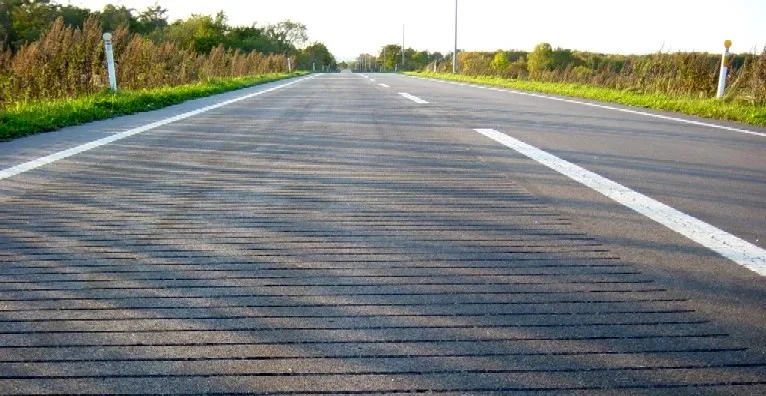
Typical Japanese sections run a few hundred meters. Groove depth is commonly in the range of about 3–6 mm, with cut widths that change from note to note. Some stretches are polyphonic: different groove patterns under the left and right tires so melody and harmony arrive together. A few longer or higher-speed designs exist (for example stretches meant to be heard near 70 km/h), but the classic rural Melody Road still rewards patience at around 40 km/h.
Look for roadside signs. Locals and tourism boards mark many of these segments; without a marker it is easy to miss the short window of music.
Where to find Melody Roads in Japan
Japan has dozens of Melody Roads scattered from north to south — enough that a single list never stays complete for long. Gunma alone has several. The table below is a practical snapshot of stretches that travelers and local coverage have documented over the years, with province, city or area, year when known, approximate length, and the melody associated with the road.
| Province | City / area | Year | Segment (m) | Melody |
| Hokkaido | Shibetsu | 2007* | ~175–565m | Shiretoko Ryojō |
| Hokkaido | Hokuto area | 2015 | 250m | Akatonbo (red dragonfly) |
| Hokkaido | Hokuto area | 2015 | 317m | Īmondana furusato wa |
| Fukushima | Kaneyama (Onuma) | 2014 | 278m | Country Road |
| Nagano | Chino | 2008 | 210m | Scarborough Fair |
| Aichi | Toyota | 2007 | 301m | Donguri Korokoro |
| Shiga | Ōtsu | 2009 | 610m | Biwako shūkō no uta |
| Wakayama | Kimino | 2007 | 320m | Miagete goran yoru no hoshi o |
| Okinawa | Nago / Futami | 2012 | 340m | Futami Jowa (polyphonic) |
| Hiroshima | Sera | 2009 | 513m | Sanpo / Totoro no sanpo |
| Gunma | Kusatsu | — | 300m | Kusatsu Onsen song |
| Gunma | Tsumagoi | 2010 | — | Snowy mountain song of praise |
| Gunma | Takasaki / Lake Haruna | 2008 | 280m | Quiet Lake |
| Gunma | Maebashi | 2010 | — | Tulip |
| Gunma | Numata | — | — | Shirasawa |
| Gunma | Nakanojō / Shima Onsen area | — | — | Itsumo Nando Demo (Spirited Away) |
| Hiroshima | Akitakata | 2014 | 270m | Kagura segment |
| Ishikawa | Nanao–Anamizu | 2015 | 1200m | Maresora |
| Ōita | Taketa | 2007 | — | Kōjō no Tsuki |
| Ehime | Ikata | 2011 | 430m | Mikan no hana saku oka |
| Shizuoka | Ashinoko Skyline (Hakone) | — | ~320m | A Cruel Angel’s Thesis / Fuji no Yama (by direction) |
| Tottori | Yonago–Sakaiminato (Route 47) | — | — | GeGeGe no Kitarō theme |
*Early Hokkaido Melody Road work is usually dated around 2007 for the full engineered installation; older scrape tests and later practical segments also appear in local accounts.
Anime and film fans often hunt specific stretches: the Totoro-linked song near Sera in Hiroshima, Always With Me (Itsumo Nando Demo) near Nakanojō in Gunma, the Evangelion theme on the Ashinoko Skyline near Hakone, and the GeGeGe no Kitarō theme on the road toward Sakaiminato in Tottori. Okinawa’s Futami stretch is famous not only for the folk ballad but for stereo-style grooves under left and right tires.
Planning a road trip? Melody Roads reward a rental car and flexible timing more than a packed train day. If you are still deciding whether driving is worth it, see our guide on car rental in Japan.
Musical roads around the world
Outside Japan, the same idea wears different motives.
In South Korea, singing-road experiments have been framed as a way to keep drowsy drivers awake. In Hungary, a 2019 installation on Road 67 memorializes singer Cipő with a snippet of the band Republic’s song about that same route. China has used musical pavement for tourism and for national or classical melodies, often with a hard speed target so the song only resolves when drivers stay disciplined.
Not every experiment survives contact with neighbors. In the Netherlands, a provincial singing stretch was removed after residents complained about noise when cars passed at the wrong speed. In the United States, the famous Lancaster, California, “musical road” built for a Honda commercial drew similar neighborhood pushback, and other American projects have faded or been expensive to maintain.
Japan’s network stands out less for inventing the concept and more for normalizing it: many prefectures treat Melody Roads as ordinary tourist infrastructure, not a one-off stunt.
How to hear them clearly (and what videos show)
To finish, a few practical notes that matter more than any playlist:
- Hold a steady speed close to the posted or recommended value for that stretch — often about 40 km/h on classic Japanese Melody Roads.
- Close the windows; cabin resonance is part of the instrument.
- Prefer the lane or wheel path the grooves were cut for; drifting off the pattern muddies the notes.
- Expect a short performance. Many segments last only half a minute or so at the correct pace.
Drive-through videos online make the effect obvious: the same groove pattern can sound clean in a compact car and thin on a bicycle or wheelchair, because contact patch and suspension change the vibration. Footage from Hokkaido, Gunma, Hiroshima, and Okinawa is easy to find if you want to hear a stretch before you go.
I have driven one of the Gunma roads myself — windows up, speed steady, melody rising out of the tires for a few seconds that still feel slightly absurd in the best way. If you have tried a Melody Road in Japan or elsewhere, the comments are open for which song you caught and whether the neighborhood seemed amused or exhausted.





Community
Comments
0 comments
There are no published comments in this language yet.
Send comment