
Cyberpunk anime is small as a genre and large as an influence. Akira (1988) and Ghost in the Shell (1995) gave it a visual language: rain-slick megacities, corporate towers, rebuilt bodies, and stories about people who are already obsolete. Later series kept that language and pushed it into television, OVAs, and streaming.
The genre works when technology is ordinary and power is concentrated. In these worlds, computers are leased infrastructure. Cybernetic limbs carry maintenance costs as well as enhancements. Antagonists are often companies, systems, or markets that have learned to treat people as inventory.
This list gathers fifteen titles across series, films, and OVAs. The first five are essential viewing, the next four are shorter films or OVAs, and the last six are older works that still hold up. Release dates and studios are included so you can trace the lineage, and the table at the end works as a quick reference.
The list starts with the title that brought the genre back to a mass audience in 2022.
Contents 19
Cyberpunk: Edgerunners (2022)
Studio Trigger's ten-episode series premiered on Netflix on September 13, 2022. It is set in Night City in 2075 and 2076, where David Martinez, a student at Arasaka Academy, loses his mother and becomes an edgerunner after installing a military-grade Sandevistan implant. Lucy, Maine, Rebecca, and the rest of the crew turn his rise into a heist story about borrowed dreams.
The show keeps the world of Cyberpunk 2077 and drops the power fantasy. David is a teenager with an unusual tolerance for cyberware and no plan for the consequences. Its neon palette, quick violence, and ten-episode length made it a gateway for viewers who had never played the game.
A standalone sequel, Cyberpunk: Edgerunners 2, premiered on October 20, 2026. It runs for ten episodes, takes place in 2078, and follows a new protagonist, Roman Carax, with a new cast. The first crew's story is complete, so the new season can be watched without homework. Both series sit in a Netflix anime catalog that has grown well beyond the 2022 debut.

Psycho-Pass (2012)
Production I.G's Psycho-Pass premiered in October 2012 and ran for 22 episodes. In a Japan governed by the Sibyl System, a measurement called the Psycho-Pass estimates a person's likelihood of committing a crime. Akane Tsunemori joins the Public Safety Bureau as an inspector and works with Enforcers, latent criminals who serve as investigators.
The cyberpunk element here is the bureaucracy that turns a probability into a verdict. Sibyl assigns jobs, measures mental stability, and decides who can be treated as a person. The first season follows Akane's education, the second tests the cost of reform, and the third widens the conflict to foreign affairs. Providence, a 2023 film, fills in the events before season three.
Psycho-Pass is the densest entry on the list. It is talky, violent, and occasionally didactic, but it commits to its central question: what happens when a society outsources judgment to a machine that cannot explain itself. The same question runs through our guide to artificial intelligence characters in anime.
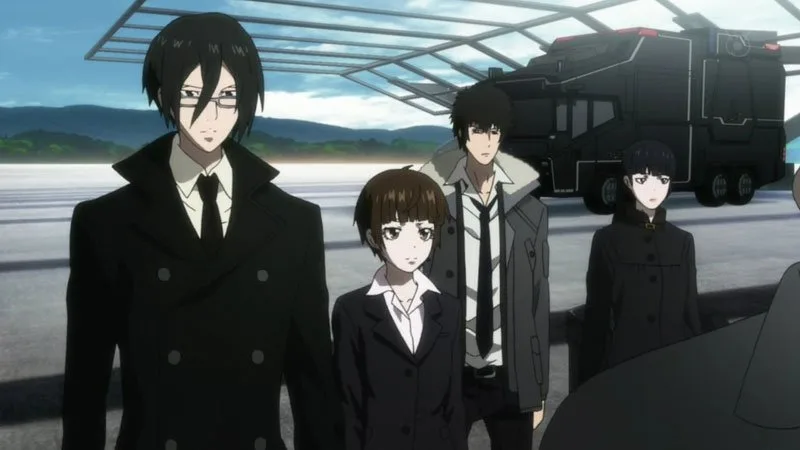
Ghost in the Shell (1995)
Mamoru Oshii's 1995 film, animated by Production I.G, follows Major Motoko Kusanagi as she hunts the Puppet Master, a hacker who rewrites memories and leaves his victims unsure of their own pasts. The plot is a police procedural wrapped around a meditation on identity, embodiment, and the boundary between a person and a program.
Its influence shows up in obvious places. Its cityscapes, thermoptic camouflage, and synth-heavy score became reference points for everything from The Matrix to later anime. The franchise continued through Innocence (2004), Stand Alone Complex, Arise, SAC_2045, and a 2017 live-action film.
In July 2026, Science SARU released The Ghost in the Shell, a television adaptation that follows Masamune Shirow's 1989-1990 manga in its entirety. It aired through September, and another anime project has already been announced. Newcomers can start with the 1995 film; viewers who want the source can go straight to the new series.

Ergo Proxy (2006)
Manglobe's 23-episode series aired in 2006. After an ecological disaster, humanity lives in domed cities. In Romdeau, people are grown in artificial wombs, AutoReiv androids handle daily labor, and a virus called Cogito gives some machines self-awareness. Inspector Re-l Mayer investigates a series of murders and finds the Proxy, a humanoid species at the center of secret experiments.
Ergo Proxy is slow, gloomy, and loaded with references to Gnosticism, philosophy, and classical myth. That combination makes it divisive. Some middle episodes wander, and the finale explains more than it dramatizes. What holds it together is a coherent visual world and a pair of leads, Re-l and Vincent Law, whose relationship carries the final act.
Watch it after Akira and Ghost in the Shell, when you are ready for a series that treats confusion as part of the atmosphere. Its questions about manufactured life and civic control sit closer to dystopian fiction than to action anime.

Akira (1988)
Katsuhiro Otomo's Akira is the film that proved anime could carry a cyberpunk epic. Set in 2019, decades after a psychic disaster destroyed Tokyo, it follows Kaneda and his biker gang in Neo-Tokyo. A collision with a child esper triggers Tetsuo's telekinetic powers, and the military, the government, and a protest movement all try to control him.
A motorcycle chase opens the film and remains one of the genre's best calling cards. The animation holds up because the city is treated as a physical place: concrete, neon, garbage, and crowds drawn with the same care as the central characters. Its story is bleak and sometimes rushed, but its images have outlived most of its imitators.
Akira is the right starting point if you want to understand why cyberpunk anime looks the way it does. It is also a reminder that the genre's future is often a rebuilt version of a catastrophe that already happened.

Cyberpunk Anime Movies and OVAs
The series get most of the attention, but the format has a strong tradition in films and OVAs. These four are self-contained and short enough to sample without a long commitment.
Battle Angel Alita (1993)
Yukito Kishiro's Gunnm was adapted into a two-part OVA in 1993. A cyberneticist finds Alita, a damaged cyborg with no memory, in a scrapyard and rebuilds her. She becomes a bounty hunter while trying to recover her past. It covers the first two volumes of a nine-volume manga, so it ends earlier than the story does. The 2019 live-action film is a different adaptation; the 1993 OVA remains the more compact introduction.
Mardock Scramble (2010-2012)
Tow Ubukata's novels became a three-film cycle: The First Compression (2010), The Second Combustion (2011), and The Third Exhaust (2012). Rune Balot, a teenage prostitute, is left for dead by a serial killer and rebuilt as a cyborg with a shape-shifting companion called Oeufcoque. What follows is a revenge tale with long dialogue scenes, body horror, and a courtroom climax. It is the most explicit entry here, and viewers sensitive to sexual violence should read up before starting.
Appleseed (1988 and 2004)
Masamune Shirow's Appleseed was first adapted as a 1988 OVA by Gainax, then as a 2004 feature directed by Shinji Aramaki. In the city of Olympus, humans and bioroids share a fragile peace. Deunan Knute and her cyborg partner Briareos are pulled into the politics that keep the city running. The 1988 version is rougher and closer to the manga's tone; the 2004 film is the more polished spectacle. Both are worth a look if you want Shirow's world-building without the philosophical weight of Ghost in the Shell.
Blame! (2017)
Tsutomu Nihei's manga is a vertical nightmare of concrete and machinery. The 2017 Netflix film, directed by Hiroyuki Seshita at Polygon Pictures, follows Killy as he searches the Megastructure for a human with the net terminal genes, a genetic key that could stop the system's expansion. At 106 minutes, the film compresses a long, almost silent manga, so it works best as an introduction. The scale is the point: corridors the size of countries, machines that treat humans as pests.

Six Classic Cyberpunk Anime That Still Hold Up
These six date from 1987 to 2003. Some are rough around the edges, and availability varies by region, but each one adds something the newer titles take for granted.
Serial Experiments Lain (1998)
Lain Iwakura is a quiet teenager who receives an email from a classmate who has died. Her investigation pulls her into the Wired, a network that is beginning to overlap with reality. The 13-episode series, written by Chiaki J. Konaka and animated by Triangle Staff, uses the internet as a setting for a study of loneliness, identity, and the collapse of distance. Its pacing is deliberate, and its imagery is still unsettling.
Texhnolyze (2003)
Madhouse's 22-episode series is set in Lux, a decaying city divided by gangs and a ruling family. Ichise, a prize fighter, loses an arm and a leg and receives texhnolyze prosthetics. The show moves at a crawl, uses long silences, and kills characters without ceremony. Its pace will test some viewers, and its portrait of a city running out of reasons to exist is one of the genre's most complete.
Bubblegum Crisis (1987-1991)
Set in MegaTokyo in 2032, seven years after a major earthquake, Bubblegum Crisis follows the Knight Sabers, four women in powered suits who fight rogue Boomers built by the Genom corporation. Across eight OVAs, the series mixes pop music, corporate conspiracy, and street-level action. The animation is uneven, but the character designs and the soundtrack gave the series a long afterlife.
Armitage III (1995)
Naomi Armitage is a Type-III android working as a police officer on Mars. Her partner, Ross Sylibus, is a human detective who has just arrived from Earth. Across four episodes, the OVA turns a murder investigation into a story about reproduction, personhood, and the laws that decide who counts as alive. A 1996 recut, Poly-Matrix, is shorter and adds English voice work; start with the original OVA.
Cyber City Oedo 808 (1990-1991)
Yoshiaki Kawajiri's three-part OVA is set in the year 2808, where three convicts are offered reduced sentences in exchange for catching cybercriminals. The setup is simple, the execution is stylish, and the English dub is a cult artifact in its own right. It is one of the shortest entries on the list and easy to watch in one sitting.
The Animatrix (2003)
Nine short films expand the world of The Matrix. The best segments, such as The Second Renaissance and Beyond, work without any connection to Neo. As an anthology, it is uneven, but it gave Japanese directors a rare chance to play in a Western cyberpunk sandbox, and its mixed 2D and 3D animation still looks distinctive.
Cyberpunk Anime List with Release Dates
The table below includes the titles covered above plus related films, OVAs, and seasons. Years refer to the first Japanese broadcast or release; films and OVAs are marked separately.
| Cyberpunk Anime | Type | Year |
| Cyberpunk: Edgerunners | Web | 2022 |
| Cyberpunk: Edgerunners 2 | Web | 2026 |
| The Ghost in the Shell | TV | 2026 |
| Ghost in the Shell | Movie | 1995 |
| Ghost in the Shell 2: Innocence | Movie | 2004 |
| Ghost in the Shell 2.0 | Movie | 2008 |
| Ghost in the Shell: Stand Alone Complex | TV | 2002 |
| Ghost in the Shell: Stand Alone Complex 2nd GIG | TV | 2004 |
| Ghost in the Shell: Stand Alone Complex - The Laughing Man | Movie | 2005 |
| Ghost in the Shell: Stand Alone Complex - Individual Eleven | Movie | 2006 |
| Ghost in the Shell: Stand Alone Complex - Solid State Society | Movie | 2006 |
| Ghost in the Shell: Arise | OVA | 2013 |
| Ghost in the Shell: The New Movie | Movie | 2015 |
| Ghost in the Shell: SAC_2045 | Web | 2020 |
| Ghost in the Shell: SAC_2045 Season 2 | Web | 2022 |
| Psycho-Pass | TV | 2012 |
| Psycho-Pass 2 | TV | 2014 |
| Psycho-Pass 3 | TV | 2019 |
| Psycho-Pass SS: Case. 1 - Tsumi to Batsu | Movie | 2019 |
| Psycho-Pass SS: Case. 2 - First Guardian | Movie | 2019 |
| Psycho-Pass SS: Case. 3 - Onshuu no Kanata ni | Movie | 2019 |
| Psycho-Pass Providence | Movie | 2023 |
| Akira | Movie | 1988 |
| Ergo Proxy | TV | 2006 |
| Serial Experiments Lain | TV | 1998 |
| Texhnolyze | TV | 2003 |
| Bubblegum Crisis | OVA | 1987 |
| Bubblegum Crash! | OVA | 1991 |
| Bubblegum Crisis: Tokyo 2040 | TV | 1998 |
| Armitage III | OVA | 1995 |
| Armitage III: Poly-Matrix | Movie | 1996 |
| Armitage III: Dual-Matrix | Movie | 2002 |
| Battle Angel Alita | OVA | 1993 |
| Mardock Scramble: The First Compression | Movie | 2010 |
| Mardock Scramble: The Second Combustion | Movie | 2011 |
| Mardock Scramble: The Third Exhaust | Movie | 2012 |
| Appleseed | OVA | 1988 |
| Appleseed | Movie | 2004 |
| Appleseed: Ex Machina | Movie | 2007 |
| Appleseed Alpha | Movie | 2014 |
| Blame! | Movie | 2017 |
| Cyber City Oedo 808 | OVA | 1990 |
| The Animatrix | OVA | 2003 |
| Human Lost | Movie | 2019 |
Where to Start
For a fast, emotional introduction, watch Cyberpunk: Edgerunners. It runs for ten episodes, tells a complete story, and the 2026 sequel does not require prior knowledge.
For the genre's foundation, watch Akira and the 1995 Ghost in the Shell film in that order. Both are feature films, and together they explain most of the visual language that followed.
For television, Psycho-Pass is the best entry if you want a mystery, while Ergo Proxy and Serial Experiments Lain reward viewers who prefer atmosphere and ambiguity.
Cyberpunk anime keeps returning to a single question: who gets to decide what a person is when the body, the memory, and the city can all be owned? These fifteen titles answer it in different ways. The best of them make the technology feel lived in, which is why they still work long after the hardware on screen stops looking futuristic.






Community
Comments
0 comments
There are no published comments in this language yet.
Send comment