
Some anime take a few minutes to grab you, others take an episode. Gyakkyō Burai Kaiji [逆境無頼カイジ], better known in the West as Kaiji: Ultimate Survivor, does something rarer: it pushes most viewers away with its look and then keeps them awake for two days straight. The series is one of the most consistent psychological thrillers in the gambling-anime subgenre, often mentioned alongside Death Note and Steins;Gate, and it remains a cult reference for fans of dark seinen stories. This recommendation goes through the manga, both anime seasons, the strongest arcs and the kind of reader who will get the most out of the ride.
Contents 12
Why Gyakkyō Burai Kaiji is considered unpopular
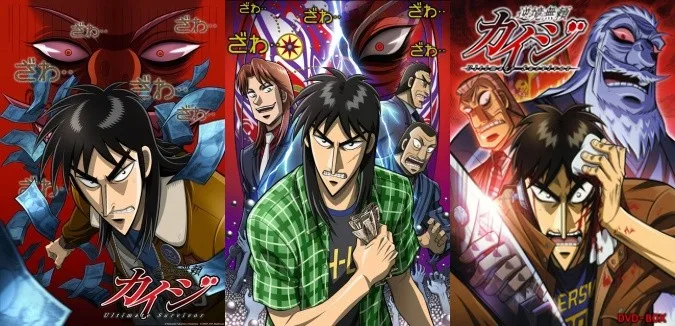
First contact with Gyakkyō Burai Kaiji is rough. The linework is thick, the character proportions are angular, the backgrounds are minimal, and the animation style looks closer to an older seinen manga than to most 2000s anime. Viewers used to the polished look of Death Note, the gloss of Madhouse productions, or the bright palette of typical shounen and slice-of-life shows tend to bounce off the cover art within minutes.
The visual roughness is not a budget accident, though. It is the direct result of working from an older seinen manga that was drawn with heavy lines and high-contrast shading on purpose, with limited animation cycles to keep the focus on the games and the psychology behind them. Once the eye adjusts, the style starts to work in your favor: expressions become exaggerated, the pauses stretch out, and the silence before a bet is broken feels heavier than in most action anime.
If you have skipped Kaiji because of the art, you are missing the exact kind of work that has kept readers coming back to Fukumoto's manga for over two decades.
About the manga by Nobuyuki Fukumoto
The original Gyakkyō Burai Kaiji manga is written and drawn by Nobuyuki Fukumoto (福本伸行), one of the defining voices of modern seinen gambling and psychological stories. Born in Yokohama in 1958, Fukumoto built his reputation on stories about debt, manipulation, and men who talk their way out of corners they walked into voluntarily. His earlier works, including Akagi: Yami ni Oritatta Tensai and the unfinished Kurosawa, share the same DNA: ordinary or broken protagonists thrown against opponents with absolute control of the rules.
Kaiji first appeared as Tobaku Mokushiroku Kaiji in the magazine Young Magazine (Kodansha) in 1996, and it was collected into tankōbon from 1998 onwards. The story is split into clearly defined arcs, each centered on a different game mechanic. This structure lets the reader drop into a self-contained story, learn the rules with the protagonist, and watch the game collapse into something the rules were never meant to handle.
About the anime adaptation by Madhouse
The first anime season, Gyakkyō Burai Kaiji: Ultimate Survivor, was produced by Madhouse and aired in 2007 under the direction of Yuzo Satō. The 26-episode run covers the introductory arc on the Espoir ship and follows the character as the stakes keep rising. The second season, Gyakkyō Burai Kaiji: Hakairoku-hen, aired in 2011 with the same studio, the same director, and a tighter focus on the pachinko and human chess arcs.
Both seasons keep the original manga's art direction close to the source, with thick lines, heavy shadows and deliberately limited motion. They are not the kind of adaptation that polishes Fukumoto's drawings into a typical anime house style, and that decision is part of what gives the series its uncomfortable rhythm. Tonegawa, the calm antagonist who runs the games, has his own spin-off manga Tonegawa: Middle Management Blues (賭博堕天録カイジ ワン・ポーカー編 is the parent work, with the Tonegawa spin-off illustrated by Tatsuya Endo), which is lighter in tone but takes place in the same universe.
The series also received two live-action films starring Tatsuya Fujiwara, the same actor who played Light Yagami in the Death Note films: Kaiji: Jinsei gyakuten gêmu (2009) and Kaiji 2: Jinsei dakkai gêmu (2011). They are a useful complement for viewers who want a different interpretation of the same material.
Themes and style
Kaiji works on a different axis from most action or shounen series. There is no training arc, no power system, no chosen one. The protagonist is a regular, often foolish man, drowning in debt he agreed to take on as a guarantor for a friend, who stumbles into games that are designed to strip every illusion of safety. The series asks a simple, uncomfortable question: what would you do, honestly, if you were three months behind on a debt you could never repay, and someone offered you a coin flip between bankruptcy and a clean slate?
The themes fall into a few recurring buckets: debt and social pressure, psychological manipulation, the illusion of fair rules, and the gap between intelligence and survival instinct. Kaiji loses as often as he wins, and his victories feel earned precisely because they cost him something physical and mental. The series treats the human mind as the only resource the protagonist can actually spend.
Visually, the show leans on still frames, repeated facial close-ups, internal monologue and very few action cuts. The tension comes from what the characters are thinking, not from what they are doing. This is one of the reasons Kaiji is often compared to other psychological thrillers in anime, and why it feels slow if you go in expecting fights.
Key arcs in the anime
The structure of Kaiji is a string of self-contained games, each with its own rules, its own antagonist, and its own slow escalation. The four most important arcs in the anime are the restricted rock-paper-scissors game, the pachinko arc, the human chess match, and the derby races.
The restricted rock-paper-scissors arc
The first arc traps the cast on a ship called the Espoir, where contestants are given a fixed amount of fictional money and forced to play a modified rock-paper-scissors game with three-card hands. The game looks absurd on paper, but Fukumoto uses the limited rules to build one of the most tense openings in the anime: a format where every gesture is a signal, every signal is a lie, and the cost of a misread is bankruptcy before the second round.
The pachinko arc
The pachinko arc is the longest and most punishing stretch of the first season. Kaiji, broke after the ship, is pulled into a scheme to climb a pachinko machine that is rigged to be nearly impossible to clear, with the prize tied to a small sliver of cardboard hidden inside a pachinko ball. The arc is essentially a heist inside a casino, and it is the moment where the show's grimmest tone takes over.
The human chess arc
The second season, Hakairoku-hen, opens with the human chess match: a board game played with real people as pieces, where losing means taking a literal fall from a high-rise platform. It is the most allegorical arc in the series, and it doubles as a long meditation on class, sacrifice, and the kind of loyalty a desperate man can buy.
The derby races arc
The derby races, often translated as the Human Derby or Chinchiro, are the manga's longest arc and the one the anime only partially adapts. The premise is brutal: contestants are forced to bet on the outcome of a foot race between desperate men, where the only rule is that the slowest runners are killed. The arc is the closest the series comes to a gore-seinen register, and it is where the Tonegawa spin-off fleshes out the antagonist's side of the story.
Who is Kaiji for?
Kaiji is not for everyone, and the recommendation is honest about it. The series is built for viewers who already like psychological thrillers, slow-burn tension and morally compromised protagonists. If you watch anime primarily for the animation, the choreography of fights, or the comfort of a hero with a clear power level, the series will feel slow and uncomfortable.
It is a strong pick if you liked Death Note for the cat-and-mouse mind games, Steins;Gate for the slow realization of how trapped the protagonist is, or Akagi for the sheer pressure of a single high-stakes game. The series also works as a gateway into Fukumoto's wider bibliography and the broader current of seinen gambling stories that came after it, including the lighter Tonegawa: Middle Management Blues.
The content is not light. Expect depictions of suicide, torture, addiction and manipulation, with no softening for younger viewers. For adult readers who want a psychological thriller that takes its own themes seriously, Kaiji remains one of the most recommendable anime in the entire seinen catalog.
Music and first impressions
For a quick sense of the series' tone, the first season's opening, Mirai wa Bokura no Te no Naka (未来は僕らの手の中, "The Future Is in the Palm of Our Hands"), captures the mix of optimism and dread that runs through the whole anime. The video below is a subtitled version of that opening.
How to watch the series
The most natural entry point is the first season, Gyakkyō Burai Kaiji: Ultimate Survivor (26 episodes, 2007), followed by the second season, Hakairoku-hen (2011). The anime covers the first part of the manga and stops where the human chess arc ends. To go further, the manga's derby races arc (Tobaku Datenroku Kaiji, with sub-arcs Kazuya-hen and One Poker-hen) is the recommended continuation, paired with the Tonegawa spin-off for the antagonist's perspective.
The two live-action films are optional but well cast, and they make an interesting companion piece for anyone who has already gone through the anime. For a focused recommendation of similar anime, the article on why Kaiji stands out as the best gambling anime covers the same topic from a different angle.





Community
Comments
0 comments
There are no published comments in this language yet.
Send comment