

Japanese is written with kanji, and one kanji can be a whole word. This means the language is full of very short words: one syllable, sometimes a single sound.
Kana are characters that each form a sound, a short beat such as ka or shi, rather than a string of Latin letters. A kanji reading is often one of those beats, and sometimes two or three. Most of the time, more than one kanji is needed to form a complete word.
The problem is that several Japanese words are formed by just one kanji. English has short words too, such as "I", "no", and "tree", but those still stack several letters. In Japanese the whole word can be one kana.
Things get even worse when you remember how few syllables Japanese has. Standard Japanese uses pitch accent: the voice drops at a set place in the word, where English would use stress. 火 and 日 are both read hi. You tell fire from day by the kanji. These are some of the main reasons why the Japanese language uses ideograms.
In Japanese, the label for a monosyllabic form is tan'onsetsu [単音節].
Japanese words with one syllable
Below is a list of Japanese nouns read as one syllable. In hiragana alone, several of them share a sound, which is why the kanji stays in the table. Later comes a shorter list: words whose whole reading is one vowel.
| English | Japanese | Romanization |
| Mosquito | 蚊 | ka |
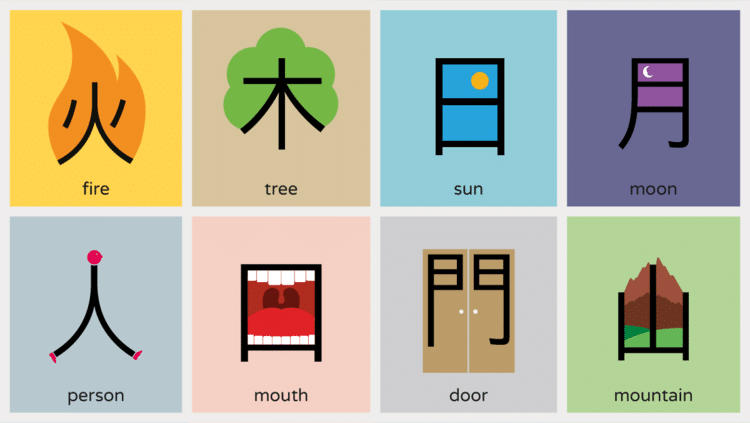
| Tree | 木 | ki |
| Hair | 毛 | ke |
| Child | 子 | ko |
| Death | 死 | shi |
| Vinegar | 酢 | su |
| Blood | 血 | chi |
| Hand | 手 | te |
| Tooth | 歯 | ha |
| Fire | 火 | hi |
| Day | 日 | hi |
| Eye | 目 | me |
| Arrow | 矢 | ya |
Some of the words mentioned in this article may not be commonly used alone, and show up only as a suffix or a prefix. Since there are multiple readings in an ideogram, there can be different ways to use the word.
Japanese words of a single vowel
There are Japanese words formed with just one vowel: i, u, e, or o. Reading a sentence without kanji makes those sounds easy to mix up. Each entry in the table is one kanji, and the romanization is that vowel.
| English | Japanese | Romanization |
| Painting | 絵 | e |
| Stomach | 胃 | i |
| Tail | 尾 | o |
| Cord | 緒 | o |
| Cormorant (bird) | 鵜 | u |
| Water well | 井 | i |
I tried to include only ideograms that are usually used in isolation as a noun or word. If we were to examine all the ideograms that have a reading of just one syllable, this list would be endless. A kanji can also name a longer word, such as 駅 (eki, station). That reading takes two morae, so it stays off this list.
Each of these words is one kana, so the reading itself is the easy part. The work is remembering which kanji belongs to which meaning.
Do you know other monosyllabic words in Japanese? If you do, share them with us in the comments!





Community
Comments
0 comments
There are no published comments in this language yet.
Send comment