
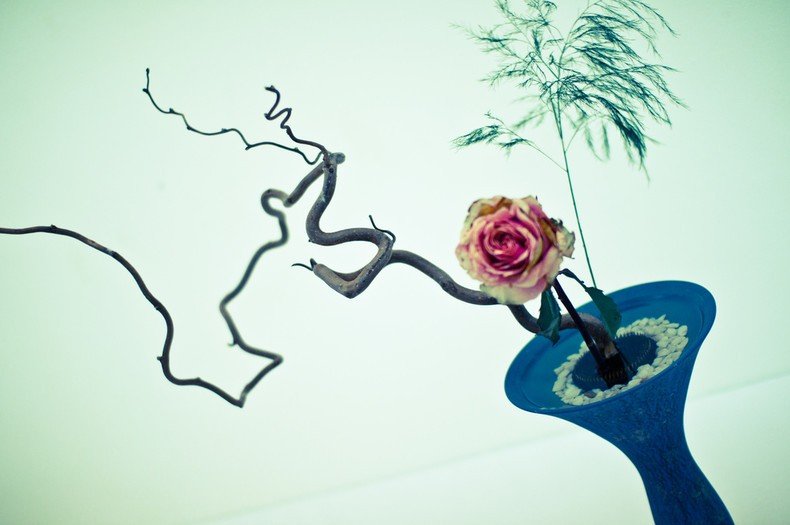
Ikebana is a millenary art, created and spread in Japan in the 7th century, whose objective is to arrange flowers, leaves, and natural branches in full harmony with the vases, thus giving life to the flower. Ikebana is a very popular art in Japan and Brazil, which is why we have put together this complete article talking about everything related to Ikebana.
Ikebana [生け花] literally means living flowers, a Japanese art focused on flower arrangement. It is also known by the name Kadou [华道] which means “the way of flowers,” resembling the name of a martial art.
The art of ikebana is known for its focus on stems and leaves, rather than the flowers themselves. Thus creating a floral arrangement with linear, rhythmic, and colorful harmony. In the art of ikebana, the aim is to portray the balance that exists in the universe, uniting the sky (shin), man (soe), and earth (tai or hikae) within the same arrangement.
Kadou is counted as one of the three classical Japanese arts of refinement, along with Kodou which appreciates incense and Chado which involves the tea ceremony.
History and Origin of Ikebana
Ikebana originated in India, where religious figures made large decorations for the Buddha’s altar as an offering. It was the Japanese who made the practice known worldwide and extended it as a type of art practiced by nobles.
Ancient documents record Lotus Ikebana being offered to the Buddha during ceremonies at Todai Temple. Another record called Manyoshu cataloged 166 types of flowers such as hagi and ume that are used to make Ikebana.
Other data states that this art does not only have a religious symbol. Ikebana also served as entertainment for the residents of the imperial house before Zensai Awase cocktails in the Heian Era.

In the book Manyôshû, the names of 166 types of flowers are cataloged, such as Hagi and Ume. There is also data confirming that ikebana served as a type of entertainment for the residents of the Imperial House before cocktails (Zensai Awase) in the Heian Era.
The ikebana is always composed of all parts of a plant, such as stems, leaves, flowers, and branches, which according to the Japanese symbolize heaven, earth, and humanity.
Like most traditional Japanese arts, it gradually lost space and its tradition. Fortunately, Ikebana has been fully disseminated as a decorative art of flowers, gaining strength in the decoration of places.
Styles and Types of Ikebana
In the beginning, Ikebana was very simple, requiring only a few stems and green branches to make an arrangement called kuge [供華]. Over time, the imperial families and their retainers evolved the art of ikebana, thus generating various styles and types that we will list below:
- Ikenobo – The oldest style, arrangements made with devotion to the gods, and decorated with branches;
- Sogetsu – One of the newer styles, with even Queen Elizabeth II and Princess Diana attending schools to learn this technique;
- Ohara – An assembly of branches and flowers almost stacked;
- Sanguetsu – Involves not modifying the materials used (leaves, flowers, branches), thus creating a more natural arrangement;

Rikka [立花] – Reflects the splendor of nature and its display. Used for decoration at parties and ceremonies. The name rikka literally means standing flowers. The key to this style is nine branches that represent elements of nature.
Shoka [生花] – Consists of three main branches that symbolize heaven, man, and earth. Represents perpetual change and renewal. Its name means pure flowers, its goal is to show the beauty and uniqueness of the plant itself.
Moribana [盛花] – Means stacked flowers, which are usually in a shallow vase or suiban, fixed in a Kenzan.
Jiyūka [自由花] – Means free flowers, consists of a creative and free design without rules reflecting the free style and modernism.
Nageirebana [投入花] – An unstructured style that led to the development of Seika and Shoka.
Each style follows a determined set of rules and techniques when creating the floral arrangement.
The Schools of Ikebana
The art is so popular in Japan that it has gained worldwide fame, generating more than 3,000 schools of ikebana spread across the world with over 15 million practitioners of the Japanese floral arrangement art.
The schools of ikebana are usually led by an iemoto, a strict hierarchical system that is often passed down by family members to ensure a particular tradition, which unfortunately ends up being seen as static and restrictive.
The schools are generally related to the styles. Some schools have their own style or helped develop a certain style. For example, ikenobo is a style developed from rikka, but it also refers to the name of the school.
Ikenobo is the oldest ikebana school dating back to the 700s and marks its beginning along with the Rokkakudo Buddhist temple in Kyoto. This school and style gave rise to several other schools such as:
- Higashiyama-Ryu
- No-ryu
- Enshiu-Ryu
- Seizan-Ryu
- Misho-Ryu
- Saga Ir-Ryu;
- Shōgetsudo Ko-Ryu;
- Ryu-Ko;
- Senzan-Ryu
- Higashiyama-Ko-Sei-Ryu
- Ryu-Higashiyama
- Soami-Ryu
- Nihonbashi Enshu
- Shin Enshu
- Ango Enshu
- Miyako Enshu
- Seifu Enshu
- Asakusa Enshu
- Sōgensai
- Murakumo-Ryu
- Toko-ryū
- Shikishima-Ryu
- Donin-Ryu

These are some of the schools formed over the years from 700 to 2000. Not to mention the countless small schools or those that spread around the world in various different ways, thus generating different styles.
If you are looking for an Ikebana course, it is possible to find places in Brazil that teach Sanguetsu ikebana. The Brazil-Japan Cultural Alliance also offers Ikebana classes in the Ikenobo or Sogetsu styles.
How to Make a Japanese Ikebana Floral Arrangement?
To make an ikebana, a simple vase, a kenzan (metal ring to hold the flowers), water, flowers, branches, and stems, and scissors are used. With these simple tools, you can create your own floral arrangement.
We recommend looking for long, straight, thin branches with few leaves and buds. Of course, everything will depend on the style of ikebana you wish to create. Some are simple and delicate, while others are terribly complex and laborious.

Ikebana is an arrangement meant to be viewed from the front, so most often it will be placed next to a wall. They are usually placed in an entrance hall or living room to welcome visitors and clients.
Since flowers are fragile, the maximum duration of a floral arrangement is about a week. Another common, but not exclusive, aspect present in ikebana is the idea of minimalism. A lot of discipline and patience is required.
If you wish to delve deeper into the world of ikebana, there is an association in Brazil located in Liberdade – SP. If you are in Japan, the most famous schools are Ikenobo, Ohara, and Sogetsu.
Vases, Books, and Ikebana Products
Perhaps you are looking for a book about Ikebana, or maybe you want to buy a vase for your ikebana. We have gathered some links from partner sites and created a catalog of products related to Ikebana for you to check out below:
Make Your Own Ikebana
The Japanese art of floral arrangement is practiced in complete silence and is designed to refine the practitioner’s patience and aesthetic sense. Since the art is highly appreciated in Japan, it is easy to find events in cities like Tokyo and Kyoto.
Many see the art as a reasonably common hobby throughout the country. Its simplicity and complexity help to understand how humans perceive their life, the nature around them, and their interaction with the divine being and the transcendental.
And what do you think of this art? We appreciate your comments and shares! To finish, we will leave a video showing how to make an Ikebana! We recommend reading other articles such as:
Leave a Reply