

Artificial intelligence (AI) became part of everyday life when OpenAI released ChatGPT on November 30, 2022, and the models have improved quickly since then. Can artificial intelligence help you learn Japanese?
One of the most popular AI tools today is ChatGPT, from OpenAI, and its basic version is free. Current models create text, hold a conversation, and also work with voice and images, so you can type a question, hear a word pronounced or send a photo of a page.
The main advantage of artificial intelligence is the time it saves you. I myself spent days searching Google, forums and WhatsApp groups for programming answers that artificial intelligence solved in seconds.

Contents 3
How AI Helps You Study Japanese
Artificial intelligence can be useful in various ways to help people learn Japanese. Some of these ways include:
- Automatic translation: tools such as DeepL and Google Translate translate words and phrases from Japanese to English and vice versa, which helps you understand words and sentences you do not know. Polite and casual forms can get lost in machine translation, so treat the result as a first pass, especially when you are learning Japanese with anime and dramas.
- Chatbot-based learning: chatbots such as ChatGPT are designed to help people learn Japanese. They can simulate a conversation with a human tutor, offering exercises and instructions to practice your Japanese when no native speaker is around.
- Educational games and apps: apps like Duolingo pack grammar exercises, vocabulary tests and other activities into short daily sessions. Our list of apps to learn Japanese on Android and iOS covers more options.
- Voice tools and virtual assistants: you can ask questions about the language and use voice features to practice listening and pronunciation. Japanese speech synthesizers such as VoiceVox turn any text into spoken Japanese.
How ChatGPT Can Help You Learn Japanese
OpenAI's ChatGPT can help you learn Japanese in several ways:
- Providing grammatical explanations: ask about a specific point, such as the difference between は (wa) and が (ga), and get detailed explanations about the different types of words and how they are used in a sentence.
- Answering questions: if you have any doubts about Japanese, ask for a breakdown of the sentence, including what each particle is doing, instead of only a translation.
- Providing usage examples: ChatGPT can build sentences with the exact word you are studying, with its reading and a translation, so you see how it is used in context.
- Offering exercises and activities: it can suggest quizzes, fill-in-the-blank and translation tasks. Check the answer key yourself, because correction is where these models fail most.
- Guidance on learning resources: it can suggest books, apps and websites for your level. Confirm that what it recommends still exists before you buy or download anything.
Some prompts that work well:
- Explain the difference between は and が with three example sentences.
- Write five sentences with the verb 食べる (taberu), each with its reading and an English translation.
- Correct my sentences and explain each mistake.
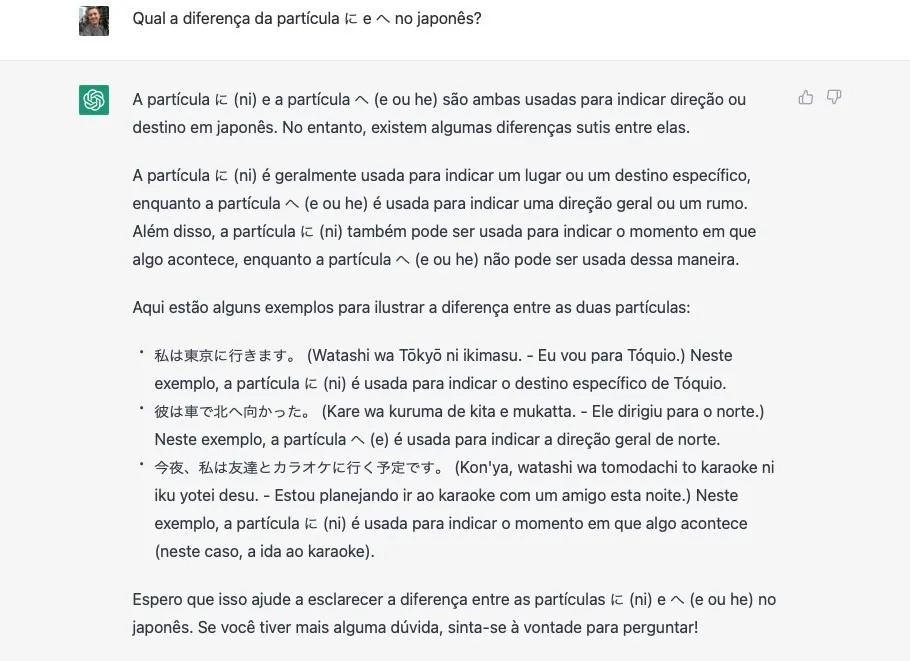
These are just some of the ways that artificial intelligence can help you. In my own experience, I was able to translate sentences with all the details and explanations, including the particles and their function in the sentence.
ChatGPT also gave me explanations about Japanese grammar, translated and explained sentences from Portuguese into Japanese, and generated sentences with any word I wanted to study, which is perfect for spaced repetition.
The Problems of Using AI to Study Japanese
AI does not make mistakes intentionally. Its answers can still be incorrect or inappropriate when the training data has gaps or when your question is too vague or ambiguous.
The model can also fail on questions that are too complex, or on topics it saw too little of during training. On top of that, answers sound just as confident when they are wrong, which makes the mistakes hard to notice without some knowledge of Japanese.
In a documented test of Japanese particles, ChatGPT claimed that がは (ga wa) works as a compound particle and produced an example sentence to prove it. That structure is not valid Japanese, as a native speaker confirmed. Asked about the topic again, the model marked the same example as incorrect in one reply and defended it in the next. Models also tend to agree with the user, so insisting that an answer is wrong may change the reply without making it more accurate.
For this reason, we recommend building a basic knowledge of Japanese so the errors in AI answers are easier to detect. Once you can read the kana and recognize the common particles, wrong answers stand out and you can check them in a dictionary or with a native speaker.
Despite these limits, using AI to learn Japanese pays off when you treat it as support. It gives you explanations, example sentences and practice when nobody else is available, and it works best alongside other methods. If you are starting out, our 50 tips for learning Japanese cover the foundation that makes those answers easier to judge.







Community
Comments
0 comments
There are no published comments in this language yet.
Send comment