
Did you know that in Japan the hours go beyond 24? Have you ever asked what time it is in Japan? Perhaps you wondered how many hours it is in Tokyo? In this article, we will understand a little about Japan’s time, its differences, and curiosities.
Table of Contents
What time is it in Japan? Japanese Time
The time in Japan is known by the acronym JST (Japan Standard Time), in Japanese it is known as Nihon Hyoujunji (本標準時). Japan’s time zone is UTC/GMT +9, 12 hours ahead of Brazil which is UTC -3.
I think we all know that Japan is 12 hours ahead, so if it is 3 PM here, it is 3 AM there. It is worth noting that Japan does not have daylight saving time, so be mindful of this when converting our time to Japan’s time.
Besides Japan, countries like Korea, Indonesia, and Yakutsk have the same standard time. The sun rises about 89º east of Japan at 05:26. The sunset occurs at 17:42 at 272º west. The day lasts about 12 hours and 16 minutes in Japan.

The time in Japan goes beyond 24:00
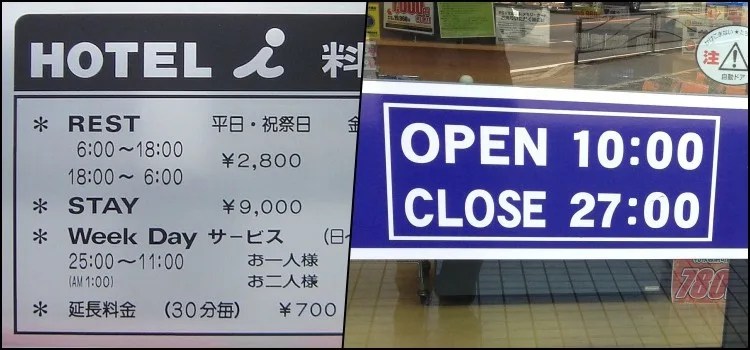
Japan uses both the 24-hour and 12-hour formats in everyday life. However, in TV programs or some places, they exceed the 24:00 existing on the clock. How so? Japan finds it easier to keep the early morning hours on the same day.
This is because the Japanese have a very active nightlife, it can be confusing for some to see a TV program starting at 21:00 and ending at 1:00. Therefore, they prefer to list it from 21:00 to 25:00 instead of leaving it as 1:00 AM.
Other countries besides Japan, such as the United Kingdom, Korea, Hong Kong, and China, use hours beyond 24:00 when business hours extend past midnight. This also prevents train tickets without any date from issuing times like from 22:00 to 01:00.
This avoids common cases that happen in Brazil when we say Sunday night at 2 in the morning, when it is already Monday. You may find Japanese time exceeding 24:00 on TV, stations, radios, shows, stores, hotels, theaters, and even in bathhouses.
The history of time and clocks in Japan
Before the Meiji Era (1868-1912), each region of Japan had its own time zone that depended on the position of the sun. When trains became popular in Japan, the practice of telling time through the highest position of the sun became a source of confusion. Trains in Osaka would often arrive 20 minutes early in Tokyo due to the slight time difference.
During World War II, countries like Singapore and Malaysia adopted Japan’s time, but this was reversed after Japan surrendered. In the past, the islands of Okinawa and Taiwan used the time which is UTC +8, meaning one hour less than Japanese time, but this ended in 1937.
Clocks have existed in Japan since the mid-7th century in the form of water clocks. In the past, during the Edo period, Japan had a traditional mechanical clock. It used a seasonal time system, based on a mechanical clock from Europe.
This traditional Japanese clock is called Wadokei (和時計) and was introduced by Jesuit missionaries or Dutch merchants. They were lantern clocks made of bronze or iron.

How many hours in Tokyo?
Besides Japan’s national time, most people tend to look for how many hours it is in Tokyo. Japan’s time is the same throughout the country, regardless of region and locality. There is no time zone difference like in some states of Brazil.
So, if you are wondering how many hours it is in Okinawa, or how many hours it is in Osaka, remember that Japan’s time is the same everywhere. In fact, South Korea’s time is the same as Japan’s.
We recommend reading other related articles below:
- How long does the trip to Japan take?
- Weather and Time in Japanese
- Seasons, Weather, and Climate in Japanese
How many hours are in Okinawa?
Although Japan adopts the same time in all its cities, Okinawa tends to have more sunlight due to its location in the south of the country, it also adopts other time zones.
Although the main time is still the same as Japan’s (JST), Okinawa has also used Okinawa Standard Time (OST) which has a one-hour difference. There is not much information about this currently.
Traditional Japanese time
The traditional clock of Japan had six numbered hours from 9 to 4, counting backwards from noon to midnight. The numbers 1 to 3 were not used for religious reasons, as these numbers were used by Buddhists for prayer.
The counting went backwards because the first artificial clocks in Japan used incense that burned to tell time. Dawn and dusk were therefore marked as the sixth hour in the Japanese hour counting system. Traditional Japanese clocks also had the symbols of the Chinese zodiac. (Source: Wikipedia);
| Zodiac | Nocturnal Zodiac | Number | Solar Hour |
|---|---|---|---|
| 卯 – Rabbit. | 酉 – Rooster. | 六 – 6 | sunrise / sunset. |
| 辰 – Dragon. | 戌 – Dog. | 五 – 5 | |
| 巳 – Snake. | 亥 – Pig. | 四 – 4 | |
| 午 – Horse. | 子 – Rat. | 九 – 9 | afternoon / midnight. |
| 未 – Goat. | 丑 – Ox. | 八 – 8 | |
| 申 – Monkey. | 寅 – Tiger. | 七 – 7 | . |
Japanese are Strict with Time
Punctuality is extremely important in Japanese culture, and this is reflected in their schedules. Trains in Japan are known for their punctuality, with delays of only a few seconds. Stores and restaurants generally open and close on time.
Being late in Japan is very rare and a source of shame, so all Japanese people try to be as punctual as possible.
The Japanese Legal Time was established in 1895. Before that, Japan used various local time zones. The unification of the time zone facilitated communication and transportation in the country.
What time do stores open in Japan?
Unlike some countries like Brazil, stores do not open very early and do not close very late. It is common to find restaurants closed at 8:00 PM, and large retail stores opening at 11:00 AM.
See the average opening and closing times for each establishment in Japan:
- Department stores and large retailers: generally open from 10 AM to 8 PM, Monday to Saturday.
- Street shops: generally open from 10 AM to 7 PM, Monday to Saturday.
- Convenience stores: generally open 24 hours a day, 7 days a week.
- Lunch restaurants: generally open from 11 AM to 2 PM, Monday to Friday.
- Dinner restaurants: generally open from 5 PM to 10 PM, Monday to Saturday.
- Izakayas (Japanese pubs): generally open from 5 PM to 11 PM, Monday to Saturday.
- Banks: generally open from 9 AM to 3 PM, Monday to Friday. On Saturdays, some banks may open from 9 AM to 12 PM.
- Museums: generally open from 9 AM to 5 PM, Tuesday to Sunday.
Time difference between Japan and the rest of the world
Japan has the same time zone as South Korea, Indonesia, East Timor, and Yakutsk (Russia). Japan is 1 hour ahead of China and 2 hours ahead of Australia.
The list below shows the time difference between Japan and other major cities and countries around the world.
- Bulgaria (-7 hours)
- Croatia (-8 hours)
- Czech Republic (-8 hours)
- Denmark (-8 hours)
- England (-9 hours)
- France (-8 hours)
- Germany (-8 hours)
- Greece (-7 hours)
- Netherlands (-8 hours)
- Italy (-8 hours)
- Latvia (-7 hours)
- Portugal (-9 hours)
- Russia (-6 hours)
- Spain (-8 hours)
- Sweden (-8 hours)
- Switzerland (-8 hours)
- Ukraine (-7 hours)
- Accra (-9 hours)
- Angola (-8 hours)
- Argentina (-12 hours)
- Auckland (+4 hours)
- Beijing (-1 hour)
- Cairo (-7 hours)
- Costa Rica (-15 hours)
- Dallas (-15 hours)
- Doha (-6 hours)
- Dublin (-9 hours)
- Djibouti (-6 hours)
- Isfahan (-5.30 hours)
- Ghana (-9 hours)
- Hanoi (-2 hours)
- Hong Kong (-1 hour)
- Iran (-5.30 hours)
- Ireland (-9 hours)
- Jakarta (-2 hours)
- Johannesburg (-7 hours)
- Korea (0)
- Kyiv (-7 hours)
- Las Vegas (-17 hours)
- Lome (-9 hours)
- Los Angeles (-17 hours)
- Luanda (-8 hours)
- Madrid (-8 hours)
- Malaysia (-1 hour)
- Mexico (-15 hours)
- Montreal (-14 hours)
- Moscow (-6 hours)
- New Delhi (-3:30 hours)
- New York (-14 hours)
- Oklahoma City (-15 hours)
- Orlando (-14 hours)
- Ottawa (-14 hours)
- Paraguay (-12 hours)
- Philadelphia (-14 hours)
- Port of Spain (-13 hours)
- Reykjavik (-9 hours)
- Rio de Janeiro (-11 hours)
- Saudi Arabia (-6 hours)
- Seoul (0)
- Shanghai (-1 hour)
- Singapore (-1 hour)
- Sydney (+2 hours)
- Tbilisi (-5 hours)
- Tehran (-5.30 hours)
- Thailand (-2 hours)
- Toronto (-14 hours)
- Tunisia (-8 hours)
- United Kingdom (-9 hours)
- Vancouver (-17 hours)
- Vladivostok (+1 hour)
- Wellington (+4 hours)
- Winnipeg (-15 hours)
- Yamousoukro (-9 hours)
These were some curiosities about the time in Japan.
Leave a Reply