
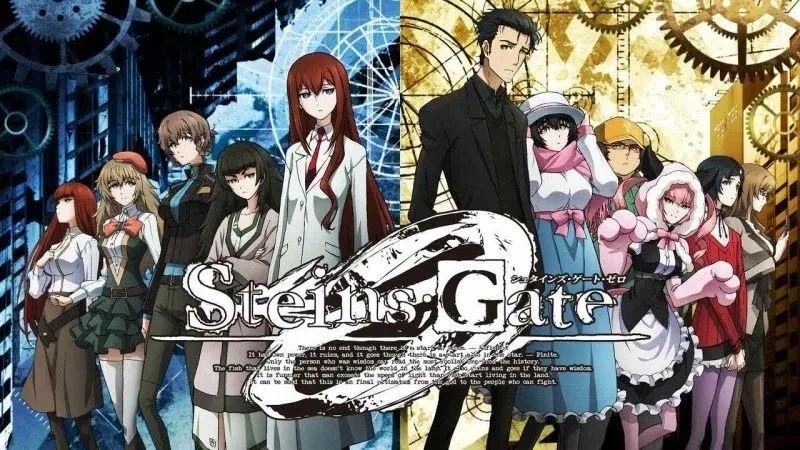
Have you heard of Steins;Gate? It is one of the most successful time travel animes of all time, and one of the intriguing things is its name and the words mentioned. With that in mind, in this article we will uncover the true meaning of Steins Gate and El Psy Congroo.
If you haven't watched the anime yet, hurry and watch it because it's the greatest experience you'll have in your life. If you've already seen it, you know that Steins Gate is just a word invented by Okabe that mixes English and German, but with no apparent meaning. Is that really the case?
Contents 7
What does Steins Gate really mean?
In the anime it is not shown, but in the original Steins;Gate game, in a certain dialogue and mentions of the game's name in Japanese, it makes a kind of wordplay.
The famous phrase This is the Choice of Steins;Gate in the game is written:
「これが運命石の扉(シュタインズ・ゲート)の選択か…」
Steins;Gate mentioned by Okabe is written [運命石の扉] which in Japanese literally means “the stone gate of destiny,” but has the furigana reading (in parentheses) sutainzugeeto.
The correct reading of the ideograms [運命石の扉] for this meaning would be something like "unmei-seki no tobira", but the wordplay did the following:
- 運命石 - unmei-seki - Stone of Destiny - Stein;
- 扉 - tobira - gate, portal - Gate;
The first expression takes a word from the German language while the second takes a word from the English language, but both were correctly represented with the Japanese language.
In a 2009 interview for the news portal Dengeki Online, the game's scenario writer Naotaka Hayashi said that "stein" has two origins.
The first is that “stein” is derived from Albert Einstein, whose theory of relativity plays a role in the story. The second is that “stein” is the German word for “stone” in the term “stone of destiny.”
Gate is an English word that generally means gate, but can also refer to a door, portal, or passage. Probably referencing the path from one timeline to another.
Stein’s gate itself is a pseudo-term created by Okabe as part of his delusions of grandeur and has no real meaning in the real world.
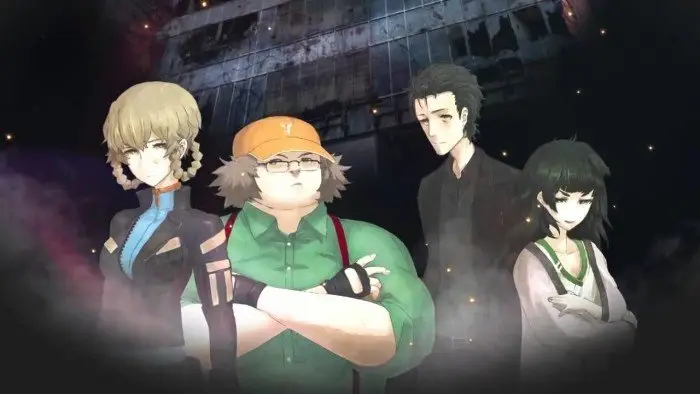
What does Reading Steiner mean?
The same happens with another term he invented to refer to Okabe's ability to retain memory between timelines.
The term Reading Steiner in the game in Japanese is written as [運命探知の魔眼] which literally means something like: demonic eye of destiny detection.
It may seem strange to use ideograms to create words with incorrect readings, but this really exists in the Japanese language and is called Ateji.
A great example of this is in the name of some countries. Brazil, for example, can be written using the ideograms [伯剌西爾] pronounced burajiru.

What does El Psy Congroo or Kongroo mean?
This is another jargon spoken by the protagonist Okabe, which he says has no special meaning. But if we analyze the word, can we find a meaning for El Psy Congroo?
El Psy Kongroo "is the password that Okabe Rintaro uses whenever he ends a phone conversation related to his crazy endeavors.
The expression possibly comes from a mix of Spanish and Latin which means something like "The mind agrees" or "The mind is congruent."
The phrase El Psy Kongroo is a reference to the @channel meme "La Yohasoh Steana" and possibly something related to the real-world code word of John Titor, "Tempus edax rerum," which means "Time, the devourer of all things."
Although the anime translates it as Congroo, the correct spelling is Kongroo, as can be seen in the scene where the video is received by Okabe via email sg-epk@jtk93.x29.jp where the first five letters mean Steins Gate El Psy Kongroo.

The Meaning of the Operations in Steins Gate
Besides the word Steins;Gate, in the protagonist Okabe's musings, he created several operations with strange names. Usually names of Norse Gods. What do you think about looking at the meaning of his operations?
The names of the three operations refer to three Norse goddesses called Nornas who are born from the Urð spring (source of life) and lived protected by one of the branches of the Yggdrasill tree. These three goddesses are responsible for the fate of people.
Operation Urd
This operation is mentioned from episode 01 to 12. Its first appearance occurs in the character presentation and in learning to change the past with the Microwave Phone.
Urd according to Norse mythology refers to the goddess of the past. She was represented as the figure of a woman or a mythical being who lived in Uroarbrunnr sometimes depicted as a Valkyrie.
Operation Verdandi
The Verdandi operation takes place between episodes 13 to 22 where Okabe tries to undo all the D-mails in order to save Mayuri from death.
The Goddess Verdandi is the goddess of the present, or goddess of occurrence. She is a young woman who always looks to the present. She appears in the verses of the Edda poem.
Operation Skuld
The Skuld operation takes place between episodes 23 and 24 of the anime, where Okarin tries to change his future without changing his past in order to reach the Steins;Gate line.
Skuld is the goddess of the future, her name can also mean debt. Skuld, Verdandi, and Urd form the three goddesses of people's destiny, her name also appears in Edda poems as a Valkyrie.





Community
Comments
0 comments
There are no published comments in this language yet.
Send comment