
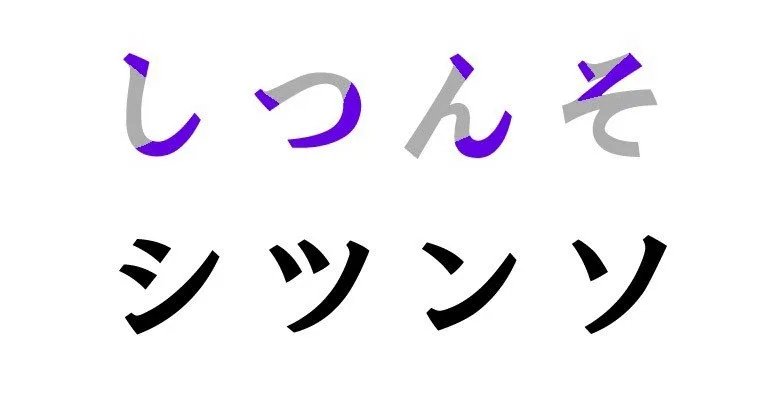
The five characters 「シ」, 「ン」, 「ツ」, and 「ソ」 are devilishly similar. At a glance they look like the same little smiley with different moods — until you try to read a menu, a game title, or a brand name and the wrong one flips the whole word.
The basic split is almost unfairly simple once you see it: シ and ン lean more horizontal, while ツ and ソ stand more vertical. The short marks and the long stroke share the same “family” of direction. There is also 「ノ」 (no), which is only one long stroke and still sneaks into the same confusion for beginners.
- シ — し — shi
- ツ — つ — tsu
- ソ — そ — so
- ン — ん — n
- ノ — の — no
The real mess starts when you try to separate シ from ツ and ソ from ン at speed. Stroke notes help, but most people stay lost until they lock one reliable method and then read a lot of real katakana in context.
Contents 6
シ vs ツ: horizontal family vs vertical family
Look first at the two short marks, not at the whole silhouette.
- シ (shi) — the small marks are more horizontal (sideways), stacked more like a short vertical column. The long stroke is flatter and often feels like it sweeps from lower left toward upper right.
- ツ (tsu) — the small marks are more vertical, side by side on top. The long stroke is steeper, more like a bar drawn from top toward bottom.
A second anchor many learners love: superimpose the matching hiragana. The “eyes” of シ follow the curve path of し; the “eyes” of ツ sit more like the top of つ. If you already know hiragana, that path is often faster than arguing about angles.
Quick read test: if the short marks feel sideways, think シ. If they feel upright and packed on top, think ツ.
ソ vs ン: the same trick, one mark instead of two
ソ and ン reuse the same horizontal-vs-vertical idea with a single short mark.
- ン (n) — short mark more horizontal; long stroke flatter, in the same family as シ.
- ソ (so) — short mark more vertical; long stroke steeper, in the same family as ツ.
Two practical reading habits help in the wild:
- Word position. Standard Japanese words do not start with ン. If one of these shapes opens a katakana word, it is almost always ソ.
- Word ending. Many loanwords end with ン. That is not a law of physics, but when you are still slow, it is a useful bias until vocabulary catches up.
Handwriting and fancy fonts will blur the angles. That is normal. Printed Gothic-style type is the cleanest place to train the difference before you fight artistic logos.
Don’t forget ノ
「ノ」 is only one diagonal stroke, yet it gets mixed into this pack because the long lines of ソ and ン can look similar when the short mark is tiny or poorly printed. ノ has no short “eye” at all — just the single slash-like stroke — and it is the katakana partner of の.
When you hesitate between ソ and ノ, ask: is there a second short mark? If not, and the shape is a single clean stroke, you are usually looking at ノ.
Face mnemonics that stick
If stroke geometry feels cold, use faces. Keep them silly; silly is memorable.
- シ — shi is a girl tilting her head, looking into tsu’s eyes
- ツ — tsu is a boy looking down
- ソ — winking “so”
- ン — thinking “NNNN… I don’t think that way”
- ノ — eyes closed “noooooooooooooo!”
These are memory toys, not calligraphy lessons. Pair them with the horizontal/vertical family so you can still read when the “face” disappears in a condensed font.
Tips that actually speed you up
- シ / ツ — train the short marks first (horizontal stack vs vertical pair). Only then check the long stroke.
- ン / ソ — same family rule as above; add the “ン rarely starts a word” check when reading loanwords.
- ラ (ra) and ル (ru) — ラ looks closer to a stiff “L” shape; ル has a more hooked bottom, a bit like a “J” curve. Both start with “r,” so the letter story is only a shape cue, not a spelling rule.
- ウ (u) and ワ (wa) — ウ keeps a clearer top bar; ワ’s upper stroke is more diagonal and open.
- マ (ma) and ム (mu) — マ usually shows three clear strokes with a middle diagonal; ム is simpler, two-stroke, with a curved base.
None of these pairs is as infamous as シツソン, but they show the same skill: compare direction and stroke count before you guess the sound.
How to stop guessing forever
Stroke tips get you unstuck for one second. Vocabulary and exposure keep you unstuck for life. The more katakana words you already know, the less your brain debates geometry — it simply refuses readings that cannot be a real word.
Practical loop:
- Write シ ツ ソ ン slowly ten times each, saying the sound out loud.
- Read a short loanword list (ブランド names, game titles, menu items) and force yourself to decide before looking up the answer.
- When you miss one, redraw the pair side by side and mark which family is horizontal.
If you are still building the whole syllabary, park this page next to a broader kana guide for hiragana and katakana and drill the confusing set as a daily five-minute micro-habit. Patience is not optional here — these five shapes are designed to annoy you until your eyes learn their angle.




Community
Comments
0 comments
There are no published comments in this language yet.
Send comment