
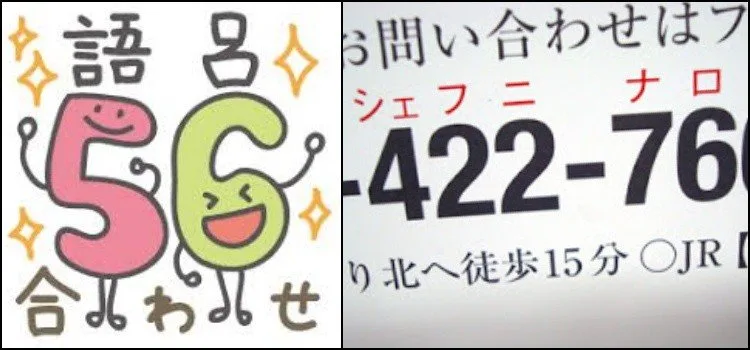
The Japanese count differently from other languages. Thanks to the Japanese ideograms, some numbers have variations in pronunciation. This can confuse some people and give rise to puns that we will address in this article.
They often use words to represent numbers or numbers to represent words. These puns are frequently used in advertisements as a way to help people remember phone numbers. These numerical puns are called Goroawase (語呂合わせ).
First, we recommend that you at least understand how counting and numbers work in Japanese. For that, we will leave some articles for you to read below:
The Japanese language has few phonemes; moreover, due to the ideograms, some words consist of only one or two phonemes. A simple phoneme can mean various things, which is why some Japanese people use the pronunciation of numbers to convey some meaning. Here is an example of the pronunciation possibilities with Japanese numbers:
| N | KANJI | 読み | ENGLISH |
| 0 | 零 | ma(ru), o, re(i) | o, zero, ze |
| 1 | 一 | hi(to), i(chi), wan | wan |
| 2 | 二 | fu, bu, pu, ni, tsu(u) | tsu, tu |
| 3 | 三 | mi, sa(n), za, su(ri) | su, suri |
| 4 | 四 | shi, yo(n) | foo, faa, ho |
| 5 | 五 | go, ko, itsu | faibu, faivu |
| 6 | 六 | mu, ro(ku) | shikkusu |
| 7 | 七 | na(na), shichi | sebun, sevun |
| 8 | 八 | ha(chi), ba, pa, ya, e(ito) | euto |
| 9 | 九 | ku, kyu(u) | nain |
| 10 | 十 | to(o), juu | ten |
This is one of the reasons why Japanese people fear the numbers 4 (shi – 四), which sounds like death (shi – 死), and the number 9 (ku – 九), which sounds like black (kuro – 黒). Another example is the number 43 (shisan), where the pronunciation is similar to the birth of the dead shizan (死産).
In the case of puns, they often read the numbers separately, as in four and three (shi san) and not forty-three (yon juu san). Japanese people can also use the reading of numbers from a foreign language, such as English, to make these puns. Not to mention that kanji often have similar readings that are alternated by the dakuten.
With these puns, Japanese people use numbers to write secret words and expressions. By using the pronunciation of Japanese numbers, which are simple syllables, we can easily form words and phrases using numbers. If someone sends you messages written in numbers, you might be able to decipher them!
Notice that even the name Goro can have a number pun (56).
Table of Contents
Goroawase – Numerical puns from Japan
1492 – This was the year that America was discovered; thinking of this, the expression Iyo! Kuni Ga Mieta (いよ国が見えた) was created. This expression literally means: Wow! I can see the land! (or a country) or Land in sight! This happens because each phoneme can represent a number from 1492: i (1) yo (4) ku (9) ni (2).
23564 – The sidereal or stellar day is exactly 23 hours, 56 minutes, and 4 seconds, indicating the Earth’s rotation period relative to the stars. In Japanese, this number can be read as ni-san-go-ro-shi, which sounds very similar to nii-san-koroshi (兄さん殺し), which translates to “killing brother.”
3.14159265 – This is the famous PI number that can be pronounced as san-i-shi-i-ko-ku-ni-mu-ko, which sounds similar to (産医師異国に向こう), meaning “An obstetrician goes to a foreign country.” For those who don’t know, an obstetrician is a doctor who cares for women’s reproduction.
4649 – This number can be read as yo-ro-shi-ku, which literally means “Nice to meet you or I count on your help.”
573 – This number sounds quite like konami. 573 appears in many phone numbers from Konami or on arcade signs.
23 – Can be read as “ni san,” referencing Nissan, which often numbers its cars with “23” in motorsport events.
59 – This number can indicate “ten go ku” (天国), which means paradise. This happens because ten is 10 in English, and the 50 is in the tens place, continuing thus with go (5) and ku (9).
- 801 “ya o i” – yaoi, which means Gay;
- 39 – “san-kyu” – (thank you);
- 893 – “ya-ku-za” (やくざ) Japanese mafia;
- 39 – “mi-ku” – Hatsune Miku;
- 15 – “ichi-go” – strawberry;
- 90 – “ku-ma” – bear;
- 96 – “kuro” – black;
- 18782 – “i-ya-na-ya-tsu” (いやなやつ) unpleasant;
- 37564 – “mi-na-go-ro-shi” (みなごろし) massacre;
- 889 – ha-ya-ku – fast;
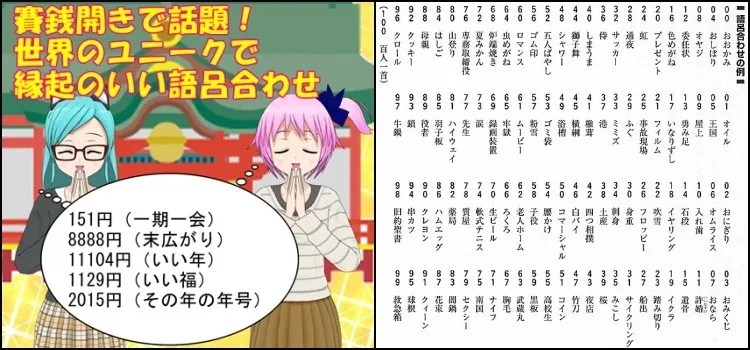
Numerical puns in anime
To understand that making puns with numbers is quite common in Japan. We have separated some examples from anime and other media that used puns involving numbers to remember something.
The first example is in the recent anime Darling in the Franxx, where the characters have numbers instead of names. If you pay attention, the names that the characters gave each other are related to each one’s number. For example, 015 is called Ichigo. The other characters are: Naomi (703) | Zorome (666) | Hiro (016) | Mitsuri (326);
In the movie “The Girl Who Leapt Through Time” (toki wo kakeru shoujo), it is mentioned that the weather will be nice on July 13 (7-1-3), which is the same as na-i-su (Nice) in English.
- The protagonist of Ah! My Goddess signs his name as K1 (keiichi);
- Kogoro from Detective Conan likes to use his name written in numbers 556 (kogoro) as a password;
- In Inazuma Eleven, Tsunami’s surfboard has 273 written on it;

Puns in Japanese dates
Japanese people also tend to put puns in special dates. Of course, these dates are not real, but it’s quite a funny idea. Let’s list them below.
- 1月3日 ひとみの日 Hitomi no hi – Hitomi Day
- 1月5日 いちごの日 Ichigo no Hi – Strawberry Day
- 2月9日 ふくの日 Fuku no hi – Clothing Day
- 2月10日 ニットの日 NEET no hi – NEET Day
- 2月22日 ニャンニャンニャンの日 Nyan nyan nyan no hi – Cat Day
- 3月9日 サンキュウの日 Sankyu no hi – Thank You Day
- 3月13日 サンドイッチの日 Sandoiicchi no hi – Sandwich Day
- 4月15日 良い子の日 Yoi ko no hi – Good Child Day
- 8月7日 花の日 Hana no hi – Flower Day
- 8月7日 バナナの日 Banana no hi – Banana Day
- 8月29日 焼き肉の日 Yakiniku no hi – Japanese Barbecue Day
There is even a website where you can create your own Goroawase. I hope you enjoyed the article! Don’t forget to share it with your friends and leave your comments. Were you able to understand all the puns?
Leave a Reply