
Have you ever wondered how elections and political campaigns work in Japan? What are the differences between political campaigns and elections in Brazil and Japan? In this article, we will examine in depth and understand a bit of Japan's politics and its differences with Brazil.
Japan is a constitutional monarchy with an Emperor who serves as a symbol, a head of government (Prime Minister), and other state ministers.
Currently, voting in elections in Japan is optional (not mandatory) and is limited to Japanese citizens. Unfortunately, in Brazil, voting is mandatory, in addition to the rush and expenses with voter registration and electoral court, something that does not exist in Japan. Now that you are aware of this, let's talk a little about the political situation in each country.
We recommend reading: Japan's Politics - How does the government work?
Contents 5
How do elections work in Japan?
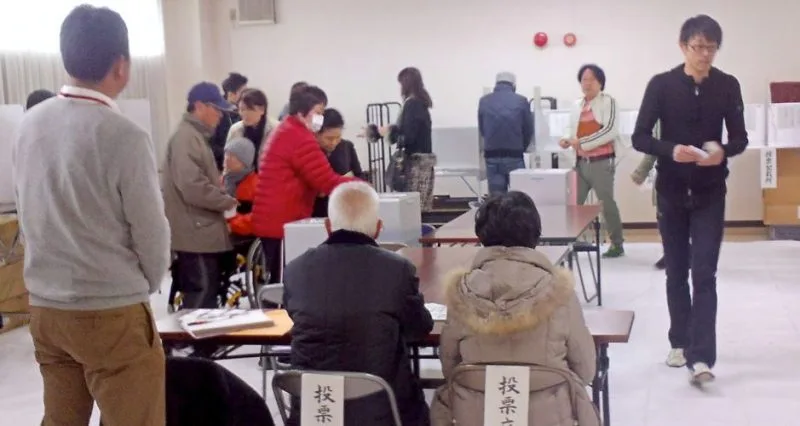
Just like in Brazil, there are regional and national elections. Regional or provincial elections in Japan are called Chihou Senkyo [地方選挙] while national elections are called Kokusei Senkyo [国政選挙]. Elections usually take place on Sundays from 7:00 AM to 8:00 PM.
In Japan, electronic voting machines are not used; they prefer to use the traditional voting system to avoid fraud. There are no numbers; voters must write the candidate's name legibly and place it in the ballot box. Although counting machines exist, votes are often counted manually in some provinces, with results available on the same day.
As there is no voter registration card, Japanese citizens receive a letter with a proof of eligibility but can also use their documents if they want to vote but do not have proof. Senkyoken [選挙権] refers to the right to vote.
Corruption in Japan is very low; the country ranks 20th in the list of least corrupt countries in the world, while Brazil ranks 96th. During election campaigns in Japan, candidates usually wear a white sash with their name and a glove with the party's name. The glove is white to represent purity, without corruption.
The problem of Japanese elections and political campaigns
Apparently, the Japanese do not have many problems in their political circle. There are no free election times or annoying leaflet distributions like in Brazil. Until a few years ago, the presence of politics on the Internet was very low, as voting is not mandatory and few people waste time trying to persuade others.
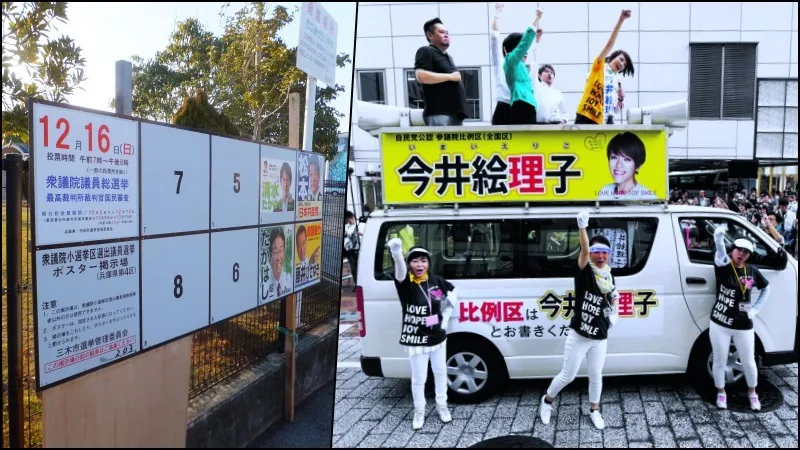
One of the things that can be annoying in Japan is the parades in trucks that candidates hold in the city streets speaking through a megaphone. These trucks usually stop in strategic places with high traffic. Additionally, politicians can hold rallies, advertisements in newspapers, or do word-of-mouth promotion.
Although Japan is a country with a lot of visual pollution, it is not very common to find political posters, but they do exist in some strategic locations. Candidates cannot visit people and ask for votes.
Another negative (or not) aspect is that candidates must pay a glove (advance payment) to the electoral authorities to participate in the election. If they receive more than 10% of the total votes, they get the money back; otherwise, they lose all the money.
For municipal positions, the payment can reach up to 600,000 yen, while in parliament, the amounts can reach 3,000,000 yen and even 6,000,000 yen. This strategy is used to avoid a huge number of candidates and those famous fringe parties that exist in Brazil.
Political parties in Japan
Japan has several parties, the main ones being the Liberal Democratic Party (LDP), which is currently in power, and the Democratic Party of Japan (DPJ), which was in power in the 1990s. Below, we will list all Japanese parties in order of popularity:
- Liberal Democratic Party (LDP);
- Democratic Party of Japan (DPJ);
- Constitutional Democratic Party (CDP);
- Party of Hope;
- New Komeito (NK);
- Communist Party (CPJ);
- Nippon Ishin no Kai;
- Social Democratic Party (SDP);
- Party for the Realization of Happiness;
- Party of Smiles;
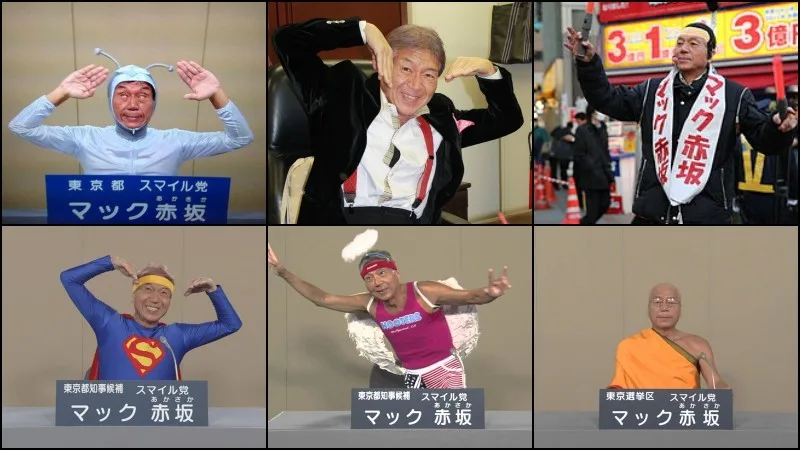
There must be other parties; the last one on the list, called the Party of Smiles, is composed of just one member and founder named Mac Akasaka, who often appears with an extravagant appearance. He has appeared in just underwear or wearing strange clothes like superhero cosplay.
That's right, Japan also has a communist party that manages to maintain an average of votes above 5%. One of its main objectives is to end the mutual military cooperation treaty between Japan and the United States. News circulated on the internet years ago saying that the CPJ is growing; I think that is a huge exaggeration.
The problem of Brazilian elections and political campaigns
One of the most absurd things I know is Brazilian politics and elections. For personal reasons, I neither want nor can get involved in politics, so I will try to be 100% neutral, although I confess that my thoughts lean a bit to the right. Currently, I am astonished by issues on social media and TV involving politics.
Apparently, all Brazilian political campaigns, both on television and on the Internet, have been made to denigrate and attack another candidate. People choose their sides based on false, generalized information or simply to defend some ideal or principle, ignoring all other problems in the nation.
Some people write giant texts on social media trying to show that they understand politics, but in reality, they write the entire text just to criticize one candidate. The internet currently boils down to the left destroyed the country and a candidate being called a racist, who will turn Brazil into a military dictatorship. Politics and Lies today are practically the same word.
First of all, thieves are not limited to just one party or side! It doesn't matter if it's left or right; Brazil will continue to sink if there are no drastic changes in laws and justice as was done in Singapore and Japan at some point in their history. But who am I to give an opinion? Many seem to be happy with the little that has been done in these decades...
No matter the circumstances, Brazilians still insist on defending criminals or using the mistakes of others to diminish those of their candidate.
In any case, this is just the basics; we haven't even talked about the papers and pamphlets that dirty the streets during election times and on election day. Not to mention the advertisements and election time on television. I don't even need to go into detail about the politics of our country; everyone is already aware.
What have we learned from the elections in Japan and Brazil?
The political system in Japan is not so different from Brazil or the world. Fortunately, Japan does not force people to vote, nor does it tolerate chaos or corruption in its country. If an act of corruption occurs and is discovered, the person must apologize publicly and may be arrested and lose their position.
We recommend reading: The habit of apologizing in Japanese society
Unfortunately, in Brazil, politicians steal right in front of us and even advertise it. I laugh out loud when I see an advertisement on television of a politician talking about the thefts of others, or people on social media trying to defend their candidate from corruption through insults or accusations against the opposing side.
Did you know these details about the electoral campaigns and Japanese politics?


Community
Comments
0 comments
There are no published comments in this language yet.
Send comment