
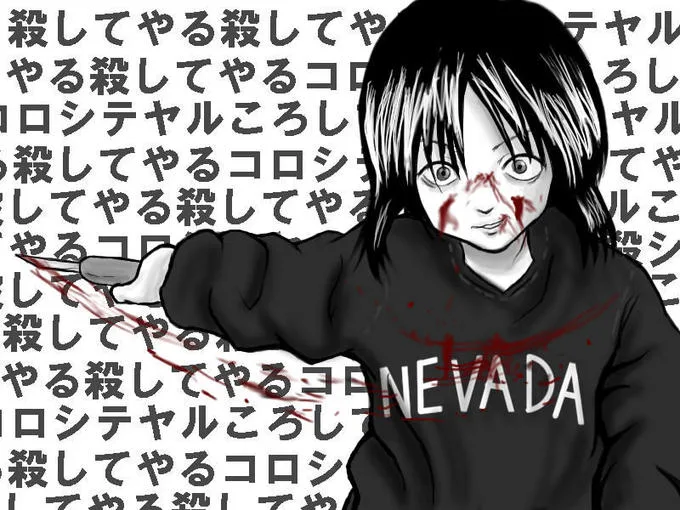
In June 2004, in the Japanese city of Sasebo, an eleven-year-old schoolgirl killed her twelve-year-old classmate. That crime produced one of the most widely known and most disturbing internet phenomena in Japan: the "Nevada-tan" meme. This article explains what happened, how the meme emerged, and why turning a murder case into pop culture is a problem.
One editorial decision first: the perpetrator is not named here, and the victim appears without a name either. Both were children. Japanese media follow legal rules on juvenile offenders, and there is no reason to carry the names forward in an article about a meme.
Contents 7
What happened on June 1, 2004
On June 1, 2004, during a break at an elementary school in Sasebo, Nagasaki Prefecture, an eleven-year-old pupil led her twelve-year-old classmate into an empty classroom and killed her with a box cutter. The two had been friends before. The perpetrator was arrested the same day and confessed.
A detailed account of the injuries and of the clothing does not belong in a text like this. Anyone who wants the full record can read the reference works and the reporting of the time. For this article it is enough to say that one child killed another, in the middle of an ordinary school day, and that Japan was in shock afterwards.
Why no names
Japanese legal procedure prohibits identifying juvenile offenders. The police referred to the eleven-year-old as "Girl A", and the authorities explicitly warned at the time against spreading her photographs online. The first wave of coverage respected that; later, names and images surfaced in forums anyway.
For a text written today the position is clear: the people involved were children, the victim is dead and cannot defend herself, and the perpetrator served her sentence as a juvenile. Anyone telling this story should stay with the facts and not with the real names.
How "Nevada-tan" emerged
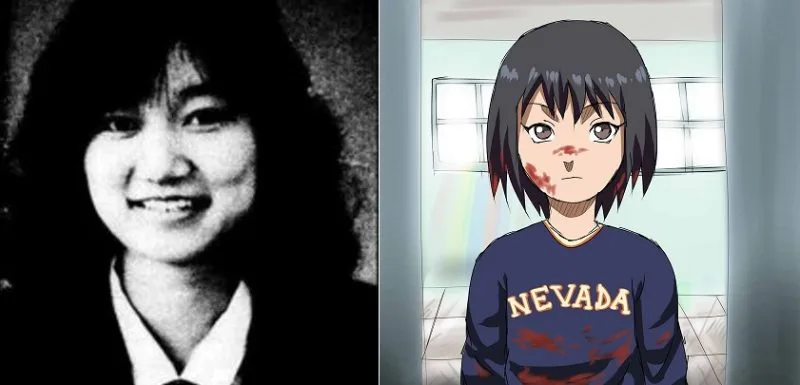
A few weeks after the killing, users of the Japanese imageboard 2channel began giving the perpetrator images and nicknames. The name "Nevada-tan" is said to come from a class photograph in which a girl believed to be the perpetrator wore a University of Nevada sweatshirt. The "-tan" is a childlike pronunciation of the Japanese honorific "-chan", used for young girls.
Photos became drawings, drawings became a character, and the character detached from the person. That is exactly how a meme works: an image is repeated until it becomes a sign. The price was that a murdered child and her likewise underage killer became templates for illustrations.
From a forum to the world
The phenomenon did not stay on Japanese forums. Images and labels travelled to international imageboards and spread there, often without the people sharing them knowing the background. In 2007 a German rock band renamed itself "Nevada Tan"; the name was later changed again. In 2019 an audio play explored the case and placed it in a story about loneliness and fascination.
Anyone searching for "Nevada-tan" today finds mostly fan art, summaries and articles about the meme. The actual biography stays behind: a child who died, a family that grieved, and a perpetrator who was also a child.
What happened after the killing
Because the perpetrator was eleven, she was below the age of criminal responsibility under the law of the time. In September 2004 a family court in Nagasaki decided to commit her to a juvenile institution in Tochigi Prefecture because of the severity of the act. The commitment was extended; there is no reliable public information about what came later.
The case triggered a debate about lowering the age of criminal responsibility again. It had been lowered from 16 to 14 in 2000, and a child killing a child fed demands for further change. At the same time it showed how hard society finds it to deal with an offender who is herself a child. Punishing a child excessively would not be a solution either.
Why the meme is a problem
The meme turns a murder into an image. It converts grief into a sign that can be shared, commented on and remixed. For the victim's family that is a second injury: the death becomes a design, the person a template. For the perpetrator it means that her name and pictures keep circulating even though the justice system did not want that.
There is also the pattern that makes such cases so attractive: an inexplicable break in an apparently normal environment, a child as perpetrator, a motive nobody can fully explain. Those gaps are exactly what images and stories grow in. The forums fill them, and the more they fill them, the more the person behind disappears.
Anyone who wants to learn from the case can think about juvenile crime, prevention, media ethics and the balance between punishment and education. The meme offers no insight; it offers an aesthetic. Telling the two apart is the point.
Conclusion
"Nevada-tan" is a meme about a real murder of a child. Its origin can be explained, and this article does that. It should not be celebrated, shared lightly or treated as pop culture that costs nothing. The two girls at the centre of it deserve more than an image that can be forwarded.
For more on the debate about punishment in Japan, see the article on the death penalty in Japan. It does not apply in this case because the perpetrator was a child, and that difference is exactly what needs explaining.



Community
Comments
0 comments
There are no published comments in this language yet.
Send comment