
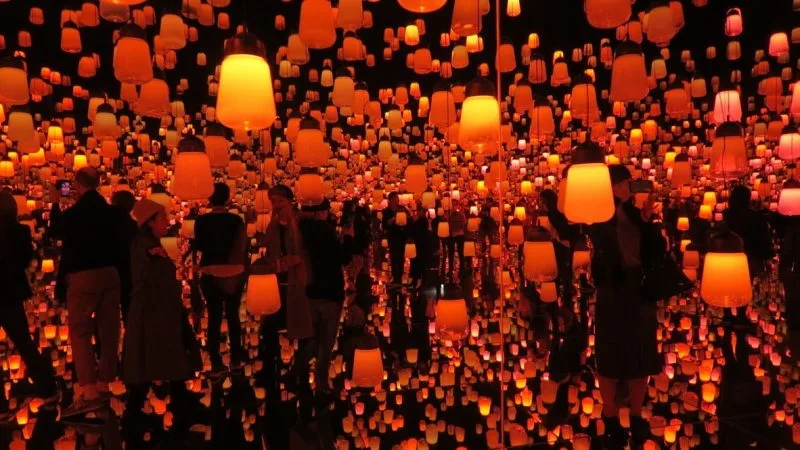
One of the best places I visited in Tokyo in 2018 was the Mori Building Digital Art Museum: teamLab Borderless, when the museum was still in Odaiba. Mirrors, LEDs, spotlights and cameras made the light show, and music ran under the whole walk. The works changed in real time. The site listed more than 50 of them, and some reacted to the people in the room, so I needed a long stay, or a second visit, before I felt I had seen it. It suited a date, a visit with children, and anyone who usually avoids museums. I would still recommend the museum at its new address in Azabudai Hills, because the Odaiba building has closed.

Contents 3
What the Odaiba rooms were like
The website at the time divided the museum into five areas:
- Borderless World
- Forest of Lamps
- EN Tea House
- Athletics Forest
- Future Park
Borderless World was the part that took the afternoon. You walked into mirrors and moving color, with images crossing the floor and the walls, and framed works turning up along the way. A little farther on, the floor rose and a waterfall came down through the middle. The walls were covered in flowers, and if you touched them, they broke apart. Past that was a room of waves, with cushions if you wanted to lie down and watch.

Still on the first floor, a room of LED strips ran animations to music, and that room was my favorite. Nearby, the infinity room used mirrors, moving art and a spotlight show, and the mirrors made the space feel endless. No matter which way you walked, there was something else in front of you.
The stairs to the second floor led into a forest of traditional Japanese lamps that changed color. Another path on that floor reached Athletics Forest and Future Park, where the art asked you to move: giant balls, a slide, a play area for children, and two climbing spots. You could color a drawing and watch it become something digital. EN Tea House was up there too. You sat down for tea, and the table itself was part of the artwork. The exit in Odaiba was on the second floor, so I left Athletics Forest for last. That route belongs to the old building.

teamLab Borderless and the Mori Building name
teamLab started in 2001 as a group of artists, animators, programmers, musicians, engineers, architects and mathematicians, exploring the relationship between people, nature, technology and art. Borderless means without borders: the works move out of one room, meet other works, and keep changing.
The permanent museum came from a partnership with Mori Building, the developer behind ARK Hills, Roppongi Hills and Toranomon Hills. The official English name is teamLab Borderless: MORI Building DIGITAL ART MUSEUM. Tokyo also has the Mori Art Museum, in Roppongi Hills Mori Tower. That is a different museum. If a map pin says only "Mori", check which building you have opened.
In Odaiba, Borderless occupied Palette Town from June 21, 2018 until August 31, 2022, and it closed on the same day as the giant Ferris wheel. VenusFort, the shopping complex next door, had already closed on March 27, 2022. The car showcase I walked through, Mega Web, closed at the end of 2021. On February 9, 2024 the museum reopened inside Azabudai Hills, another Mori Building complex, as a permanent installation. It is still a museum without a map. Borderless World, Future Park, EN Tea House and the drawing activity, listed as Sketch Factory, remain on the official Azabudai page, along with works made for the new building, including Bubble Universe. The second-floor exit and the lamp forest I walked through were part of the Odaiba route.

teamLab Planets, in Toyosu, is a separate museum, and the visit there means walking through water. In Ginza, Universe of Water Particles on the Living Wall has been a permanent work at Ginza Six since April 20, 2017. teamLab: Massless, at Amos Rex in Helsinki, ran from August 30, 2018 to January 6, 2019, and then ended. Future World, at the ArtScience Museum in Singapore, is its own teamLab exhibition, separate from the Tokyo museum.
How to reach teamLab Borderless now
In 2018 the door was inside Palette Town, after the car showcase. Google Maps did not help that day. You looked for the Ferris wheel, walked through the area full of cars, and the entrance was on the far side. Palette Town has closed, so that walk no longer ends at the museum.
The museum is now at Azabudai Hills Garden Plaza B, basement level B1. The English address on the official page is 5-9 Toranomon, Minato-ku, and the Japanese address printed there is 東京都港区麻布台1-2-4. From Kamiyacho Station on the Tokyo Metro Hibiya Line, Exit 5 is about a two-minute walk. From Roppongi-itchome Station on the Namboku Line, Exit 4 is about six minutes. Both stations connect underground, and the signs lead to the museum without a climb up to the street. The museum has no parking of its own. If you drive, the official page points you to Azabudai Hills P6, then the D elevator to B1, with the entrance on the left.
Buy a ticket for a specific day on the official ticket page before you go. Prices change with the date. The 2026 calendar prints adult reference prices, and the price you pay can differ from that reference. The reference range starts at 3,600 yen, and October 2026 is listed from 4,800 yen. When I went, adult entry was about 3,200 yen. I thought it was a lot of money, and I would rather have spent it in the museum than pay about 3,000 yen to go up the SkyTree and be back on the ground within an hour. Those two numbers are the prices I was comparing in 2018.

Usual hours are 8:30 to 21:00, and last entry is one hour before closing. Some days end at 17:00 and some stay open until 22:00. EN Tea House opens 30 minutes after the museum and takes a last order 30 minutes before closing. Closed days are posted on the official page. For the rest of 2026 the list includes October 20, November 24 and December 8. The museum does not close every Tuesday, so read the posted dates before you choose a day. If Odaiba is still on the trip for other reasons, the island has its own route now that Borderless has left: Odaiba.
The waterfall, the LED room, the lamps and the tea tables are what I paid for in 2018, and they were worth that ticket. If you go now, the ticket has to be for Azabudai Hills, on a day the official calendar shows the museum open.



Community
Comments
0 comments
There are no published comments in this language yet.
Send comment