
Round 6 or Squid Game is a Korean drama released on September 17, 2021, and it was a worldwide success, staying on the Netflix TOP 10 list for several weeks in a row. One thing that caught a lot of attention in the series was the children's games that the participants had to follow to ensure their lives and the cash prize.
Let's see what these games are and also give tips on how you can play too, of course without the violent part, right!
Contents 8
A brief summary of the story
I have already written a complete text about each episode of Round 6 and also about a possible continuation. But, it is important to contextualize... The drama revolves around Seong Gi-hun or player 456, who has a huge debt and ends up agreeing to participate in a kind of "scavenger hunt" to pay off what he owes.
All kinds of people who owe huge amounts are called to participate, but the problem is that the one who wins the competition is the one who will also come out alive, as it is inspired by children's games but uses brute force to ensure survival. The winner receives a huge cash prize of 45.6 billion wons (South Korean currency).
Ddakji
This is the first game that appears in the drama to determine who is classified to try to win the bigger prize. The game is played in pairs and is very common in kindergartens for teaching origami. The step-by-step for the technique is:
1. Cut two squares of colored paper;
2. In both squares of paper, you will follow the same folding process. Fold the squares of paper into three equal rectangular parts;
3. Fold the left corner up and the right corner down;
4. Place one piece on top of the other, as in the image;
5. Fold the left and right flaps inward and then fold the top flap down and under the right flap, then fold the bottom flap up and under the left flap.
Red Light, Green Light
In the Portuguese version, the game was translated as Batatinha Frita 1,2,3, but in reality, what the doll says has another meaning. The lyrics are 무궁화 꽃이 피었습니다 (mu-gung-hwa koti piot sup-ni-da) which means "the mugunghwa flower has bloomed." In Brazil, it generated many memes and even funk-style songs.
To play, one child must be 술래 (sulle), who is responsible for facing the wall with eyes closed and singing the phrase that, when finished, must turn around and open their eyes while the other children must freeze like statues. If the sulle sees that any of the children moved, they must hold hands with them until the end of the round.
With each round, the level of the game becomes more difficult because the sulle starts to sing the phrase at a faster pace. When any child gets close to the sulle, everyone needs to run away, as it is the sulle's turn to run and catch another child, who will become the next sulle in the game.
There is also a "safety zone," where children can try to run to avoid being caught by the sulle. If no one is caught, the same child must be the sulle for one more round.
Ppogi or Sugar Honeycomb
This sweet became popular because it is made with sugar, an easily accessible ingredient in homes. It is generally not used for a game itself, but to sell and attract children's attention, designs are made on the sugary treat.
They are usually placed on sticks as if they were lollipops so that children can have fun trying to break out the design.
Juldarigi or Tug of War
The tug of war or 줄다리기 (juldarigi), as it is called in South Korea, was one of the most exciting games in Round 6! It showed that strength does not matter for this game, but the correct way to hold the rope.
In Korea, this game is even considered a ritual since 1969, where two huge ropes made of rice straw are connected to a stake in the center. Before and after this competition, rituals are performed. There is also a version where two teams split and pull each side of a rope until all opponents on the opposite side are pulled.
Guseulchigi or Marbles
Who doesn't know the traditional marbles, right?! They were part of the childhood of many children, especially those born before the 90s. In South Korea, it is called 구슬치기 (guseulchigi).
There are several ways to play with marbles, but the objective should be the same: to collect the most marbles, that is, to make the opponent lose their marbles. However, the most common way is to draw a triangle on the ground, place the marbles inside, and each player receives a marble to try to throw and knock the others out of the triangle; whoever knocks out the most marbles wins the game.
Glass Bridge
This game is the only one that does not have an inspiration in a children's game. In Round 6, the participants must cross a glass bridge that contains its tempered version; if a person steps on it, they fall from a great height and die.
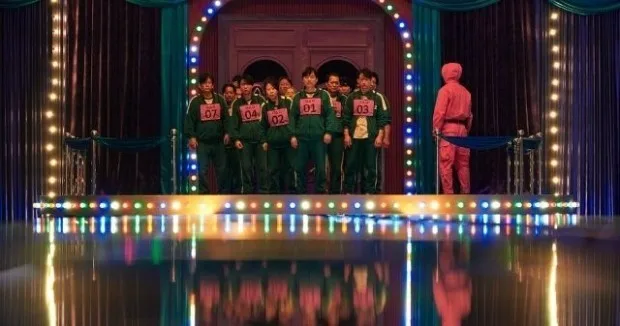
Squid Game
This is the game that gives the original name to the drama, Squid Game. The more popular name is 오징어놀이 (Ojingeo Nori) and literally means "Squid Game." The children are usually divided into two groups of four or more. A geometric shape that resembles a squid is drawn on the ground, and the game has the objective of defense and attack, while they run (and hop on one foot in the case of the attacking players) around the shape drawn on the ground.
Which of these games do you think you would do well in if you were in the money competition?






Community
Comments
0 comments
There are no published comments in this language yet.
Send comment