
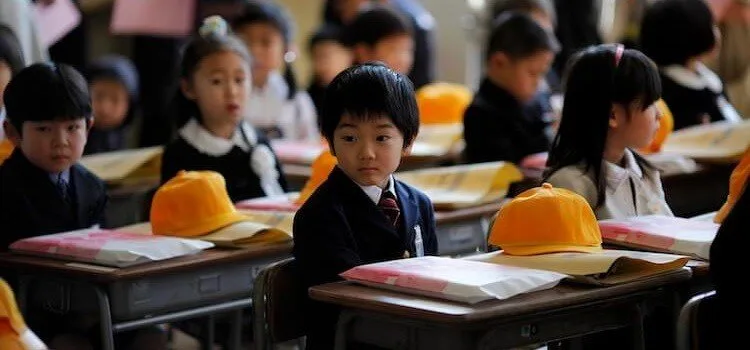
Walk into a Japanese classroom and the first words you need are not abstract grammar—they are the things on every desk: pencil, eraser, notebook, board. If you are studying nihongo or heading into a real school setting, these classroom objects become daily vocabulary almost immediately.
Below is a practical beginner map of school supplies and room items in Japanese, with kana, romaji, and English. Many loanwords sound familiar, but kanji still decide the exact meaning—and a few names hide small stories worth remembering.
Contents 5
Writing utensils and surfaces in Japanese
Tip: On mobile, swipe the table sideways to see every column.
| Kana / kanji | Romaji | English |
| えんぴつ / 鉛筆 | enpitsu | pencil |
| シャーペン | shaapen | mechanical pencil |
| 消しゴム | keshigomu | eraser |
| ペン | pen | pen |
| ボールペン | boorupen | ballpoint pen |
| マジック | majikku | marker (from “magic marker”) |
| チョーク | chooku | chalk |
| こくばん / 黒板 | kokuban | blackboard |
| ホワイトボード | howaitoboodo | whiteboard |
| ふで / 筆 | fude | writing brush |
| 筆箱 | fudebako | pencil case |
| かみ / 紙 | kami | paper |
| げんこうようし / 原稿用紙 | genkou youshi | Japanese composition paper (grid of boxes) |
| ぶんぼうぐ / ぶんぐ | bunbougu / bungu | stationery / writing supplies |
On 消しゴム (keshigomu): keshi comes from the verb “to erase,” while gomu is “rubber,” borrowed via the French word for rubber. It is the everyday eraser you keep next to your enpitsu.
Majikku usually means a felt-tip marker, not a highlighter. For mechanical pencils, Japanese often shortens “sharp pencil” to shaapen (シャーペン)—a classic example of Japanese-made English you will hear in class and stationery shops.
Arts, crafts, and tools in the classroom
Tip: On mobile, swipe the table sideways to see every column.
| Kana / kanji | Romaji | English |
| 色紙 | irogami | colored paper |
| 折り紙 | origami | origami paper |
| はさみ | hasami | scissors |
| のり / 糊 | nori | glue, paste |
| 定規 | jougi | ruler |
| ホッチキス | hotchikisu | stapler |
| ステープル | suteepuru | staple |
| クリップ | kurippu | paper clip |
| バインダー | baindaa | binder |
The stapler word hotchikisu comes from the brand name Hotchkiss—another reminder that Japanese classroom vocabulary mixes native words, kanji compounds, and borrowed labels that stuck for decades.
Books and paper materials
Tip: On mobile, swipe the table sideways to see every column.
| Kana / kanji | Romaji | English |
| 本 | hon | book |
| 絵本 | ehon | picture book |
| 教科書 | kyoukasho | textbook |
| ノート | nooto | notebook |
| じしょ / じてん | jisho / jiten | dictionary |
- jisho is the everyday word for “dictionary.” jiten often appears when you name a specific type—for example, a Japanese–English dictionary (和英辞典) or an English–Japanese dictionary (英和辞典).
Electronics in the classroom
Tip: On mobile, swipe the table sideways to see every column.
| Kana / kanji | Romaji | English |
| 電気 | denki | light; electricity |
| 電話 | denwa | telephone |
| テレビ | terebi | TV |
| CDプレイヤー | shiidii pureiyaa | CD player |
| DVDプレイヤー | diibuidii pureiyaa | DVD player |
| リモコン | rimokon | remote control |
| パソコン | pasokon | personal computer (abbr.) |
| プロジェクター | purojekutaa | projector |
| でんしじしょ | denshi jisho | electronic dictionary |
Even when classes lean digital, older classroom electronics remain useful labels: many learners still meet pasokon, rimokon, and denshi jisho in textbooks and school life.
Around the classroom
Tip: On mobile, swipe the table sideways to see every column.
| Kana / kanji | Romaji | English |
| 部屋 | heya | room |
| 教室 | kyoushitsu | classroom |
| 床 | yuka | floor |
| 壁 | kabe | wall |
| 天井 | tenjou | ceiling |
| ドア | doa | door |
| 窓 | mado | window |
| 時計 | tokei | clock; watch |
| 机 | tsukue | desk |
| 椅子 | isu | chair |
Notice how 教 links classroom and textbook: kyoushitsu (教室) and kyoukasho (教科書) share the same “teach” kanji. Once you spot that pattern, school vocabulary starts to feel less random.
When you can name the objects, the next step is using them in real lines—borrow a pencil, open the textbook, write on the board. Those classroom phrases live in our guide to classroom expressions in Japanese.




Community
Comments
0 comments
There are no published comments in this language yet.
Send comment