
Hi everyone, how are you? Do you know what a Funko is? Today we will talk about these action figures that are adorable and their role in pop culture. We can see many of these little dolls out there, all with different styles. But there is a company called Funko that stands out in the market because of its licensed toys and its many other items based on pop culture, including anime, manga and games.
In this technological age, almost nothing stays isolated in just one place; things spread around the world and often become so widespread and popular that they are hard to forget. Fads, songs, movies, action figures, electronic items and everything else that can be made in one part of the planet has the potential to spread all over it, like a fire that spreads wherever it can burn.
Contents 13
Funko is a global culture
For those who don't know, I will try to explain what pop culture is. I don't know if it will be the best explanation, but it will serve for this article. Basically, pop culture, or popular culture, is the set of practices, beliefs and objects that are dominant in a society at a given time. It is strongly influenced by mass media and shapes daily life in societies.
For example, our beloved action figures are popular both in Brazil and in Japan. They are everywhere in the world, and most people know what they are or have seen one. Pop culture is that: a custom that is dominant in a society. In the case of action figures, they are a global pop culture, if that is the correct term.
Getting to know the Funko company
Funko is an American company that produces licensed pop culture collectibles. It is renowned for manufacturing licensed vinyl figures and bobbleheads, as well as plush toys and other licensed products.
Founded in 1998 by Mike Becker, the company started as a small project to create low-tech toys with nostalgic themes. In 2005, Becker sold Funko to Brian Mariotti, who expanded the catalog and signed licensing deals with companies such as Netflix, Ubisoft, Paramount Pictures, Cartoon Network and the Pokémon Company.
The turning point came in 2010, when Funko showed a prototype line at San Diego Comic-Con. The line that became Pop! was fully revealed at the New York Toy Fair in 2011, and Funko went public on NASDAQ in 2017.
Its pop culture brand has global reach, and its products are found all over the world. Below, I will list some genres of toys related to what the company produces.

Designer toys
Designer toys are innovative and collectible toys made by independent artists. Usually produced in limited editions, they are made from materials such as vinyl, metal, latex and resin. The first designer toys emerged in the 1990s.
This type of toy makes a significant contribution to pop culture. In the case of anime, these figures are even more successful, and some artists work without an official license while still shaping the industry.
Urban vinyl
Urban vinyl is a type of designer toy, particularly action figures, that are usually made of vinyl. Vinyl is a synthetic plastic made from polymer, better known as PVC, the same material used in household plumbing.
These toys feature original designs and small production runs, and they are marketed to collectors, who are usually adults.
Resin toys
Resin toys are another subcategory of designer toys. And as the name suggests, they are made of resin. The resin is poured as a liquid into a mold and left to harden; the pieces are then painted, and some receive a layer of varnish.
This process is more labor-intensive and time-consuming than with vinyl. Unlike vinyl toys, these are sculpted, molded and painted by a single artist. Vinyl toys, by contrast, are practical for industrial production.
Plush toys
Plush toys, another subcategory of designer toys, are soft, stuffed dolls created in limited quantities by artists and designers. Common designs include animals or human-like characters; the designers often create entirely unique characters. These toys usually receive names and personalities, which are described on their tags or in booklets included in the packaging.

Bobblehead
Also known as a nodder or wobbler, a bobblehead is a type of collectible doll. It is a different category from designer toys. Its head is often large compared to its body, and instead of a stable connection, the head is connected to the body only by a spring or hook, so that any shake will make the head wobble.
Most Funko Pop! figures are not bobbleheads: their heads are fixed. The Marvel and Star Wars lines are the best-known exceptions.
Despite being part of pop culture today, this type of doll is not entirely new. We will present a bit of the history of this specific type of figure. This history helps explain the format, and it may be interesting to learn more about it.
A bit of bobblehead history
Figures of Buddha and other religious figures were produced in 17th-century Asia. It is believed that the oldest reference to these dolls is in the 1842 tale by Nikolai Gogol, "The Overcoat." During the 19th century, bobbleheads made of bisque were produced in small quantities for the U.S. market.
During the 1920s and 1930s, many of these dolls sold in the U.S. were produced in Germany. By the 1950s, plastic and bisque versions had made them much more popular.
Increase in popularity
Around 1960, Major League Baseball produced a series of papier-mâché bobbleheads, one for each team, all with the same face. In the next decade, these were made of ceramic, and within a few years, other sports copied the theme. The Beatles bobblehead set from the same era became one of the most valuable collectibles of the period.
The next increase occurred in the late 1990s. Although they were sought after, these dolls had almost no innovation. Cheaper manufacturing processes finally changed that. Instead of ceramic, they began to be made of plastic, which made it possible to produce them in sufficient numbers to be collectible. In 1999, the San Francisco Giants gave away 35,000 Willie Mays bobbleheads at a game.
Funko Collectibles
Like other types of dolls and toys, bobbleheads have an impact on pop culture. These objects are targets of admiration and obsessive searches, especially the rarer ones. The difference here is their reach and level of influence, as millions of people collect these items.
Based on my research, I can say that collecting these little dolls, or the others already mentioned, is not cheap at all. As I once heard, the price of a figure is only part of the problem; the rest is the budget you can set aside for it. Sad, but it is the pure reality.
Rarity drives much of the hunt. Chase variants, rare versions of a figure with a different paint job or mold, were once inserted at a ratio of 1 in 36; today the ratio is closer to 1 in 6. Convention and retail exclusives add another layer. In Japan, shops such as Admski in Osaka sell used figures and give collectors a way to find older releases.
Funko product line
Funko has produced thousands of products across dozens of toy lines. The first line was Wacky Wobblers, a series of bobbleheads representing various characters, mainly from pop culture.
The catalog has changed a lot since then. Current lines include Pop!, Bitty Pop!, Mystery Minis, Vinyl Soda, Vinyl Gold, Popsies and Ad Icons, along with plush toys and the Loungefly bags and accessories sold under the same corporate umbrella. Older lines such as Hikari, Rock Candy, Spastik Plastik, Blox, FunkoVision, Funko Force and Wacky Wobblers have been discontinued.
In 2018, Funko also announced a cereal brand with mini Pop! figures inside the box, a collector novelty from that period.
Funko Pop!
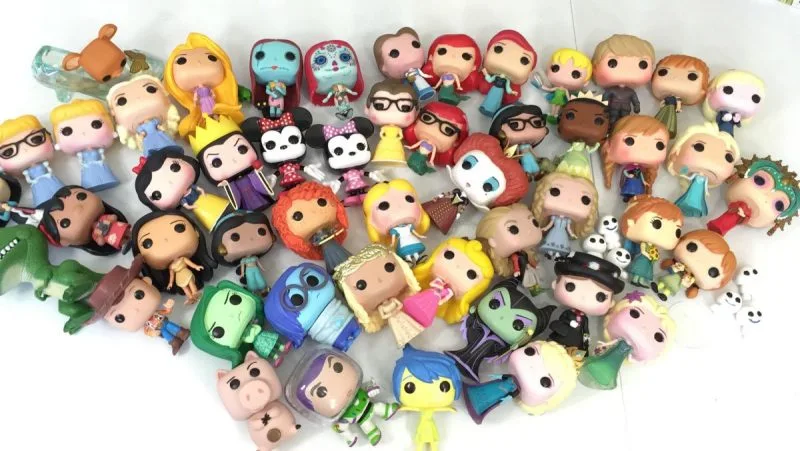
Funko Pop! is a line of vinyl figures modeled in the chibi style. Typically, this line represents licensed characters from franchises like Marvel, Disney, Star Wars, Harry Potter, DC Comics and a growing list of anime series, including Dragon Ball, Naruto and Demon Slayer.
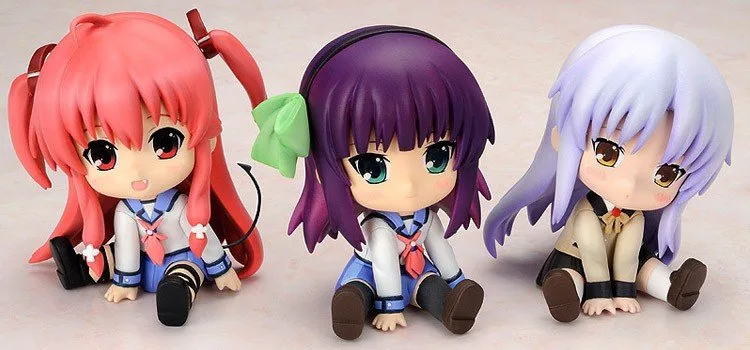
Several other products have been released using the Pop! brand and its style, such as plush toys, T-shirts, keychains (miniature versions of the original figures) and ceramic mugs. The proportions invite comparisons with Good Smile's Nendoroid figures, another chibi-style line with a dedicated collector base.
Within this theme, there is Funko Rides, which features the figure in a vehicle. Funko also produces Pop! Deluxe, where a character sits on an external piece such as a throne, a vehicle or a creature.
Funko also produces Pop! Movies and Pop! Moments, which feature figures interacting with each other in scenes that reproduce moments from movies, comic books or other genres. Pop! Albums and Pop! Comic Covers apply the same idea to album art and comic book covers.
Conclusion
I personally do not own any of these products, which is unfortunate. I still enjoy admiring them. They are lovely and pleasing to the eye; however, they come with prices that match their virtues.
Plush toys, vinyl, resin or bobbleheads are all collectible items, produced in limited numbers and priced accordingly. Licenses and manufacturing costs add to that. Despite these dolls being popular, the hobby of collecting these toys is not for everyone.
This article has come to an end. If you have any questions, suggestions, criticisms or anything of the sort, just comment. And just to satisfy my curiosity, if anyone has a collection of these products, comment below. Thank you, dear reader, for reading this far. And until next time.





Community
Comments
0 comments
There are no published comments in this language yet.
Send comment