
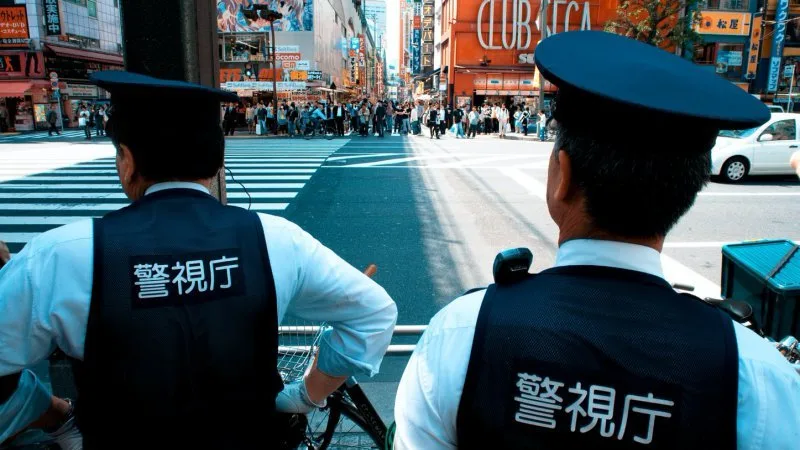
Whenever we talk about Japan, people think of a super safe country, which is true. Still, crimes happen like anywhere else. In this article, we will discuss crime and theft rates in Japan.
It is believed that 20% of Japanese people have been victims of some type of crime at least once in their lives. Whether it be a scam, price gouging, bicycle theft, pervert attacks, beatings, and others.
Fortunately, Japan continues to decrease its crime rate in 2019, marking the fifth consecutive year with the lowest crime rate since World War II. What is the secret to such an achievement?
– – – – –
Table of Contents
Homicide Rate in Japan
The homicide rate in Japan is 0.8 for every 100,000 people. That is, for every 117,000 people, one is murdered in Japan. In a year, about 1,200 people are killed in Japan, mostly by sharp weapons.
In Brazil, there are 30 deaths for every 100,000 inhabitants, totaling over 60,000 deaths per year, a large part due to firearms. The homicide rate in the United States is 4.8 per 100,000 inhabitants.
In Japan, firearms are rare and practically extinct, to the point that few police officers have ever used them, and some do not even carry them. It is believed that fewer than 5 people are killed by firearms throughout the country.

Other research claims that the homicide rate in Japan is 0.31, with only 395 intentional homicides recorded in 2012. Between 2000 and 2009, the rate was about 0.50, or about 600 homicides per year.
It is difficult to know which of these rankings and estimates are more accurate. Still, we can say that there are safer countries like Austria, Norway, Ireland, Singapore, Germany, and Hong Kong.
Remember that comparing statistics between countries is not always very accurate. Nations have different laws and methods for collecting crime statistics. Still, Japan is one of the safest countries in the world.

Crimes and Thefts in Japan
In Japan, there are no armed robberies, assaults, and things like that. Rarely do people steal secretly. So much so that many lose expensive belongings and manage to recover them thanks to Japanese honesty.
Of course, Japan is not immune to thieves; such occasions are rare due to strict laws and Japanese culture. Still, tricksters exist everywhere, inducing you to give money or secretly stealing a belonging.
The most common are white-collar crimes, such as computer and credit card fraud. Others cause thefts through counterfeit money and insurance fraud.

There is also evidence of foreign criminals traveling from abroad to take advantage of Japan’s lax security and the unpreparedness of the Japanese. Even international gangs have committed some type of theft in Japan.
Incredibly, Japan has the ability to reduce crime, theft, murder, and suicide rates every year. For decades, theft records in Japan have fallen from 2,800,000 in 2002 to 900,000 in 2017.
These records pertain to violations of the Penal Code, so they are generally not always thefts and crimes as most of us imagine. After all, the biggest problem in Japan is bicycle thefts.

Bicycle Theft in Japan
One of the biggest criminal problems in Japan is bicycle theft. There are about 6.6 bicycles stolen for every 100,000 inhabitants. Japan is the second country with the most bicycle thefts among the G20.
Fortunately, 50% of bicycles are recovered by the police. The rate is probably even higher; some Japanese simply steal bicycles out of necessity and sometimes return them to the owner or to where they were.
We also recommend reading:

Gangs and Yakuza in Japan
Many know the Yakuza as the main criminals in Japan. Fortunately, they are not the biggest threat; in fact, they are even legal and follow codes of conduct similar to those of the samurai.
Their operations are generally united by a familial relationship of father and son between the leader and his subordinates. Although this traditional arrangement continues to exist, Yakuza activities are increasingly diminishing.
Currently, there are modern gang groups that use force and money as organizational concepts. However, the Yakuza generally see themselves as saviors of traditional Japanese virtues.
Members of the Yakuza often form ties with traditionalist groups adopting the same views and attracting citizens dissatisfied with society. Their crimes are usually fraud and extortion for protection fees from a business.

Scams and Frauds in Japan
In Japan, the most common crimes are scams, frauds, and extortion that often disguise themselves as legitimate and cannot be avoided. Business owners sometimes try to charge for things that do not exist.
Foreigners traveling to tourist areas are the main victims. For this reason, be cautious of invitations made by random people to restaurants and nightclubs. They practice unrealistic prices and charge fees to extort all your money.
To this day, I remember a store wanting to charge me 2,000 yen for a keychain that could be found for 100 yen in some random store. Friendly women simply approached me on the street trying to sell me souvenirs.
There are Japanese people asking for money for humanitarian aid at tourist spots; in most cases, this money goes to them, which we call the famous scam. This can be considered a type of scam.

How Does Japan Manage to Reduce Its Crimes?
It is impressive how Japan manages to reduce its crimes every year, despite human society becoming crazier each year. Besides the strict culture and education, what other measures are taken to reduce crimes?
A Japanese agency stated that the decrease in crimes is a result of the spread of surveillance cameras and public and private efforts to prevent crimes.
To give you an idea, thefts fell by 9% in 2019, assaults fell by 8.5%, and white-collar crimes fell by an incredible 14%. Still, unfortunately, cases of murder and rape did not decrease.

The majority of crime and fraud victims are elderly. Tokyo and Osaka are the provinces with the highest number of crimes in the country. Akita has been considered the safest and crime-free province in Japan.
What do you think helps Japan to continuously reduce its crimes? I want to see your comments and also your shares! Thank you very much and see you next time.
Leave a Reply