
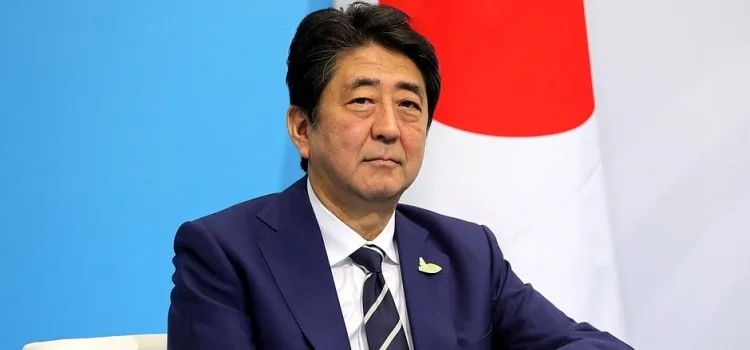
The former Japanese prime minister Shinzo Abe died at the age of 67 after a shooting in the Japanese city of Nara on Friday, July 8, 2022.
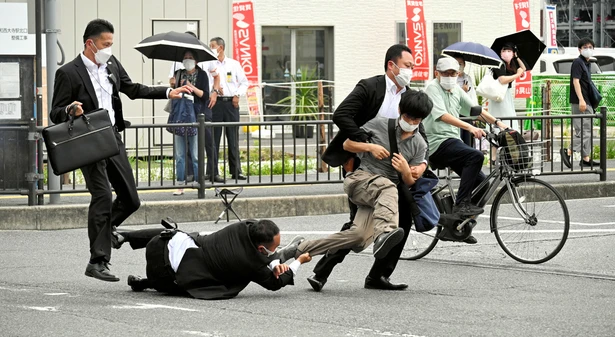
Shinzo Abe was shot twice during a speech on Friday morning in Nara. He was campaigning outside a train station for Kei Sato, a Liberal Democratic Party candidate in the Upper House election. The shooter, 41-year-old Tetsuya Yamagami, was arrested at the scene. The gun was homemade.
Doctors at Nara Medical University Hospital said Abe bled to death from deep wounds to the heart and the right side of his neck. He received more than 100 units of blood over four hours.
According to emergency services, the former leader was in cardiac arrest when he was transported to the hospital. He was pronounced dead at 5:03 p.m.
Contents 4
Who was Shinzo Abe?
Shinzo Abe was prime minister of Japan in 2006 for one year and again from 2012 to 2020. He was the country's longest-serving prime minister. On August 28, 2020, Abe announced his resignation as prime minister, citing a resurgence of his ulcerative colitis.
Shinzo Abe [安倍 晋三] was born in Tokyo on September 21, 1954, and served four terms as the country's prime minister. He was a conservative politician in the Liberal Democratic Party.
Abe's policies were called "Abenomics": monetary easing, fiscal stimulus, and structural reform.
About Tetsuya Yamagami
Tetsuya Yamagami was a former member of the Japan Maritime Self-Defense Force, Japan's equivalent of the navy. According to sources from the Japanese Ministry of Defense, he worked in the naval branch of the Self-Defense Forces for three years, until 2005.
On the day of the attack he told police he held a grudge against a specific group and believed Abe was connected to it. At the trial, which opened in October 2025, he said his mother's donations to the Unification Church, formally the Family Federation for World Peace and Unification, had destroyed his family, and that he targeted Abe because he regarded the former prime minister as an ally of that group.
The Nara District Court sentenced Yamagami to life in prison on January 21, 2026, the sentence prosecutors had requested. The defense had asked for 20 years or less. His lawyers filed an appeal on February 4, 2026.
The weapon used in the crime was homemade. Japan has strict laws on firearms, and deaths from them are rare.
What leaders said on the day
Former Australian prime minister Kevin Rudd, writing while Abe was still alive, called an attack on any democratically elected political leader an attack on supporters of democracy everywhere and said he hoped Abe would recover.
The U.S. ambassador to Japan, Rahm Emanuel, said that Abe was an "outstanding leader of Japan and an unwavering ally of the United States." He added that the United States was praying for the well-being of Abe, his family, and the Japanese people. Emanuel released that statement while Abe was still in the hospital.
The Brazilian president stated that he received the news of the assassination of the former Japanese prime minister "with extreme indignation and sorrow." Bolsonaro declared three days of national mourning for the death of Shinzo Abe.
Firearms in Japan
Firearms are rare in Japan. The National Police Agency's 2018 white paper, as reported by The Japan Times, listed eight firearm homicides in 2017, all of which involved members of crime syndicates. The same paper counted 13 firearm deaths that year, 11 of them believed to be suicides. Firearm homicides last exceeded single digits in 2014, with 13 incidents.
This shooting was the first killing of a sitting or former Japanese leader since a coup attempt in 1936.



Community
Comments
0 comments
There are no published comments in this language yet.
Send comment