
Yes, it is possible to explore Japan with a volunteer guide without paying a guiding fee. Local groups in many cities connect visitors with residents who enjoy sharing their area, language, and everyday perspective. It can be a wonderful fit when you want more than directions: perhaps help understanding a shrine visit, choosing a sensible walking route, or finding the small details that do not make it into a tight itinerary.
Free does not mean that every part of the day costs nothing. In most volunteer-guide arrangements, visitors cover the guide's transport, admission, and meal costs during the outing. Availability also depends on the group, language, date, and number of guests. Think of it as a local introduction arranged in advance, not a guaranteed on-demand service.
Contents 6
How volunteer guides in Japan work
Many programs are run by Systematized Goodwill Guide groups, often called SGG groups. The Japan National Tourism Organization maintains a directory of registered volunteer-guide groups across the country, with contact details, languages, areas, and notes about how each service operates. That directory is a much safer starting point than relying on an old city-by-city list, because each group sets its own rules and may update its contact process.
Some guides offer a defined route around a historic district, a castle, a museum area, or a famous neighborhood. Others can help shape a private half-day or full-day visit around your interests. A good request is specific enough to be useful but flexible enough to respect the volunteer's knowledge of timing, transit, and local conditions.
Where to look for a free guide
Start with the JNTO volunteer-guide directory. It lists groups by region and gives practical information such as available languages, guide areas, websites, and contact methods. If your destination is not covered there, search for the city name together with SGG, Goodwill Guide, or volunteer guide, then confirm the details on the group's own page.
Official city tourism sites can also be useful. In Tokyo, for example, GO TOKYO publishes volunteer-guide routes and service notes. Local tourism associations are often the best place to discover whether a guide focuses on one neighborhood, a heritage site, or a broader city walk.
A Tokyo example
Tokyo Free Guide provides volunteer-guided visits in Tokyo and nearby areas for a half or full day. Its service has no guiding fee, but guests are expected to cover the guide's transportation fares, entrance fees, and meals during the tour. That distinction matters: budget for the day as though you were paying for one additional traveler.
Tokyo is large enough that a volunteer can save you from building an exhausting route. Rather than asking to see the whole city, choose one or two connected areas. A morning around Asakusa and Ueno, or an afternoon focused on Meiji Shrine and Harajuku, leaves room for conversation and the unexpected stops that make a local walk memorable.
What to include in your request
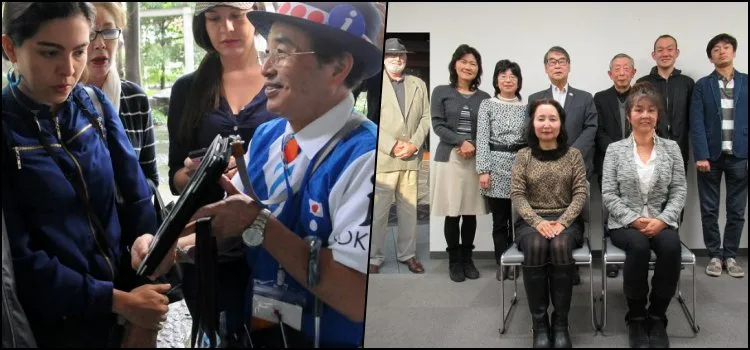
Volunteer groups receive many requests, so a clear message helps them decide whether they can assist. Include your travel dates, the city or area you hope to visit, your group size, the language you need, and a short note about your interests. Mention practical needs too: a slower pace, step-free access, children, food restrictions, or whether you are comfortable using local trains.
- Ask well ahead of your visit; many groups need time to match a guide and confirm a route.
- Keep the first request realistic. One city, one day, and a few interests work better than a wish list for all of Japan.
- Check the reply carefully for meeting point, costs, cancellation rules, and any group-size limits.
- Have a backup plan. A volunteer group may be fully booked or unable to find a guide for your language and date.
Costs, gifts, and good manners
Before the day begins, confirm exactly which expenses you will cover. Transport, admission tickets, and meals are common, but the arrangement belongs to the individual group. Do not assume that a volunteer can enter an attraction for free, and do not pressure anyone to extend a route beyond what was agreed.
A small gift from your home country can be a kind gesture, yet it should never be treated as payment or an obligation. The most useful courtesy is punctuality, a genuine interest in the place, and a short thank-you message afterward. If plans change, contact the group as early as possible instead of disappearing on the day.
Is a volunteer guide right for your trip?
A volunteer guide is ideal when you value conversation, local context, and a gentler pace. It may be less suitable when you need a licensed specialist, a fixed commercial itinerary, last-minute availability, or guaranteed interpretation for a complex appointment. In those cases, a paid professional guide may be the more reliable choice.
For many independent travelers, though, one guided day can make the rest of the trip easier. You gain confidence with trains, neighborhood etiquette, and the rhythm of a Japanese city, then keep exploring on your own. If you are planning a longer stay, our guides to homestay with a Japanese host family, Japan tourist visas, and traveling alone in Japan can help with the next steps.





Community
Comments
0 comments
There are no published comments in this language yet.
Send comment