
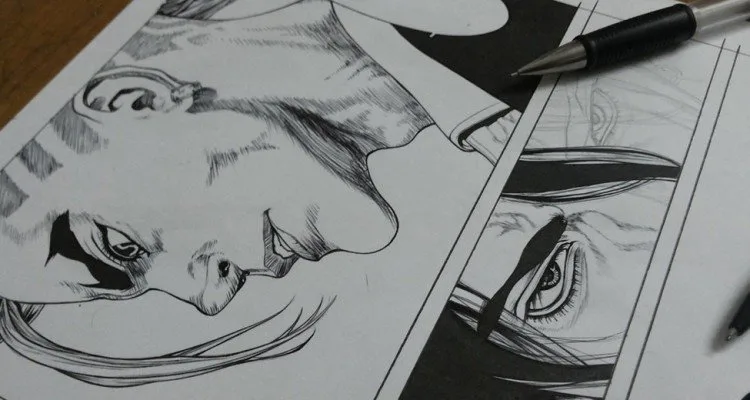
Want to become a mangaka? Start by drawing often enough that a blank page stops feeling like a test. A sketchbook and a few short gesture sketches will not make a finished manga overnight, but they give you two habits that matter: noticing what you see and recording an idea before it disappears.
You do not need expensive tools or a perfect routine to begin. A pencil, an eraser, and any notebook that invites you to open it are enough. What matters is giving each page a job: studies, character notes, scene thumbnails, or quick poses. That makes practice less vague and gives you material to revisit when a story starts taking shape.
Contents 7
What a sketchbook is for when you want to draw manga
A sketchbook is a working notebook, not a gallery. Use it to test a character silhouette, compare two hairstyles, study hands, copy a pose from life, or write down a line of dialogue next to a rough panel idea. Pages can be messy. In fact, a page full of corrections often teaches more than one polished drawing.
For manga work, the useful part is the record it creates. A small note beside a drawing can preserve why a character is angry, how a jacket folds, or where a scene should take place. Months later, those fragments can save you from inventing everything again from memory.
Give each session one clear target
- Character studies: draw the same face with different expressions, angles, or hair shapes.
- Observation: sketch objects, people, hands, shoes, rooms, and clothing around you instead of drawing only from imagination.
- Story notes: pair a thumbnail with a sentence about the action, mood, or dialogue.
- Review: mark one drawing worth revisiting, then redraw it after a few weeks without tracing the first version.
This separation helps when practice feels scattered. A page for anatomy does not need to solve your character design, and a page for story thumbnails does not need finished line art.
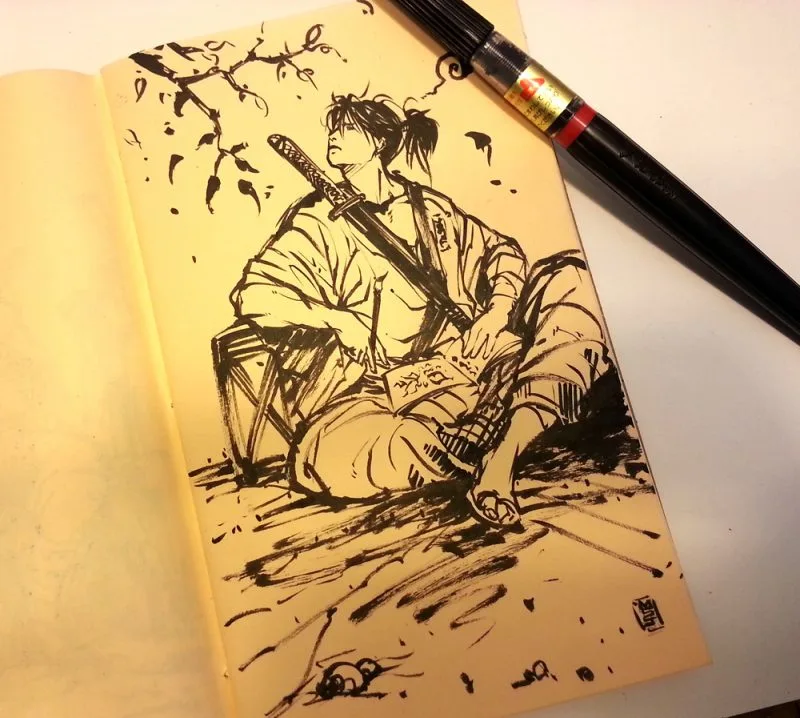
Quick sketches: capture movement before detail
A quick sketch, often called a gesture drawing, is a short study of pose, balance, and direction. It is not meant to be a finished illustration. Its job is to catch the action before you start worrying about eyelashes, folds, or clean outlines.
Begin with the largest movement in the pose: a curve through the spine, a tilt of the shoulders, or the angle between hips and feet. Add simple masses for the head, ribcage, and pelvis. If the pose still reads from a few loose lines, you have something useful to develop later.
Short time limits are helpful because they stop you from polishing one hand while the rest of the figure falls apart. Try a few poses at thirty seconds, then move to one or two minutes. The goal is not to finish on time every time; it is to train your eye to see the whole figure first.
A simple gesture-drawing sequence
- Choose a reference with a clear pose: a photo, a video paused at a useful moment, or someone moving in daily life.
- Set a short limit and draw the direction of the body before adding details.
- Use basic shapes for the torso, pelvis, limbs, and head.
- When time ends, write one note: what read well, what felt stiff, or what proportion went wrong.
- Repeat with a new pose. Compare the notes after several attempts, not after one drawing.
That last step matters. A crooked drawing is not proof that you cannot draw; it is information about the next study. If arms keep looking too short, make the next page about arms. If your characters feel flat, collect poses with strong twists, weight shifts, and overlapping forms.
How sketchbook practice becomes manga practice
Sketchbook work becomes more useful when you connect studies to a small project. After a week of gesture drawings, choose one pose and turn it into a character. After studying a room, use it as the setting for a three-panel scene. This bridge between observation and storytelling is where practice starts serving your manga rather than staying in a separate notebook.
Keep your first projects small: a character turnaround, a one-page scene, or a sequence with a beginning, change, and ending. Large stories can wait. A short page teaches pacing, expressions, backgrounds, and readability at once, and it gives you a clear reason to return to the sketchbook when something does not work.
Build a routine you can repeat
Consistency does not mean drawing for hours every day. A realistic routine might be ten minutes of gesture sketches on busy days and a longer session once or twice a week. Put the notebook where you can reach it, choose a subject before you begin, and stop while you still know what you want to try next.
Paper and pencil are enough for this stage. Markers, ink, colored pencils, and digital tools can be useful later, but buying supplies will not replace observation or repetition. Pick materials that make you want to practice, then spend most of your attention on what the drawing is trying to say.
From fan to working mangaka mindset
There is no secret Japanese formula for becoming a mangaka. The work begins with ordinary pages: rough poses, failed hands, notes about characters, and scenes that need another attempt. Keep those pages. They show what to practice next, and they become a private archive of ideas that may eventually belong in your first manga.
Open the sketchbook today and give yourself one small task. Draw a pose, design a face from three angles, or thumbnail a moment from a story you like. Finish the page, write one note about it, and return tomorrow. That is a more useful start than waiting to feel ready.





Community
Comments
0 comments
There are no published comments in this language yet.
Send comment