
Japan is probably best known as the land of cute things — kawaii, konbini, cherry blossoms, Hello Kitty — but beneath the surface hides a pretty horrifying truth. Japan is home to some of the scariest animals on the planet, and a lot of them live in the very rivers, beaches and forests we wander through when we travel. That's exactly why today I'm walking you through the 5 most horrifying animals in Japan — the ones that genuinely made me pause while I was researching this post.
A small warning before we start: if you're currently planning a hiking trip in Kyushu, a snorkeling day along the Pacific coast, or a casual walk through the mountains of Honshu, maybe don't read this one on a full stomach. Some of these creatures you'll never bump into in your life — others end up in the news because they surprised hikers, divers and curious tourists. Brace yourself for a few goosebump moments.
Contents 6
Goblin Sharks
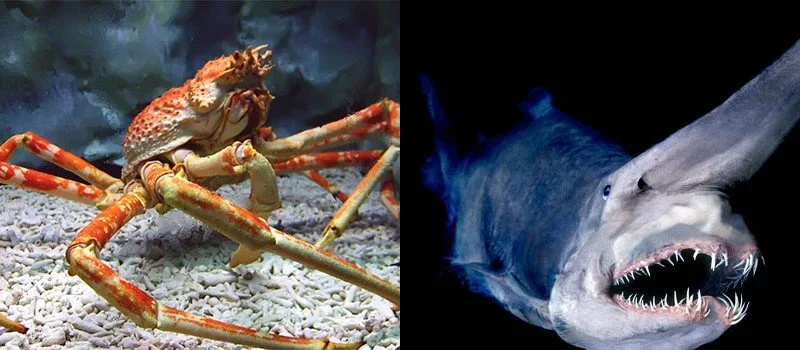
Say hello to the goblin shark, known in Japanese as mitsukurizame or tenguzame. The word tengu refers to a mythical creature with a long nose, and the first time you see the head of this shark you'll understand exactly why Japanese fishermen gave it that name. Goblin sharks can be found outside Japan as well, but the highest catch rate sits right off the Japanese coast — even though most of those encounters are pure accidents, when deep-sea trawlers haul their nets up from around 1,000 meters down.
They live in the depths of the ocean, around 1,200 meters down, and can grow to roughly 6.2 meters long and weigh up to 210 kg. Sure, that's smaller than the great white shark (which can reach around 6 meters, with a few historic specimens pushing past 11 feet), but the intimidation factor here is something else entirely. Look at the irregular teeth that look like barbed wire, the saw-like snout sticking out of the face, and those small black eyes that look like they belong to something that hasn't slept in weeks. These animals are basically "living fossils" — the last members of an ancient lineage that goes back around 125 million years and that still carries the same "primitive" features it always had.
Spider Crabs
Known as takaashigani in Japanese — literally "tall-leg crab," but commonly translated as "spider crab" — these are the largest arthropods on Earth. With legs that can reach around one meter each, the leg span ends up at over 3.8 meters across. The reason this monster only shows up at number five on this list is that, surprisingly, they're GENTLE, despite the absolutely horrifying look.
They prefer to gather on the seafloor, cover themselves in sponges and other small marine animals, and basically eat anything they can scrape up. Still, I personally would not want to come face-to-face with one of these creatures in the water. They're found off the southern coast of Honshu, Japan's main island, so I'd honestly recommend staying out of the ocean there on your next trip. If you still want the chance to see one alive, head to a coastal aquarium — a few of them along the Pacific side keep these crabs on display and you get the size perspective without, you know, having to share the water with them.
Coconut Crabs
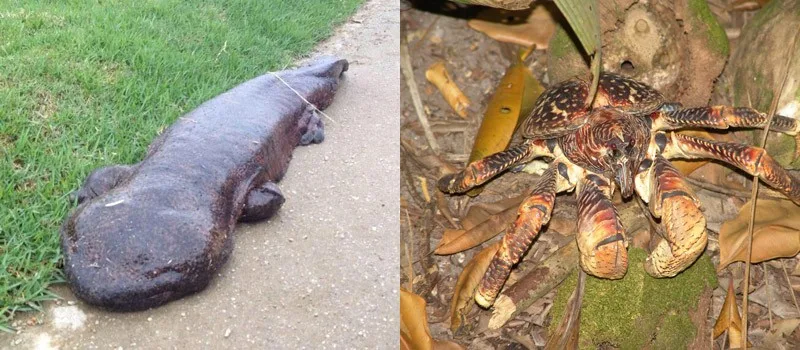
Meet the yashigani, or coconut crab — the largest terrestrial arthropod in the world. These guys can grow to about 1 meter in length and weigh up to 4 kg. Their name comes from their unusual ability to crack open coconuts with their powerful claws, which are among the strongest in the entire animal kingdom relative to body size. They live on islands across the Pacific and Indian Oceans, and in Japan you mostly find them on the warm, remote beaches of the Ogasawara (Bonin) Islands, south of the main archipelago.
They look like a giant purple-brown spider that decided to retire to the seaside, and honestly that image alone is enough to ruin a quiet beach evening. Coconut crabs are mostly nocturnal, and they will eat basically anything: fruit, seeds, dead animals, and — yes — the occasional coconut. They can climb trees, which is the part that always freaks people out the most, and they have an excellent sense of smell. On the Ogasawara Islands, locals have learned to keep food well sealed at night, because these crabs will investigate anything that smells interesting. They are not aggressive toward humans, but their claws are strong enough to crack bone, so please don't try to pick one up.
Giant Salamanders
The ōsanshōuo, or Japanese giant salamander, is one of the largest amphibians in the world, reaching up to 1.5 meters in length and weighing up to 25 kg. They live in the cold, clean mountain rivers of northern Kyushu and western Honshu, where they spend the daytime hiding under rocks and come out at night to hunt. Despite their prehistoric look — flat, slimy body, wide head, tiny eyes — they're actually protected in Japan and considered a special natural monument.
What makes them genuinely unsettling is the sound. During breeding season they produce a barking call that carries through the valleys at night, and locals in some mountain villages have reported "mysterious barking" from the rivers for centuries. The current scientific name, Andrias japonicus, was given to them in the 19th century, and genetic studies have shown that the species has been around for tens of millions of years. So if you ever hear a dog barking from a clear mountain stream in Japan, look into the water very carefully before you assume it's safe to wade in.
Asian Giant Hornets
Last on the list, and probably the one that should worry you the most if you actually live in Japan, is the suzumebachi — the Asian giant hornet (Vespa mandarinia japonica). Workers can reach around 4 to 5 cm long, with queens pushing past 5 cm, and a wingspan that looks like a small bird flying past you out of the corner of your eye. They are the world's largest hornets, and they show up most actively between late summer and early autumn across rural Japan.
What makes them genuinely terrifying is the sting. Vespa mandarinia japonica has the longest stinger of any hornet, and the venom contains a strong neurotoxin. In Japan, the species is responsible for around 30 to 50 deaths every year, mostly among elderly people, beekeepers and hikers who stumble into an underground nest by accident. The hornets are also famous for "slaughter phase" raids on honeybee colonies, where a small group of workers can wipe out an entire hive of tens of thousands of bees in a few hours. If you're out hiking between September and October, watch for warning signs near farmland and forest edges, keep bright perfumes to a minimum, and never, ever try to swat a hornet near its nest — the alarm pheromone is what turns one sting into a coordinated attack.
Final thoughts
Japan is still one of the safest, cleanest, and most visitor-friendly countries in the world to travel through, and the chance of running into any of these creatures in a way that ruins your trip is honestly quite small. That said, a little awareness goes a long way: respect the ocean, watch where you step in the mountains, and keep an eye on local warnings during hornet season. Most of the scary stories you hear about Japanese wildlife come from people who got too close on purpose, not from ordinary travelers.
Out of these 5, which one would you least like to bump into on a quiet evening? Personally, I'm not sure I could pick — but the hornets are the one I'd genuinely want a few extra meters of distance from.





Community
Comments
0 comments
There are no published comments in this language yet.
Send comment