
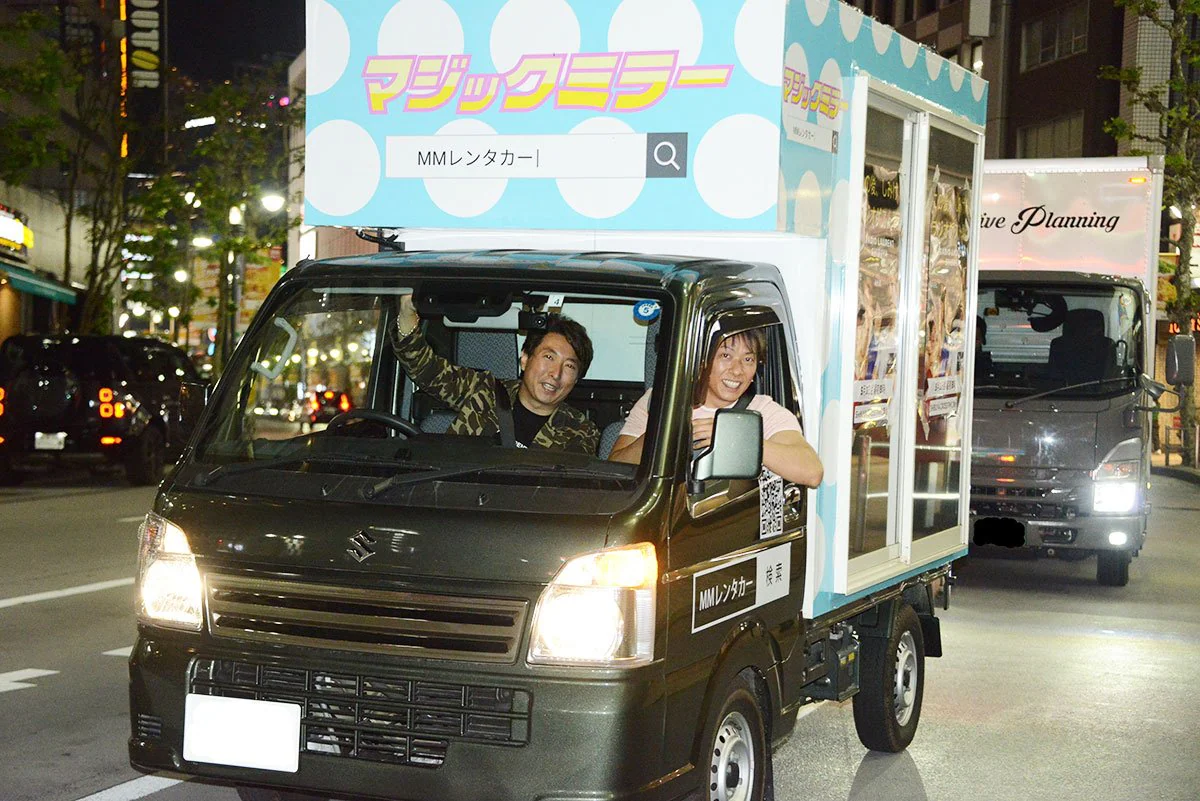
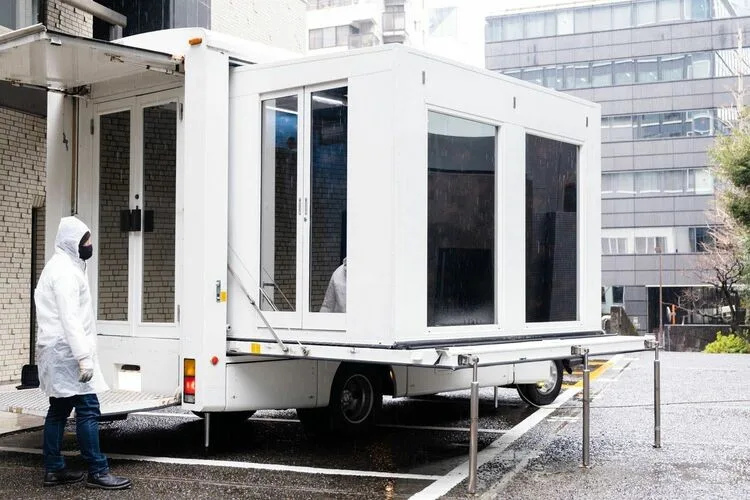
Picture a plain white van parked at a busy intersection in Tokyo. From the sidewalk it looks like any other delivery vehicle — the kind that drops off vegetables, newspapers, or parcels. Step inside and you find reporters, camera operators, and anchors staring at monitors, watching the street in real time and going live on air without anyone outside realizing they are being watched. That is the whole idea behind a Magic Mirror Van, known in Japanese as Mājikku Mirā-go (マジックミラー号) or, more colloquially, Mircle-gō (ミラクル号). It is a vehicle dressed up to look like a normal commercial truck, fitted with a partially mirrored panel that only lets you see in one direction.
The effect is almost theatrical: pedestrians passing by see nothing but a reflective surface, while the team inside looks straight out onto the street. The trick itself is not new, but in Japan it has been refined over decades into a small media institution — most famously on election nights, when the country's most recognizable Magic Mirror Van has been part of the national broadcast ritual for a generation.
Contents 6
What is a Magic Mirror?
The term Magic Mirror (マジックミラー, majikku mirā) is the Japanese label for a one-way mirror. It is a sheet of glass treated so that one side is half-transparent and the other half-reflective, depending on how light falls on it. When one side of the glass is brightly lit and the other is kept dark, the bright side acts like a normal mirror to the dim side. Flip the lighting and the bright side becomes a clear window into the dark room.
The principle is simple, but the practical consequences are huge. Police interrogation rooms, reality TV confession booths, observation windows in neonatal units, and psychology labs all rely on the same trick. The Japanese term has stuck in pop culture partly because "magic" sells the idea better than "semi-transparent dichroic glass." In everyday chat, Japanese speakers will use Magic Mirror for any pane that behaves this way, whether it is a real two-way panel or a darker piece of tinted privacy glass that just gives a similar effect.
Magic Mirror in Japanese culture
Japan has a long love affair with vehicles that are more than they appear. The country nurtured itasha — cars plastered with anime decals — and dekotora, the art-truck subculture with neon piping and mirror finish panels. A plain white van that hides a full broadcast studio fits naturally into that lineage. It looks ordinary, then suddenly isn't.
There is also a distinctly Japanese appreciation for technical objects that pull off a clever physical trick. Fans, hobbyists, and otaku subcultures tend to obsess over the engineering behind a Magic Mirror Van just as much as over what it does on screen: the angle of the glass, the brightness of the internal lighting, the camera placement, the cable runs, the satellite uplink tucked into the roof. That mix of showmanship and craft is part of why the format has stuck around for so long. It is, in a small way, a working example of yume no chikara — the idea that a well-built object can turn a mundane street corner into something memorable.
The Mircle-gō: the Magic Mirror Van from NTV
The most famous Magic Mirror Van in Japan belongs to Nippon Television (NTV / 日本テレビ), one of the country's major commercial networks. Reporters and viewers simply call it the Mircle-gō, a nickname that has outlived any specific generation of the vehicle. On the outside, it is a sober white truck with no markings that would tip off a passerby. On the inside, it is a compact studio: monitors, lighting rigs, audio mixing, an anchor desk, and a team of journalists running the night's coverage.
The Mircle-gō has been a fixture of Japanese election nights, especially during Shūgiin-senkyo (衆議院選挙), the House of Representatives elections, since the 1990s. As exit polls and constituency results come in, the network moves the van between party headquarters, candidate offices, and protest sites, broadcasting live from each stop. Reporters inside can see the crowd and react in real time; the people on the other side of the glass have no idea a camera is pointed at them. The setup is part logistical tool, part symbol of how Japan's tightly choreographed election coverage works under tight deadlines.
Beyond elections, the NTV van has turned up at major disasters, royal weddings, Olympic announcements, and breaking news scenes, always with the same logic: get close to the action, broadcast without obstructing it, and keep the crew hidden in plain sight. Documentaries about Japanese media culture regularly use the Mircle-gō as a visual shorthand for the country's blend of modesty and technical ambition. Other networks have since built their own variants, but the NTV van is the one most Japanese viewers picture when they hear the term.
How one-way mirrors work
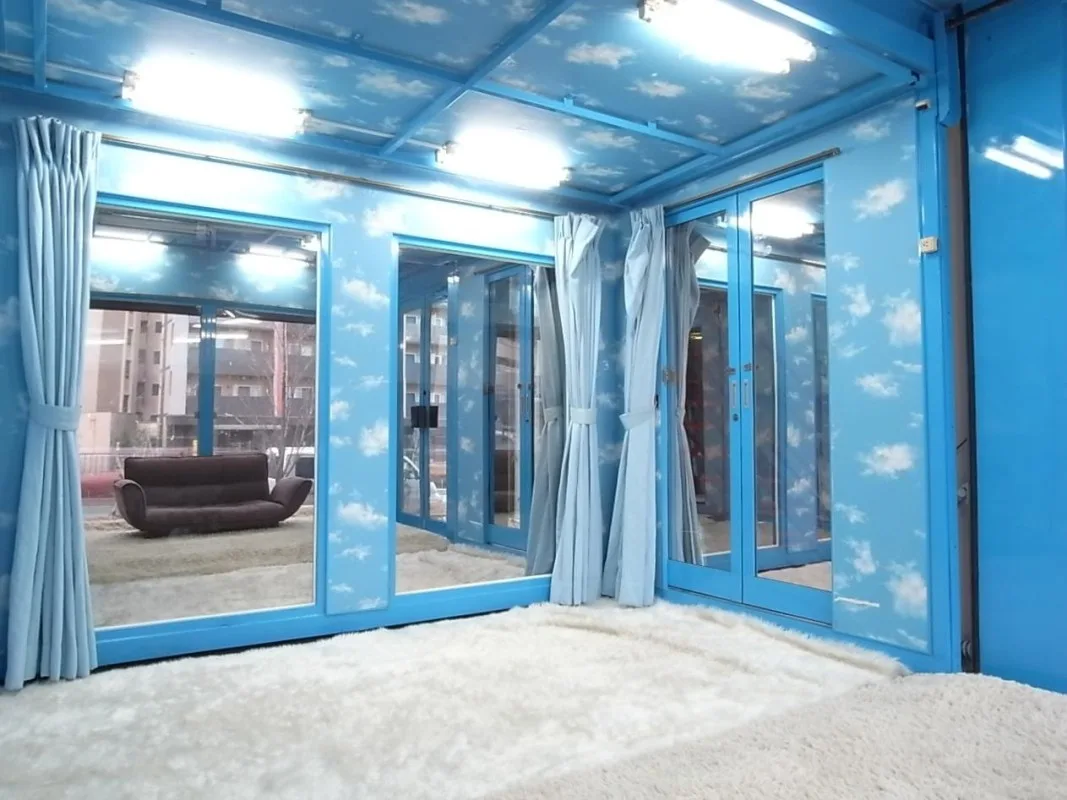
A one-way mirror is a piece of glass — sometimes acrylic — that has been coated on one side with a very thin, partially reflective layer, usually a metal oxide. The coating is so thin that some light passes through and some bounces back. What you see depends almost entirely on the light balance between the two sides.
If the room on side A is brightly lit and the room on side B is dark, an observer in B sees side A as a mirror, because the light coming from A overwhelms the small amount of light from B that makes it through. An observer in A, by contrast, sees a faint reflection of their own room, but the brighter room B is clearly visible through the glass. This is the setup used in police interrogation rooms: the suspect sits in a bright room, the observers sit in a dim one, and the glass appears mirrored from the suspect's side.
Magicians and TV producers exploit the same physics. In a studio, the camera side is kept dark, while the talent side is brightly lit. From the talent's perspective, the "mirror" is a window. From a viewer at home, the glass surface that the talent thinks is a mirror simply looks like dark scenery. The classic Hidden Camera segment on Japanese variety shows — where a celebrity sits on what looks like a normal set and gets pranked through a one-way mirror wall — uses the same trick, scaled up to a full wall.
Inside a Magic Mirror Van, the engineering is similar but mobile. The window panel is fixed into the side of the truck, the interior is sealed off with curtains, dimmers, and blacked-out equipment bays, and the lighting is tuned so that from the outside the panel just reads as a mirrored surface in daylight. Cameras, often multiple 4K setups, sit just behind the glass. Directional microphones handle audio. A satellite or microwave link on the roof ships the signal back to the studio, and a small generator or shore-power hookup keeps everything running through the night.
Other uses for Magic Mirror Vans
Once you know the principle, you start spotting it everywhere. Beyond election broadcasting, vehicles that use one-way glass or similar privacy glass show up in several other fields.
- Election observation — broadcasters in several democracies have copied the Japanese Mircle-gō concept, parking mobile studios near party headquarters or polling stations to file live reports.
- Police surveillance — covert observation vehicles, sometimes called "presentation vans," have been used in cities around the world to monitor public spaces, drug deals, and counter-terrorism targets without breaking cover.
- Film and TV production — location shoots often need a mobile base where the director can watch a scene from outside the set, and a Magic Mirror panel lets the crew blend into a street or a parking lot.
- Traffic monitoring — police speed-check vans in many countries use darkened or one-way glass to hide operators and cameras from approaching drivers.
- Military reconnaissance — armored and plain-clothes intelligence vehicles have used one-way glass for decades, letting operators observe checkpoints, crowds, or hostile areas without being seen.
- Disaster monitoring — aid organizations and broadcasters sometimes deploy mobile observation units near evacuation centers or damaged infrastructure to keep an eye on conditions without getting in the way.
- Mobile medical and research labs — privacy glass is common in mobile blood-donation vans, dental clinics, and field research vehicles, where patients inside need a clear view but observers outside should not be able to look in.

Magic Mirror Vans and public perception
The Magic Mirror Van sits at an awkward intersection of admiration and unease. On one side, it is a clever piece of broadcast engineering that has helped Japanese networks cover elections, disasters, and breaking news with remarkable speed. On the other, it raises the same privacy questions that follow one-way glass anywhere: who is really watching, and who gets to decide?
Japanese viewers tend to be aware of the Mircle-gō by now, and most accept it as part of the country's distinctive media culture. There is a touch of humor in that acceptance — the idea that a humble white delivery truck can be the nerve center of a national broadcast appeals to the same sensibility that enjoys itasha, dekotora, and other subcultures of visually striking vehicles. Other networks have built their own versions, which has spread the format without diluting NTV's association with it.
For visitors to Tokyo, the practical takeaway is simple. If you see a plain white van with unusually clean, mirror-like side panels parked near a political office, a train station, or a protest, do not be surprised if a familiar news anchor's voice drifts out of it. You are probably looking at a Magic Mirror Van in action — a small, slightly weird piece of Japanese media culture that turns an ordinary street corner into a live broadcast booth, and that has been quietly doing its job since before most of today's viewers were born.



Community
Comments
0 comments
There are no published comments in this language yet.
Send comment