
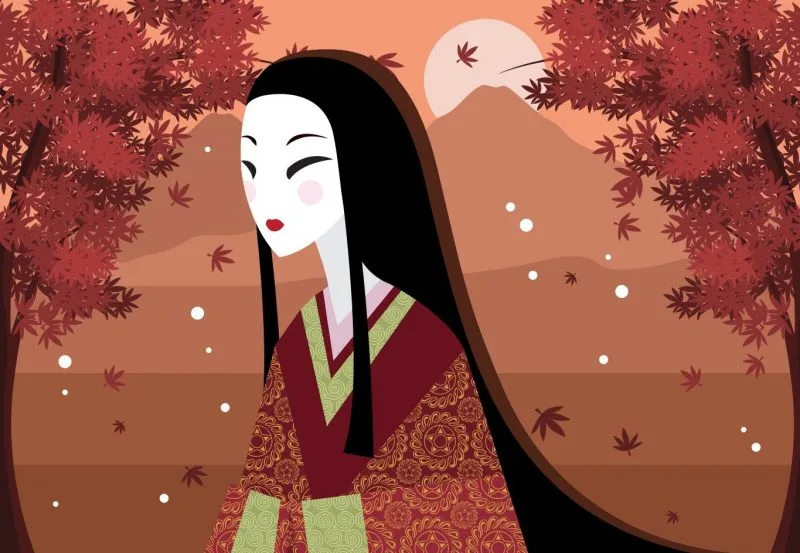
Do you know what a geisha is? What is their history in Japan? Are they really prostitutes? In this article, we have created a complete guide to explain everything about geishas in a simple and practical way. Read below for curiosities, stories, and many other information related to the geishas of Japan.
Geisha [芸者] are Japanese women who study the millennia-old tradition of art, dance, and singing. In Japan, being a geisha is a cultural, symbolic condition filled with status, delicacy, and tradition.
The very name geisha [芸者] can be literally translated as “art” (gei – 芸) and “person” or “practitioner” (sha – 者), that is, an artist. Geishas can also be called Geiko (芸子, Geiko) or Gueigi (芸妓, Gueigi).
To facilitate navigation in this article, we have prepared a summary:
Table of Contents
What is a geisha? What do they do?
They live in neighborhoods known as hanamachi [花街], which means City of Flowers. Their quarters are called okyia where they eat, receive advice, kimono, obis, and other special tools and treatments during their geisha contract called nenki.
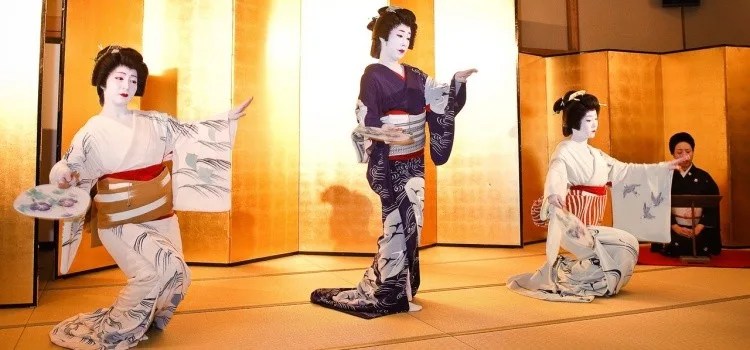
They work in places called Ochaya, which are tea houses where they offer entertainment that consists of conversations, flirting, drinks, traditional games, musical performances, singing, and dancing. Geishas also often play the traditional instrument shamisen, and also play other instruments like flute, koto, ko-tsuzumi, and taiko.
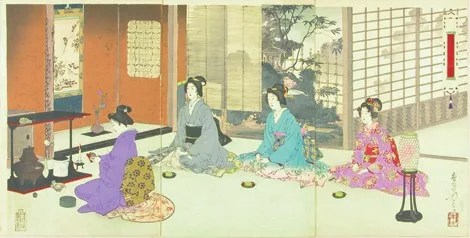
In addition, they write poems, paint pictures, and compose music. They learn conversation techniques and also games to entertain guests. They also need to learn shodo calligraphy and tea ceremony. It is not necessary to be beautiful to become a geisha; having these skills is enough.
Geishas are also quite mysterious; they try to be as anonymous as possible, using stage names that give an air of mystery and fascinate clients even more. Everything about geishas is very worked and delicate, from their completely complex hairstyles, their kimono, and their white makeup.
It is believed that a geisha takes about 2 to 3 hours just to get ready. Currently, most of a geisha’s clients are older or wealthy men who have great admiration for Japanese culture. They convey the idea of a perfect woman and make their clients feel valued and attractive.

Are geishas prostitutes?
Many Westerners believe that geishas are prostitutes, a completely erroneous idea. On the contrary, geishas were created for entertainment without sex; they were prohibited from selling sex. Geisha clients sometimes fall in love and are deluded but need to face the reality that they will never have a geisha in their arms.
Geishas were prohibited from having relationships because at the time, prostitutes in Japan were licensed and known as Oiran (花魁) courtesans. Thus, the routine of geishas was completely supervised; they did not have the freedom to do as they pleased, as prostitution could interfere with the business of the Oiran.

Some come to this conclusion because in the early stages of Japan’s history, there were artists called saburuko, many of whom were without families and ended up prostituting themselves or making a living entertaining the upper class at social gatherings.
Over time, a division emerged between those who provided sexual favors and those who worked entertaining people with dance, art, games, and music (geishas).
We do not blame Westerners for creating these confusions; both geishas, Oiran, Saburuko, and other classifications of girls who worked in entertainment districts wore similar clothing and makeup. Another reason for this conclusion is that indeed, some women who became geishas were once prostitutes.
To give you an idea, the first geishas were actually men entertaining clients who were waiting for courtesans; they were known as “Taikomochi” or “Houkan.” Becoming a geisha was a way for girls to leave the world of prostitution and enter the world of art.

Geishas cannot have relationships
Geishas also could not engage in serious relationships. If they decided to marry, for example, the geisha was forced to retire permanently from the profession.
We can compare geishas to current Japanese idols; if any scandal arises about them dating or having relationships with someone, it can ruin their careers and affect the fans who are in love with them. Similarly, geishas avoid both relationships and prostitution.
Despite all this, there was a practice in the ceremony called Mizuage, where a Maiko (apprentice) becomes a geisha. In this ceremony, her virginity was auctioned off, and the money was used to promote her debut. Fortunately, this practice became illegal in 1959.
In any case, it is undeniable that in the past, people sought these places for entertainment. They were even known as “Pleasure Quarters” (yuukaku – 游廓).
It was in these places that many current aspects of Japanese culture emerged, such as Kabuki, which is currently a theater performed by men but was once a sensual dance.

What happened to the Geishas?
Geishas were quite popular in Japan, to the point that it became a female occupation. They were known as elegant and high-class women. Being a geisha was honorable and glamorous; many of them started their training from a young age, around 3 to 5 years old, with an average of 9 years.
Geishas decreased significantly around World War II because tea houses, bars, and geisha houses were forced to close, and all employees were put to work in factories for the war. The country considered the training of geishas from childhood as child labor.
The name geisha also lost its meaning because prostitutes began to refer to themselves as geishas to American soldiers. After a while, geisha houses were allowed to reopen, and the few women who returned decided to reject Western influence and resume traditional forms of entertainment and life.

Currently, there are few geishas in Japan compared to the past; they can be found in the hanamachi districts of geishas in cities like Kyoto.
Entering a tea house or restaurant that has geishas today is something luxurious and very expensive; being a geisha is a quite profitable profession, but complicated and demanding.
In 1920, there were about 80,000 geishas. In 1970, approximately 17,000. And nowadays, it is estimated there are about a thousand traditional geishas.
Gion Matsuri – Festival of the Geishas
The Gion Matsuri is one of the most famous festivals in Japan and also the longest – taking place throughout the month of July. This festival is held in Kyoto in the geisha district of Gion. However, most of the main attractions of the festival do not happen only in Gion. This is a festival full of attractions.
This festival originated as part of a purification ritual (goryo-e) to calm the gods and prevent fires, floods, and earthquakes. This practice was repeated whenever an outbreak occurred. In 970, it was declared an annual event.

The Yamaboko Float
The peak of the festival is the Yamaboko parades on July 17 and July 24. The streets of Gion are reserved for pedestrian traffic three days before. Vendors offer snacks and games in the streets, and many people attend these days wearing traditional Yukata.
The floats in the Yoiyama Parade are divided into two groups, Hoko and Yama, which are called Yamaboko (or Yamahoko). There are 9 large Hokos (with long poles or halberds), representing the 66 spears used in the original purification ritual, and 23 smaller Yama, which carry life-sized figures of important and famous people.

All floats are decorated with beautiful Nishijin tapestries (the best in all of Japan) or imported from various parts of the world. In addition to artistic elements, there are many musicians and traditional artists on top of the floats.
The Hoko floats tend to be heavy and dangerous, reaching up to 12,000 kg and 25 meters in height. Their wheels usually have about 2 meters in diameter. The Yama floats usually weigh one and a half tons and are about 6 meters tall.
The Gion Matsuri is perhaps the best event in Japan for geisha fans and photographers. You can find the most famous and traditional Geisha, Maiko, and Tayu.

Hanamachi – Geisha Districts
Kyoto has several geisha districts or hanamachi, known for their Ochaya tea houses. The atmosphere of the hanamachi takes you back to the Edo era; most of these districts are filled with restaurants and nightlife attractions. Kyoto is a historical and traditional city, where you can find the best Geisha Hanamachi in all of Japan.
The word Hanamachi means City of Flowers, which are the geisha districts, where the Ochaya are located, which are the tea houses where geishas offer entertainment that consists of conversations, flirting, drinks, traditional games, musical performances, singing, and dancing.
Geishas live in an Okiya, a boarding house that offers all special treatment to geishas, and they live there during the duration of their nenki (contract or career as a geisha). Now let’s see the 4 largest Hanamachi or Geisha Districts in the city of Kyoto:
Gion – The largest geisha district in Japan
Gion is the largest and most exclusive geisha neighborhood in Japan. The Ochaya in Gion are exclusive refuges for wealthy individuals in Japan. It is also common for foreign dignitaries and important clients to be invited.
For the general public, the best place to see geishas and maikos is the streets of Gion. Many tourists walk the streets of Gion in hopes of seeing one, but it is not easy. I myself did not have the chance to see any, but the streets are beautiful for photos.

There is also an annual evolution of Gion geishas called Miyako Odori (cherry blossom dance). It is held every night in April at the historic No Theater of Kaburenjo. This attraction has been held annually since 1869.
Pontocho – The district by the Kamogawa river
Pontocho is a street near the hanamachi of Gion, parallel to the river, formed by shops, tea houses, and restaurants. All the architecture is original to the 12th century and has withstood destruction and modernization, remaining untouched to this day.

Pontocho is centered around a narrow stone corridor that extends for about six blocks. The area is filled with restaurants and a variety of neon lighting up the nightlife.
Most restaurants on the east side of the alley overlook the Kamogawa river. Some offer a dining platform over the river known as a kawayuka.

The “back” part of the street is along the banks of the Kamo River, and the balconies of the restaurants create a very picturesque view. Your chance of encountering geishas or maikos in this area is quite high. A place to enjoy the river by the edge of a lawn where you can even play soccer.
Miyagawacho – Hanamachi with kabuki
Miyagawacho has a large entertainment area along the banks of the Kamo River. In addition to several Ochaya, you will find the famous Kabuki Minamiza theater in Miyagawacho, which sometimes features geisha performances.

In this region, various performances involving geishas and maikos take place; you can easily buy a ticket and watch a show. A very popular event is the Miyako Odori, which only runs for a few weeks in April.
Miyagawacho was once home to many kabuki theaters that occurred along the riverbank; there were even tea houses that operated on boats in the river.

Kamishichiken – the music district
Kamishichiken [上七軒] literally means 7 upper houses and refers to the seven tea houses built from materials from the reconstruction of the Kitano Shrine during the Muromachi Era (1333-1573).
In the neighborhood, there are about 25 geishas and maikos working in 10 Ochaya. The geishas in this district are known for their excellent music. Here you will find the Kamishichiken Kaburenjo theater and events such as Kitano Odori.

Kamishichiken is one of the oldest geisha neighborhoods in Kyoto. Unlike the other areas that are in the city center close to each other, this one is located further away, making it quieter and with fewer tourists.
Classifications and Training of Geishas
The children or daughters who were trained as geishas were known as hangyoku. At the time, it required long training to become a geisha, and they went through the following stages:
- Shikomi – Means “servant”;
- Minarai – Means “learning by observing”;
- Hangyuku – Means half-jewel – they receive half the salary of a geisha. (Maiko)
- Maiko – Final stage of training, means “the girl who dances”;

Currently, women can directly become geishas or maikos. A woman over 21 years old is too old to become a maiko, so she becomes a geisha.
Girls can become apprentices (Maiko) before the age of 18. They do everything and learn everything with their onee-san, an experienced geisha who serves as a tutor. Being a Maiko has its advantages and prestige; they are at the peak of femininity. After 5 years as a Maiko, or upon reaching a certain age, they become geishas and earn much more.
Geishas were allowed to have a danna, a wealthy man who covered the costs of their training. There was no exchange of sexual favors, but in some cases, a forbidden romance could be happening between the two.
If a geisha decides to marry, she participates in a Hiki Iwai (celebration of separation) ceremony, thus she ceases to be a geisha and sometimes finds a danna protector who supports her.
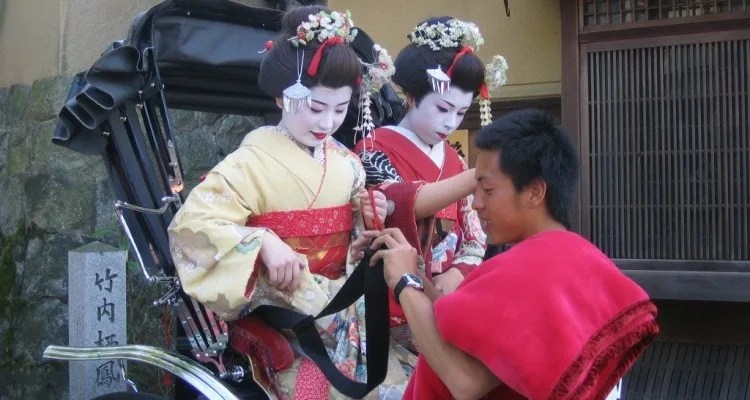
Differentiating Geisha from Maiko
To differentiate a geisha from a Maiko, just look at her collar. A Maiko usually wears kimonos with bright colors and a red collar. While a Geisha usually wears soft colors and a white collar.
There are many details about geishas that have not been mentioned. There is a lot of information for just one article, so we will conclude here. We recommend that you also read other related articles:
Unfortunately, we know few animes or stories that feature geishas or maikos as protagonists, but we will try to mention a few below:
- Shouwa Genroku Rakugo Shinjuu;
- We also recommend the movie Memoirs of a Geisha;
Questions about Geishas
How do geishas sleep?
The apprentices spend hours doing their hairstyles, and to avoid messing them up, they sleep on a wooden block (older geishas may use wigs).
Leave a Reply