
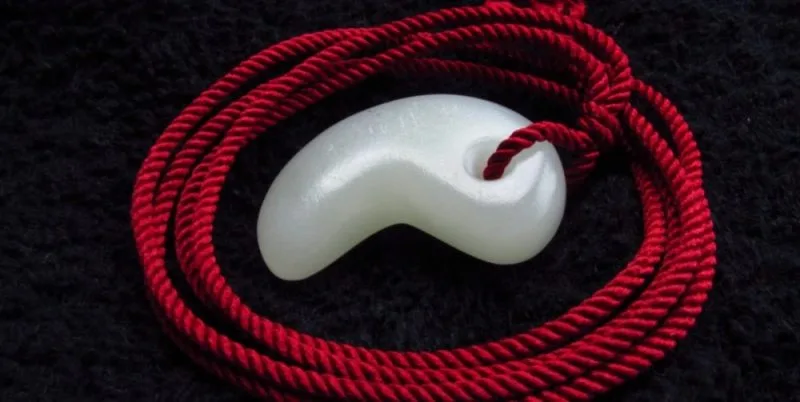
Just as we already have an article about the Yata no Kagami mirror, it is only fair to talk about the other treasures. By the way, we are talking about the three sacred treasures of the Imperial Regalia of Japan. These are the mirror Yata no Kagami, the jewel Yasakani no Magatama, and the sword Kusanagi.
We already have an article discussing the mirror, so now we will talk about the jewel Yasakani no Magatama. But before we start, we need to give a brief introduction about the subject of Magatama.
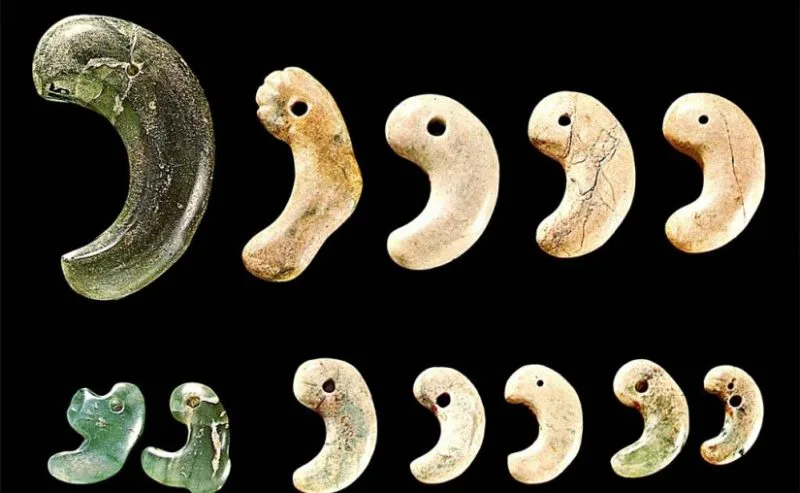
For those who don't know, magatama is a type of jewel that has a specific shape. It has been made since ancient times in Japan. But it is not known exactly where it originated. However, it became very important and valuable to Japanese society over time.
Contents 3
Magatama
The Kojiki and the Nihon Shoki are two collections of Japanese tales. These books tell stories and history that serve as a basis for many aspects of Japanese society and its traditions and culture. For example, the Nihon Shoki largely describes the mythology of Japan.
They were completed in the 8th century and are nothing less than the most important books in the country. They contain numerous references to magatama. For example, right in the first chapter of the Nihon Shoki, we already see one.
In this chapter, it is mentioned that Susanoo, the god of the sea and storms, received five hundred magatama. These were given to him by Tamanoya no mikoto, or Ame-no-Futodama-no-mikoto, the deity who made jewels.
Susanoo went to the heavens and presented them to his sister, the sun goddess, Amaterasu. Amaterasu then divided the magatama into equal parts and blew them to create other deities. In the legend, Amaterasu later, for some reason, closes herself in a cave.
Ama-no-Koyane-no-mikoto then thought of a way to lure Amaterasu out of the cave. She then hung a magatama, among other objects, on a sakaki tree with five hundred branches. And thus she managed to attract Amaterasu out of the cave.
Yasakani no Magatama
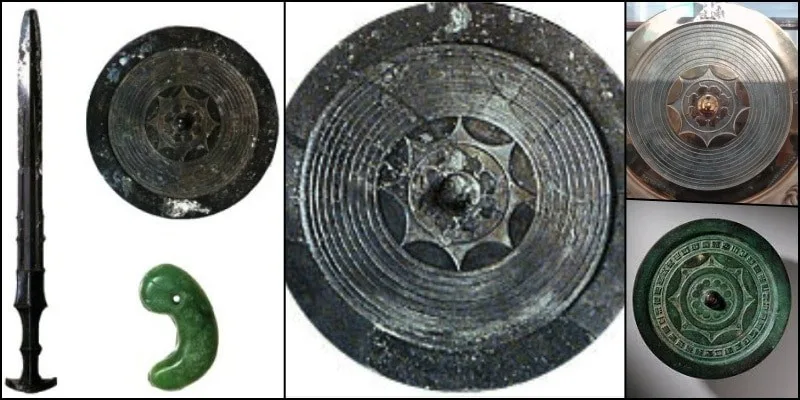
So, let's introduce the Yasakani no Magatama. As we have said, this is one of the three sacred treasures that are part of the Imperial Regalia of Japan. An important thing to know is the significance that swords, mirrors, and jewels had.
For example, these items were so important that they became something like a form of identification. These objects were commonly used to demonstrate status to regional rulers in Japan. This practice emerged in the Yayoi period but was even more widespread in the Kofun period.
The Yasakani no Magatama is stored in the Kashiko-dokoro. This is the central sanctuary of the Three Sanctuaries of the Palace in the Imperial Palace of Tokyo, which is used in the coronation ceremony of the emperor of Japan.
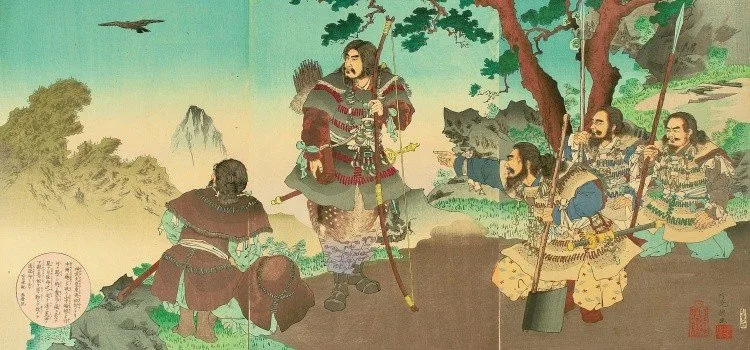
According to legend, this Yasakani no Magatama was the stone that, along with other objects, attracted Amaterasu out of the cave. And in turn, it was given by Amaterasu to her grandson, Ninigi-no-mikoto, along with the other two treasures. This happened when he was sent to pacify Japan.
After a while, Ninigi passed the treasures to his great-grandson, Jimmu. This, by the way, was the first emperor of Japan, meaning he is almost a direct descendant of the goddess Amaterasu. But let's not go into details about lineages.
Is Yasakani no Magatama lost?
Daniel Clarence Holtom made a statement in 1928 during Japanese coronation ceremonies. He stated that among the three treasures of the imperial regalia, only the Yasakani no Magatama exists in its original form.
It is speculated that replicas of the sword and the mirror were made as early as the 9th century. The originals were entrusted to other sanctuaries. The theories are many, and the versions of what happened are numerous. But no one has proven anything so far.
The most we can say is that these are treasures of a country that is one of the greatest world powers. If their treasures were easy to find, they would be stolen quickly. So, what we have is just speculation.
But anyway, do you have any questions, suggestions, guesses, or anything like that about this subject? Leave it in the comments, and feel free to share the site on social media; it helps a lot. Thank you for reading this far, and see you in the next article.





Community
Comments
0 comments
There are no published comments in this language yet.
Send comment