
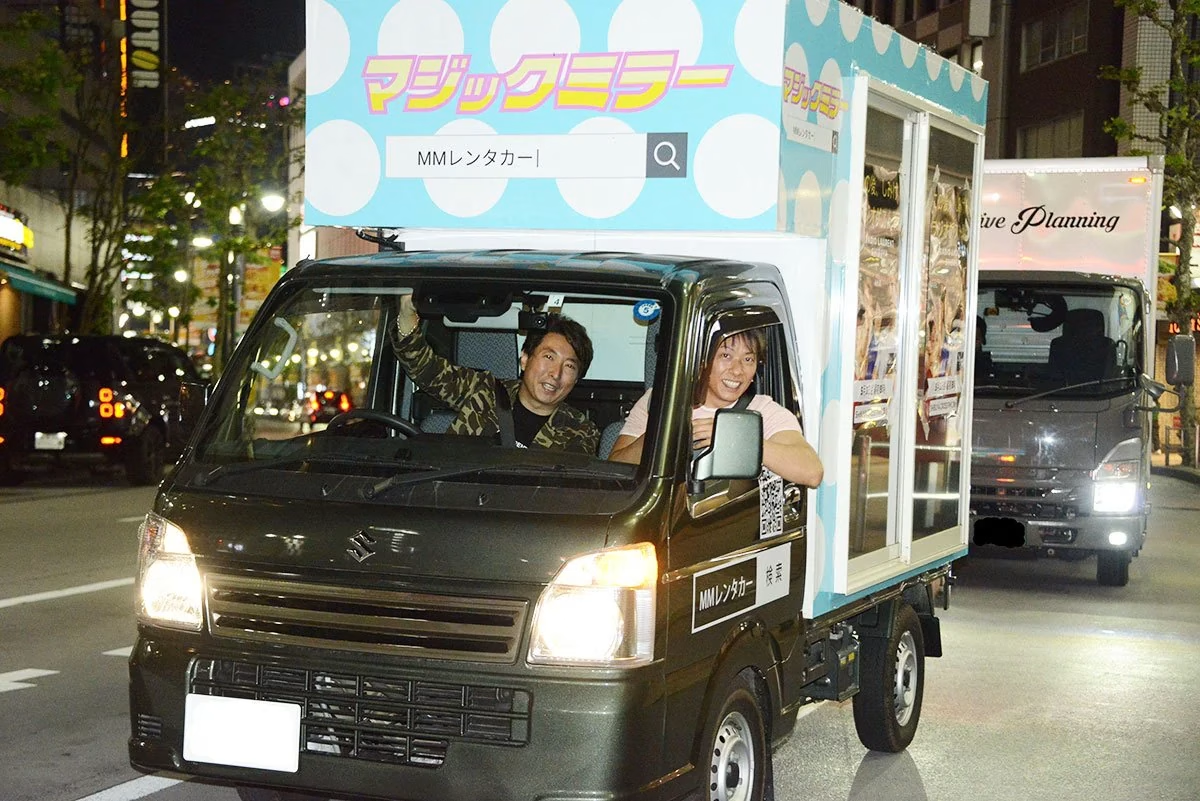
Imagine a van with mirrored windows on the outside, but those inside can see all the people on the street. Japan used exactly this to elevate pleasure and its adult productions in a van called Magic Mirror-go [マジックミラー号]. The idea seems simple, but it changed the aesthetics of audiovisual: city as a backdrop, privacy intact, tension in the air.
Both those inside performing their actions feel that adrenaline of seeing people passing by or even sticking their faces in the mirror. As well as the advertising that such a van can do both locally and in its adult productions. It’s a money-making machine!

Table of Contents
How does the Magic Mirror work?
At its core, the Magic Mirror-go is a van adapted as a mobile studio. Its one-way glass works through light; if the internal light is higher than the external, something may end up being revealed. That’s why the production uses dimmers, curtains, and clever camera angles.
The wheeled form also matters. The van parks in busy places, changes locations quickly, reacts to the weather. In some cases, they participate in events and promotions. Last Halloween, the van was on display to encourage recycling and cleanliness, with trash cans that produced the voices of adult actresses.
The vehicle belongs to the producer Soft On Demand, which is a company that produces adult videos. It has been used for decades in recordings of this type, with several versions built over time.
In the first version, its size was 6 tatamis, with air conditioning and even a shower. In the MM versions, there is only a place with a comfortable sofa and 360 cameras to capture hotter angles.

How is the Magic Mirror usually used?
The Magic Mirror is well-known in the adult entertainment scene in Japan, with hundreds of commercial productions being released. It has even become a sub-genre in AV videos. In some cases, they supposedly approach people on the street to record amateur videos as pick-up.
From this core, sub-series emerged like reverse nanpa (逆ナンパ), thematic variations (bikini, seasons, specific cities) and, in a later phase, NTR — a arc that revived public interest when the franchise cooled down.
In 2019, the “逆転マジックミラー号” (gyakuten = inversion) appears: the “inverted plot” subverts the premise — what seemed hidden turns out to have been seen all along. It’s a creative response to logistical limitations and the saturation of the original format.
In some cases, the Magic Mirror can be used for advertising, TV interviews, artist interviews, and YouTube channels, events, and other non-adult uses. Would you have the courage to enter this van knowing what happened inside?

Types of Magic Mirror
Below we will see the different vans created and their differences:
Original platform (MM号 clássica)
The base is a modified Mitsubishi Fuso Canter truck/camping car: the box receives mirrored glass (one-way) walls and the vehicle operates in “studio mode,” with an expandable capsule (slides out from the body via “slide-out/out-rigger”), air conditioning, shower and about 6 tatamis of internal area. The glass is hidden by a “wing” (shutter/wing) that only opens during filming; at night they need curtains because the interior can become visible. Production cost is around 50 million yen.
The second generation (2001) expanded the space, and over time, the van received several nicknames as it was updated. The operation requires an experienced team and maintenance is laborious — there are even reports of blown tires — due to the weight of the set.
Compact
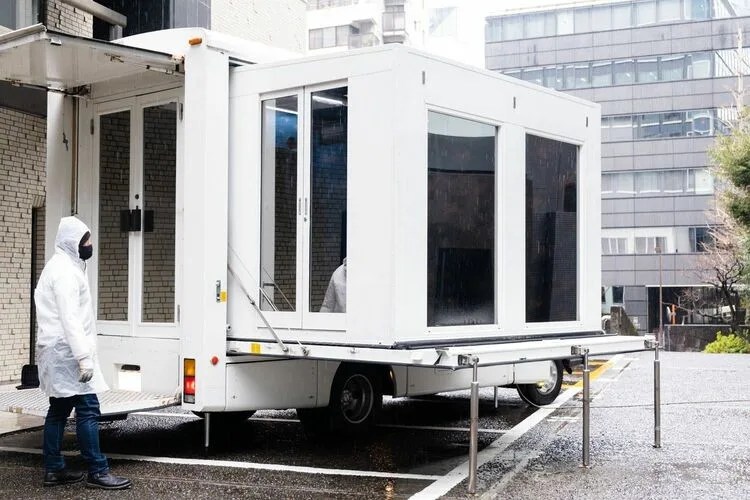
As it was difficult to park the large van in public streets, SOD created in 2009 a compact version of the MM concept called “マジックミラー便 (MM便 / Magic Mirror-bin)”. There is also the “ちびQ” (2004): a mirrored box that can be carried in a kei truck or even pushed — it is not an autonomous vehicle, but a portable MM cabin.
Curiosities about the Magic Mirror
The term “magic mirror” exists outside of AV to designate semi-transparent glass used in observation rooms, market research, interrogations, and teleprompters — but this is the physical concept; the “Magic Mirror-gō” from SOD is specific to adult entertainment.
Technical profiles indicate that the MM号 is practically a unique piece, with over 100,000 km driven and frequent maintenance. The interior was designed as a mobile studio: climate control, dedicated electrical system, and modular setup for cameras and sound capture.
The fact that the van is so easily recognizable attracts crowds, cell phones, and curious onlookers — which ends up contaminating the scenes and making “classic” filming difficult. Therefore, the so-called “magic mirror effect in public places” has, in part, been replaced or adapted for more controlled sets, preserving the visual concept without the inconveniences of the streets.
The popular use of the van in public today is entirely for advertising, events, and interviews with people. What do you think of this Japanese adult business model? Doesn’t it seem like a brilliant idea? If you liked it, share it with your friends!
Leave a Reply