
If you walk through an older neighborhood in Osaka, Tokyo or any other big Japanese city in the evening, you will eventually come across a small door, a red paper lantern and a wooden counter with no chairs. Behind it, an older person pours beer, sake and shochu into small glasses while the customers stand, eat and chat. That is a tachinbo (立ち飲み), literally "drinking while standing". It is not a brand or a chain. It is a whole category of simple, unpretentious bars that have been part of daily life in Japan for decades.
Once you have spent an evening in one, it is easy to see why tachinbo have cult status in Japan: drinks cost very little, food arrives in a few minutes, the mood is relaxed and people who arrive alone rarely stay alone for long. If you have never been inside one, this guide walks you through the origin, the atmosphere, the drinks, the etiquette and the main differences from the better-known izakaya.
Contents 23
What is tachinbo?
The word tachinbo comes from two Japanese terms: tachi (立ち, to stand) and nomi (飲み, to drink). A tachinbo is, quite literally, a place where you stand and drink. Three features usually define the format: a tall wooden counter where guests stand, simple shelves or barrels used as small tables, and very few or no seats at all. Some bars keep three or four stools for older customers, but in most cases there really is just enough room to stand.
The atmosphere is plain, sometimes a little rough, almost always friendly. The menu is written on a blackboard, on a small chalk sign or on the noren (暖簾, the cloth curtain that marks the entrance). The list is short, the kitchen is tiny and the whole experience is designed to move quickly so the next guest can step in.
Tachinbo belong to a wider category of Japanese bars often called taishū sakaba (大衆酒場), or "public drinking houses". That category also includes the seated shirokiya-style bars and the small railway-side joints. Tachinbo are the standing, low-cost version of that family, and they are the most democratic entry point if you want to feel how regular Japanese people actually drink on a weeknight.
History and origins
Tachinbo culture is rooted in Osaka and the Kansai region, and most historians trace it to the years after the Second World War. Between the late 1940s and the 1950s, Osaka rebuilt its central markets and shopping streets from scratch. Workers, merchants and small shop owners needed a place to drink something warm, eat something quick and finish the day without spending much. Bars that simply removed the chairs turned out to be the cheapest way to serve that crowd.
Through the 1960s and 1970s, the format spread fast. Reconstruction brought more foot traffic, more night-time work and more money for small pleasures, and tachinbo popped up around train stations, under shopping arcades and along the backstreets where office workers cut through on their way home. The style stayed popular in Osaka long after the rest of the country had moved on to bright, plastic izakaya chains.
From the 1980s onwards, tachinbo quietly expanded into Tokyo, Yokohama, Kyoto and Kobe. The capital now has its own standing-bar districts in areas like Ueno, Shimokitazawa and parts of Shinjuku, but the heart of the culture is still in Osaka. In recent years, tachinbo have also become a talking point on social media and travel blogs, which has helped a younger audience rediscover the format.
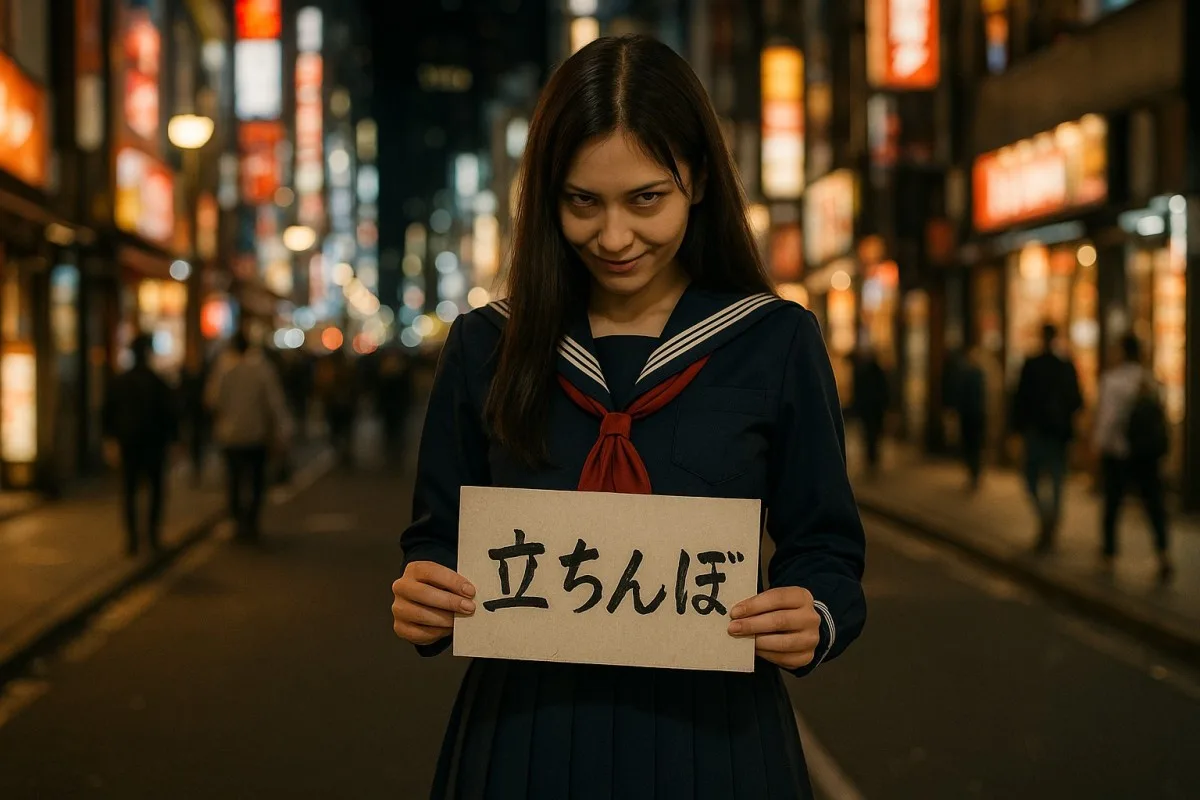
It helps to separate two very different uses of the word tachinbo. The standing-bar format described here is 立ち飲み ("standing drink") in kanji. The romanized spelling tachinbo is also used in Japanese media to refer to a different and unrelated subject, so if you are searching online, double-check the kanji before you trust a result.
Characteristics of a tachinbo bar
Even though no two tachinbo are identical, a few details show up again and again. Knowing them in advance makes the first visit feel a lot less awkward.
Layout and decoration
Almost every tachinbo uses a tall wooden counter that runs along one or two walls, with the kitchen and drinks on the inside. Shelves behind the counter hold bottles, glasses and small plates. The lighting is warm, sometimes a little yellow, and most of the room is lit by a single akachōchin (赤い提灯), the small red paper lantern that hangs near the entrance. A faded noren curtain and a few wooden signs usually do the rest of the decoration.
How service works
Most tachinbo follow a simple flow. You walk in, take any open spot at the counter and either order from the master or the okami (the woman who runs the floor) directly, or grab a plate of oettai (お節介, the small side dishes already laid out on the counter) and start there. Drinks arrive in seconds because most of them are simply poured from a bottle, a tap or a jar.
When you leave, the master tallies what you had and you pay on the spot. There is no table service in the restaurant sense, and there is no tipping. If the bar is full, the person next to you may simply push a little to the side so you can squeeze in. That is normal.
The osettai and sashi-modoshi systems
Two small customs shape the way tachinbo food is served. Osettai (お節介) refers to the small plates of food the bar puts on the counter for everyone to share at the start of the evening: a few pieces of oden, a small dish of edamame, sometimes a slice of butter with cucumber. The idea is that nobody has to drink on an empty stomach, and the cost of those first bites is folded into the price of the first drink.
Sashi-modoshi (差し戻し) is the opposite move. If you order a small plate and do not finish it, the staff simply takes it away. The bar does not throw it out, though: it is sent back to the kitchen to be reused in another dish. It is a small, polite way of saying that waste is not part of the experience, and that finishing what you ordered is the right thing to do.
Smoking and the anti-tobacco shift
For a long time, smoking was simply part of the tachinbo atmosphere. Cigarettes went well with sake, and the layout was already designed to deal with the smell. That changed gradually with Japan's indoor smoking rules introduced in the late 2010s and early 2020s. Many tachinbo now ban smoking inside, separate smokers with a small partition or close earlier in the evening. The atmosphere is still relaxed, but the room is usually clearer than it used to be.
Drinks and food
The tachinbo menu is short on purpose. Most places rotate a handful of drinks and a small set of dishes, and the master decides what to cook based on what came in fresh that morning. If you do not know what to order, the easiest move is to ask for the master's choice.
Typical drinks
The most common drinks at a tachinbo are exactly what you would expect from a Japanese neighborhood bar.
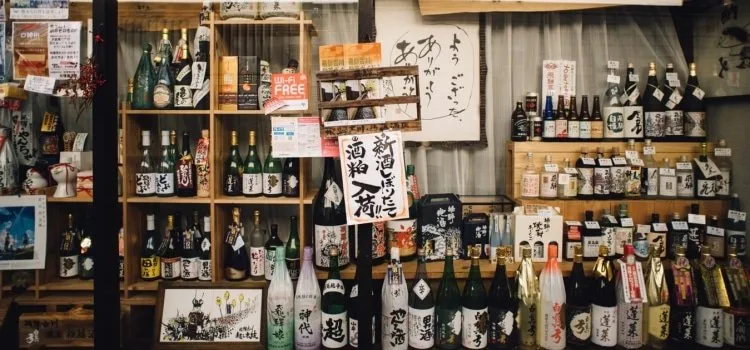
- Sake (日本酒): usually served in a small cup called an ochoko, in a masu (wooden box) or in a tokkuri (small carafe). One standard pour is one go (合), which is 180 ml. Sake can be served at several temperatures, which are covered in the etiquette section below.
- Shochu (焼酎): a stronger distilled drink made from sweet potato, barley, rice or brown sugar. It is usually served on the rocks (rokku de), with cold water (mizuwari), with hot water (oyuwari) or in a chu-hi. It is the workhorse drink of many tachinbo.
- Chu-hi (チューハイ, short for shōchū highball): shochu mixed with sparkling water and a slice of lemon or lime. Light, easy to drink and usually one of the cheapest options on the menu.
- Beer (生ビール, nama bīru): draft beer served very cold. The standard pour is a chū jokki (中ジョッキ), a medium mug of about 500 ml, although a smaller nomi-komi glass is also common.
- Highball (ハイボール): whisky and sparkling water over ice. Suntory popularized the format decades ago, and it is now a default option in most tachinbo.
Typical food
Food at a tachinbo is meant to be fast, salty and perfect with a drink. The same handful of dishes shows up all over the country.
- Oden (おでん): a winter stew of daikon (radish), boiled egg, konnyaku (jelly-like tuber) and fishcake simmered in a light dashi broth.
- Edamame (枝豆): young soybeans boiled in the pod and sprinkled with salt.
- Hiya yakko (冷奴): a block of cold tofu topped with grated ginger, sliced green onion and a splash of soy sauce.
- Sunomono (酢の物): a small vinegared salad, often with cucumber, seaweed or octopus.
- Karaage (唐揚げ): Japanese fried chicken, juicy on the inside and crispy on the outside.
- Tataki-age (たたき揚げ): small pieces of fried tofu with a light, herby batter.
- Tako-san (蛸さん): boiled octopus pieces served with a dab of wasabi.
- Kyūri ippon-zuke (きゅうり一本漬): a whole quick-pickled cucumber, sliced at the counter.
- Niku-jaga (肉じゃが): the homey stew of meat, potatoes and onions that is almost a national comfort dish.
- Ninniku-yaki (にんにく焼き): garlic grilled in oil, often served with slices of bread or vegetables.
Tachinbo vs izakaya: key differences
The most common question travelers ask is how a tachinbo differs from an izakaya (居酒屋). Both are Japanese bars where people drink and eat, but they are designed for different moments.
An izakaya is a sit-down bar-restaurant. Guests usually have a full table, a printed menu with photos, sometimes even a private room, and a much wider list of drinks and dishes. Service is table-based, the bill is calculated at the end, and the price per head is usually noticeably higher. Many chains in Tokyo, Osaka and other big cities fit this description.
A tachinbo is the more informal, more local cousin of the izakaya. Guests stand at a wooden counter, the menu is short and written by hand, drinks cost a fraction of what they would in a chain izakaya and the food is meant to be eaten in three or four bites. The pace is faster and the room is louder, but the experience is also more honest about how regular people in Japan actually go out for a drink.
You can think of it this way: an izakaya is where you go to celebrate a birthday or close a deal, a tachinbo is where you go because it is Tuesday and you want a beer and a plate of oden on the way home. Both serve sake, both are central to Japanese drinking culture, and most locals happily move between the two depending on the mood. In Osaka you may also hear the word fudō (不動) for a similar standing-bar format, especially in older neighborhoods.
Tachinbo culture and etiquette
Standing bars feel easy once you know a few small rules. None of them are strict, but they help the evening run smoothly for you and for the people around you.
Standing, talking and the social counter
Because everyone is at the same counter, strangers end up shoulder to shoulder within minutes. In busy hours, a regular tachinbo will rotate customers slightly so newcomers can squeeze in. Once you are in, a short nod or a quick sumimasen ("excuse me") to the neighbor is enough. The famous champuru spirit of Okinawa has its own name, but the same easy-going mix of strangers and regulars is the default mood in any tachinbo.
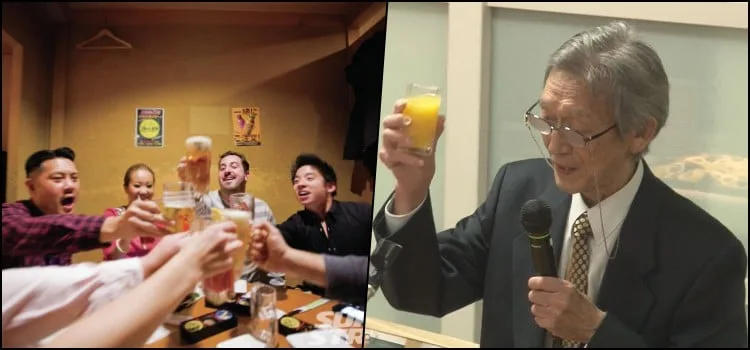
Light conversation with the person next to you is welcome, especially after the second drink. Topics like where you are from, what you do for work, the local baseball team or the food on the counter are all safe. Loud phone calls, drunken singing and heavy political arguments are not.
Ordering and paying
You can order by pointing at the menu on the wall, by saying the name of the dish or, very often, by simply telling the master that you would like whatever he or she recommends. Omakase ("I leave it up to you") is a perfectly normal phrase to use.
Many tachinbo use a small tabe (sometimes written as "tab"), which is just a running count of what you have had. When you leave, the master reads it back to you and you pay the total in cash. Tipping is not a thing in Japan. Leaving small change on the counter can even confuse the staff.
Sake temperature options
Sake is one of the drinks that changes the most with temperature. The four main options a tachinbo will offer are:
- Jō-on (常温): room temperature, around 15 to 20°C. The default way to taste good sake.
- Reishu (冷酒): chilled, around 5 to 10°C. Light and crisp, good in summer.
- Nuru-kan (温燗): gently warm, around 30 to 40°C. Smooth and rounded, good with richer food.
- Atsu-kan (熱燗): hot, around 45 to 50°C. The classic winter option, especially with oden.
Do not be shy about asking. Most masters will happily bring a small sample so you can pick the temperature you like.
Basic etiquette
A few small habits go a long way. Do not shout across the room to order, because the master is usually only a meter away. Do not switch seats repeatedly; once you are in, stay in. Do not get visibly drunk: pacing yourself is part of the culture. And when you leave, a short gochisōsama deshita ("thank you for the meal") to the master is the perfect closing line.
Where to find tachinbo in Japan
Tachinbo exist almost everywhere in Japan, but a few neighborhoods make the format especially easy to try.
Tokyo
Tokyo's standing-bar scene is concentrated in the older shitamachi districts. Ueno still has small tachinbo tucked under the Ameyoko shopping street, Asakusa mixes standing bars with traditional izakaya around Senso-ji, and Shimokitazawa and Nakano lean younger, with more music and a more indie feel. A short walk away from the main stations is where you will find the most authentic places.
Osaka
Osaka is the spiritual home of tachinbo. The areas around Dōtonbori, Shinsekai and Tsuruhashi are dense with standing bars of all sizes. The small alleys behind the main avenues are where most of the older, more local tachinbo still operate. Prices are usually a little lower than in Tokyo, and the atmosphere is louder and more open.
Kyoto
Kyoto is better known for kyō-machiya dining and high-end kaiseki, but it also has a solid standing-bar scene. Ponto-chō and the backstreets near Gion have a few tachinbo hidden among the traditional houses, and a few cluster near Kyoto Station and the office districts. They tend to be smaller and quieter than the Osaka version, which is part of their charm.
Yokohama and beyond
Yokohama has a good number of tachinbo around Chinatown, the port area and the Koreatown in Tsurugamine. Kobe, Nagoya and Fukuoka also have their own local tachinbo scenes, and almost every mid-sized city in Japan has at least a couple of standing bars near the main station.
Practical tips for first-time visitors
Visiting a tachinbo for the first time is easier if you keep a few things in mind. Bring cash, because most of these bars do not take cards. Learn the basics: sumimasen ("excuse me") to call the master, arigatō gozaimasu ("thank you") when leaving and gochisōsama deshita ("thank you for the meal") to close the evening. If you do not read Japanese, a translation app that works offline is enough to read the menu. And remember: tachinbo are about the small, ordinary moment of drinking with your neighbors, not about ticking off a tourist checklist. Order what looks good, slow down, and let the master do the rest.
Final thoughts
Tachinbo are not the most famous part of Japanese food culture, but they are probably one of the most honest. There is no branding, no script, no elaborate service ritual. Just a counter, a few drinks, some simple food and a room full of people who came in alone and leave as part of a tiny temporary community. If you ever get the chance to spend an evening in one, take it: it is the easiest way to see how everyday Japan actually drinks.


Community
Comments
0 comments
There are no published comments in this language yet.
Send comment