
Lotteries and bets have existed since the time of the Hebrews, Egyptians, Hindus, Chinese, and Romans. Thousands of people around the world bet daily in the hope of winning the lottery, and the Japanese are no different.
Some see lotteries as a waste of money, others play casually, and there are those who fully dedicate themselves and are rewarded for using mathematical strategies. No matter where you fit in, today we will look at some curiosities about the lotteries of Japan and Brazil.
We have already written about gambling in Japan, so this time we will focus specifically on the lottery side of things.
Contents 4
Lotteries in Brazil
In Brazil, the lottery emerged in 1784, in Vila Rica, the former capital of Minas Gerais. From there, lotteries spread throughout the country. The first regulation in Brazil was published on April 27, 1844.
In 1961, President Jânio Quadros determined that the Federal Government would be the only party responsible for conducting lotteries in the country and that the drawing system would be managed by the Caixa Econômica Federal.
It was in 1996 that one of the most famous games in Brazil emerged, the beloved Mega-Sena, which takes place twice a week. Only in 2008 did the famous Mega da Virada appear, drawn on December 31.
Brazil usually has around ten lottery games running. Some have been discontinued, but the following modalities are the ones most players will recognize today:
- Mega-Sena;
- Timemania;
- Lotofácil;
- Lotomania;
- Dupla Sena;
- Quina;
- Lotogol;
- Loteca;
- Loteria Federal;
- Dia de Sorte;
There are other lotteries that were discontinued over the years, such as Toto Bola, or the famous scratch cards of Instant Lottery, which were pulled after a federal decree.
How do some people play the lottery?
Both in the West and in Japan, people have the habit of playing lucky numbers, numbers they dreamed of, or numbers tied to personal milestones. In Japan, the culture of luck is especially strong because of its Shinto and Buddhist beliefs.
Some use lottery generators, run advanced calculations, and apply real strategies in order to win, even if the prizes are small. There are people who live almost entirely off betting.
Once, I stood in line at a lottery outlet to pay a bill, and the woman in front of me spent almost an hour filling out about 100 lottery tickets. She was clearly determined to win.
Takarakuji: Lotteries in Japan
Takarakuji [宝くじ] is the name given to Japanese lotteries, where takara [宝] means treasure and kuji [くじ] means lottery draw. In other words, literally "treasure lottery."
Unlike Brazil, where it is more common to buy tickets and scratch cards at lottery outlets, in Japan you can buy them at city halls, convenience stores, and specialized points called takarakuji.
Ticket prices for Japanese lottery games usually range from 100 to 500 yen, and prizes can exceed 100,000 yen. Below are the different types of lottery games you can find in Japan:
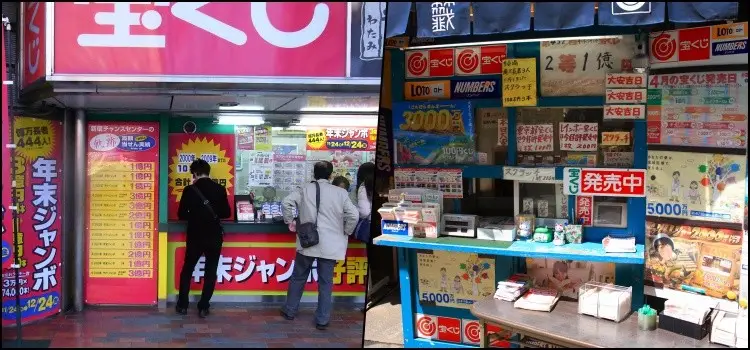
Nenmatsu Jumbo Takarakuji — The largest lottery in Japan, drawn on the last day of the year, similar to Mega da Virada. Tickets are sold in sealed packages, so you do not pick your own numbers.
Jumbo Green, Jumbo Dream, and Jumbo Summer — In addition to the New Year's lottery, there are three other jumbo lotteries that take place in March (Green), June (Dream), and August (Summer).
Mini Lotto — The ticket costs ¥200, and draws take place on Tuesdays. In this game, you choose 5 numbers from 1 to 31, and a bonus number is randomly selected by the machine.
Numbers 4 — You need to choose a number between 0000 and 9999. Those who match the number can win up to more than one million yen.
Numbers 3 — You choose a number between 000 and 999. The draw takes place during the week at 6:45 PM. Those who match the number can win up to ¥80,000. The ticket usually costs 200 yen.
Loto 6 and Loto 7 — 6 or 7 main digits are drawn, quite similar in feel to Mini Lotto.
Sukuratchi — Scratch cards with instant prizes. Tickets usually cost between ¥100 (Lucky 3) and ¥200 (Puzzles Scratch, Mrs. Happy Link, and Scratch Lottery).
Kuji no Hi — Drawing Day
When you buy Takarakuji tickets at any time of year, keep them until the next September 2, even if you have not won anything.
On that date, mini prizes are drawn, and the day is called kuji no hi [くじの日]. If you hold the drawn number on one or more tickets, you win a small prize.
If your number comes up, just go to the nearest lottery outlet, or request a hagaki (postcard) to choose one of the prize options for the year.




Community
Comments
0 comments
There are no published comments in this language yet.
Send comment