
In the 1990s, a stop at a Japanese gas station often felt like a small theatre of hospitality: teams in matching uniforms greeted drivers, pumped the fuel, wiped the windshield, and took out the trash — quick, friendly, and treated as ordinary good manners. Anyone who lived through that era still notices the contrast with today's quiet touchscreens.
Self-service pumps and machines now shape everyday refueling, but full-service stations never disappeared. If you drive in Japan — on a rental, after sorting a Japanese driver's license, or in daily life — what you really need is the difference between セルフ and full service, the fuel color codes, and a few Japanese words. That is worth learning before the first fill-up.
Contents 7
Fewer stations — not "almost all self-service"
At the end of fiscal year 1994, Japan still counted about 60,421 service stations (SS). By the end of fiscal 2024 that number had fallen to around 27,009 — more than half gone. The Petroleum Association of Japan points to lower gasoline demand, more efficient cars, competition, costs for underground tanks, and the long shift in how people move around.
- Public transport efficiency: In big cities many people skip private cars for trains and subways; if trains are more your thing, start with how people ride the rails in Japan on pieces like the JR Pass and train travel.
- Full service and self-service side by side: Since 1998, customers have been allowed to pump under qualified staff supervision. At the end of FY2024 there were about 10,915 self-service stations — roughly 40% of all SS. The majority are still full service, even though セルフ stands out on busy roads and late at night.
- Hybrids and electrics: Fewer pure gasoline cars and more alternative powertrains pressure classic stations over time — the change is gradual and uneven, especially outside the big metro areas.
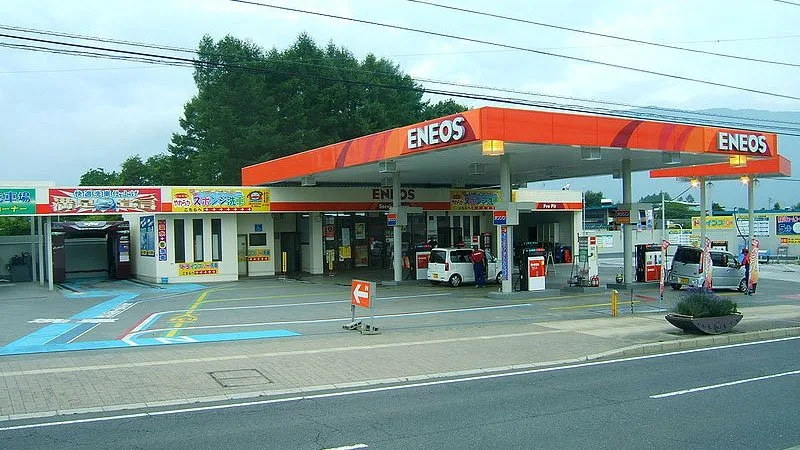
Full service: the famous welcome
At full-service stations you stay in the car. Staff pump the fuel, often with a greeting and small extras such as wiping the glass. In cities and on expressways this model is still common; the price per liter is often a little higher than pure self-service next door — in exchange you save time and guesswork if the machine interface is still new to you.
Anyone on Japanese roads also benefits from clear traffic signs in Japan and the colorful car stickers (wakaba and more) — both sit in the same everyday package as refueling.
How self-service works
Self-service stations are usually marked with the word セルフ (serufu) on signs. At the pump, a touchscreen walks you through each step. Staff are typically on site and step in when something is unclear — "self" in Japan does not always mean unmanned.
A typical flow on many machines (brands may reorder a step or two):
- Engine off, parking brake, safe position at the island.
- Touch the static pad (often a metal plate or button) before you grab the nozzle — that discharges static electricity and is a standard safety note in Japan.
- Start on the screen (often 開始 / kaishi).
- Payment method: cash (現金 / genkin), credit card (クレジットカード), or a chain/membership card.
- Choose fuel — screen colors match the nozzles (see below).
- Amount: yen value, liters, or 満タン (mantan) for a full tank.
- Insert the nozzle, fill, return it, take the receipt.
Payment options commonly include:
- Cash (現金で – genkin de)
- Credit card (クレジットカードで – kurejito kādo de)
- Store or chain cards with points or small discounts
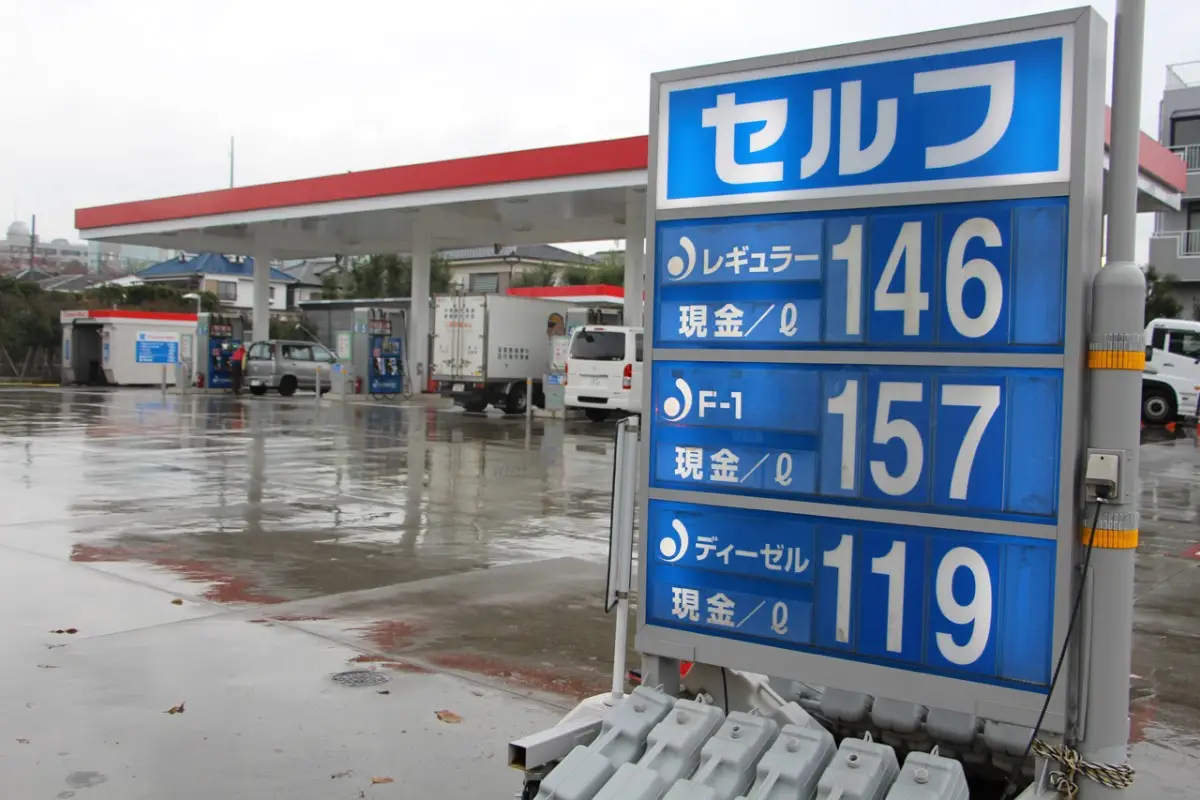
Fuel types and color codes
Japanese pumps usually offer three fuels — and the color codes help avoid mistakes:
- Regular gasoline (レギュラー – regyurā): usually red; the everyday choice for many private cars.
- Premium / high-octane (ハイオク – haioku): often yellow; higher octane for engines that require it.
- Diesel (軽油 – keiyu): commonly green; for diesel cars, trucks, and buses.
Modern systems and color matching make misfueling less common — still, check the sticker on the fuel door and the car display. Many machines ask for a short confirmation before fuel starts flowing.
Gas prices in Japan
Liter prices move with the week, the region, the chain, membership deals, and temporary government measures. Instead of a forever price list: the board at the station is what you pay. As a recent national orientation, regular often sits around 160–180 yen per liter, haioku a bit higher, and diesel on its own track — not always automatically cheaper than regular.
- Regular (レギュラー): often near about 170 yen/L in nationwide averages, with regional spread.
- Premium (ハイオク): typically around 10 yen/L above regular, depending on the week.
- Diesel (軽油): its own price line; do not assume it is always cheaper than regular.
Self-service is often slightly cheaper than full service at the same brand — the per-liter gap is small enough that comfort, time, and confidence still matter. If you are budgeting a car in Japan, it helps to read how car insurance in Japan works alongside fuel costs.
Useful vocabulary at Japanese gas stations
If you plan to drive in Japan, these phrases help at the machine and with staff:
- ガソリンスタンド (gasorinsutando): gas station
- セルフ (serufu): self-service
- 満タン (mantan): fill the tank
- 現金で (genkin de): pay with cash
- クレジットカードで (kurejito kādo de): pay with credit card
- 灰皿 (haizara): ashtray
- ガソリン / レギュラー (gasorin / regyurā): regular gasoline
- ハイオク (haioku): premium gasoline
- 軽油 (keiyu): diesel
- 開始 (kaishi): start (on the touchscreen)
Where gas stations are heading
Fewer outlets, a higher self-service share, and growing charging for electric and plug-in hybrid vehicles are reshaping the map. Big brands such as ENEOS and others rebuild networks that mix classic fueling with new services. At the same time, gasoline and hybrid cars remain daily tools in many rural areas — places where public transport is thinner and a car is still a necessity.
For travelers and everyday drivers, the practical takeaway is simple: expect セルフ machines and touchscreens, but also real full service — and give yourself a little patience for the first screen. With color codes, 満タン, and the phrases above, the "mysterious terminal" turns into routine faster than it looks.




Community
Comments
0 comments
There are no published comments in this language yet.
Send comment