
An Escape Room is an immersive puzzle experience that puts your mental skills and problem-solving abilities to the test. In Japan the format has long been part of pop culture, and major providers such as SCRAP run their scenarios in English and Chinese so that international visitors can play along.
At its core, an Escape Room is a kind of indoor scavenger hunt: you and a small group are locked inside a themed space and usually have 60 minutes to work through a series of puzzles, combine the clues, and find the key or code that opens the way out. Some rooms are pure logic and observation, while others wrap the puzzles in a story whose atmosphere shapes the pace and the decisions of the group.
Since the first dedicated rooms appeared around the year 2000, the concept has spread quickly. Today there are roughly 3,000 fixed Escape Rooms worldwide, and the number of people playing them each year is estimated at around 1.6 million.
Contents 6
What is an Escape Room?
An Escape Room works like a live adventure set in a single, carefully designed space. The team collaborates, inspects the props, decodes combinations, and calls out loud what each person has found. A clock on the wall counts down the time; everything else belongs to the puzzle.
What makes it compelling is the mix of three ingredients: a hard time limit, a story that gives the investigation some shape, and a controlled environment in which nothing surprising happens from the outside. You can focus fully on solving, without the usual distractions of daily life.
Common genres include horror scenarios with dim lighting and unsettling soundscapes, adventure sets in temples or old mansions, science-fiction worlds, and crime stories in which the group itself becomes part of the plot. Beginner-friendly rooms lean on search tasks and logic, while experienced groups usually prefer narrative rooms with several phases and stronger roleplay.
History and SCRAP in Japan
In Japan, SCRAP is the pioneer of the genre and a household name among puzzle fans. Beyond running its own venues, the company also organises large-scale events, including an Escape event at the Tokyo Dome where thousands of participants played at the same time.
From 2015 onward, SCRAP began offering two of its most popular scenarios on a permanent, multilingual basis: Escape from the Red Room and Escape from the Haunted Manor. Both run at the Real Escape Room Asakusa in Tokyo, where English and Chinese versions are available. Tickets cost ¥1,800 in advance and ¥2,300 at the door.
Escape from the Red Room looks deceptively simple: six players are locked into a room painted entirely red, with nothing in sight except two padlocked doors. Even so, only about 3% of groups crack the code within the 30-minute time limit. A 10-minute extension is available for an extra ¥800, which lifts the success rate to roughly 15%.
Escape from the Haunted Manor tells a far creepier story, built around a murdered child and a string of strange disappearances. The gameplay is denser than the Red Room, because it layers haunted-house atmosphere, scavenger-hunt mechanics, and classic puzzle-solving, all under shifting light and a soundtrack designed to distract as much as to frighten. The price and time rules match the Red Room.
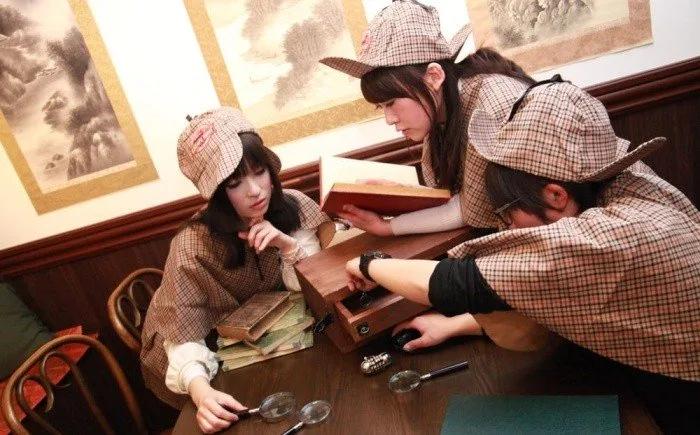
The Underground Mysteries: Tokyo as a game board
For the third year running, SCRAP has also been collaborating with Tokyo Metro to run The Underground Mysteries, a puzzle game that spreads across the entire Tokyo subway network. Once you have gathered all the clues, you can submit the final answer on the SCRAP website to complete the game. Since 2015, this format has also been offered in English and Chinese.
Unlike a traditional Escape Room, The Underground Mysteries lets you solve at your own pace. On top of the game materials, each group gets a day during which Tokyo Metro opens sections of the system exclusively for the event. Participants move freely between stations, and a full run takes about four hours. One of the best parts of the game is that you can reach places that are normally off-limits to regular passengers, including areas behind the platforms and the technical levels underneath.
A quick stop in São Paulo
The concept is not limited to Japan. Brazil has its own Escape Room scene too, especially in São Paulo. The scenarios there often lean on tropical settings, urban crime stories, or historical themes, which shows how adaptable the format is to different cities and storytelling traditions.
Tips for your first Escape Room
If you plan to try an Escape Room in Tokyo, a few simple pointers make the first visit smoother:
- Mind the group size: Most rooms work best with 4 to 6 players. Groups that are too small miss clues; groups that are too large get in each other's way.
- Stay calm and talk: The most common mistake is everyone shouting at once. Split the tasks and call out clearly what each person has found.
- Book in advance: Popular slots, especially on weekends, fill up weeks ahead at Asakusa. Online booking also saves you ¥500 per ticket.
- English is enough: The SCRAP rooms in Asakusa run in multiple languages, so you do not need any Japanese to play.
- Check for claustrophobia: If you are uncomfortable in tight spaces, ask about the room size before booking. The Red Room is one of the more confined options.
More information
If you want to dig deeper into the topic, the links below cover the concept, the history, and the official channels behind Japan's Escape Room scene.


Community
Comments
0 comments
There are no published comments in this language yet.
Send comment