
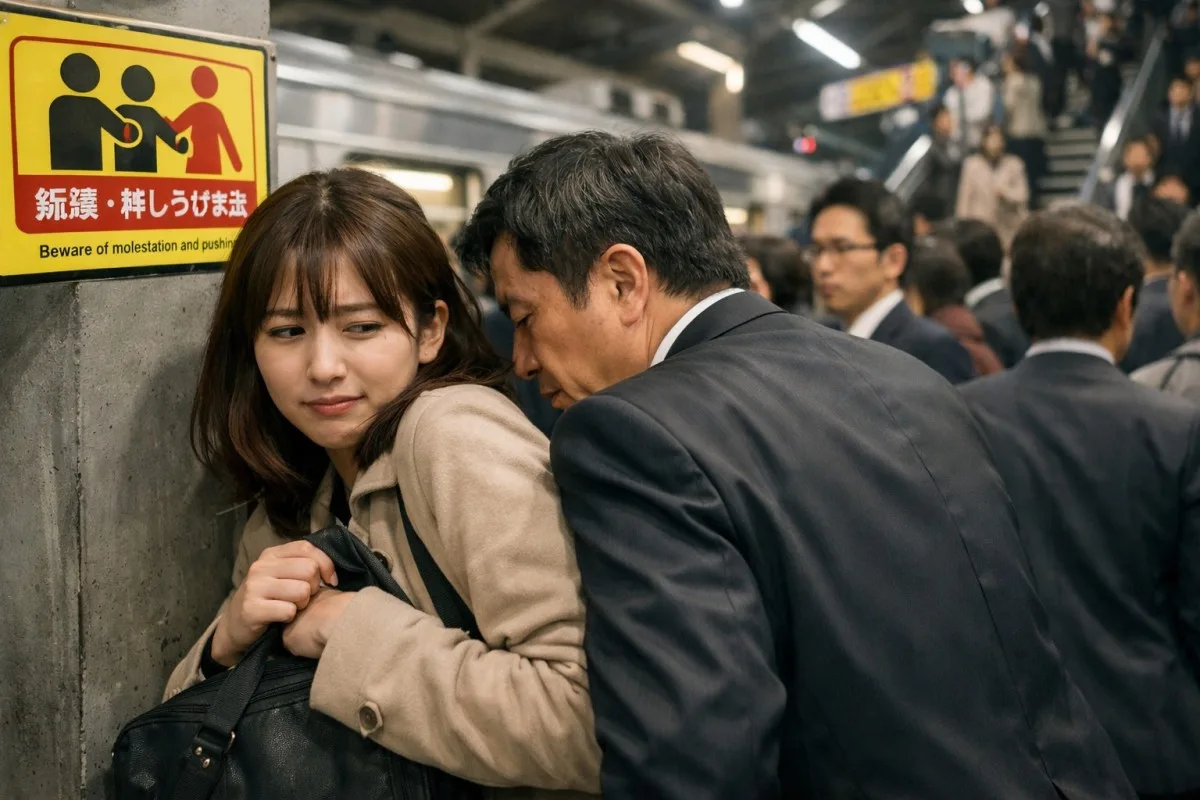
Butsukari Otoko is a term that has started to circulate more strongly in Japan in recent years, especially among young women who use public transportation daily. Perhaps you have already seen this name on Japanese social media or in foreign reports. It describes a specific, silent, and disturbing behavior: men who intentionally push women in crowded stations or trains. Does it seem like a small thing? It’s not. And understanding this phenomenon says a lot about urban life in Japan.
In the next few minutes, I want to explain to you what is really behind Butsukari Otoko, why it happens, how Japanese society reacts, and why this topic deserves attention, even outside of Japan.
Table of Contents
What does Butsukari Otoko mean, after all?
The word Butsukari Otoko (ぶつかり男) can be literally translated as “man who collides” or “man who bumps.” But the translation does not tell the whole story. In everyday use, the term refers to men who bump into or push women on purpose, usually in crowded environments like train platforms, escalators, or stations.
It is not an accident. It is not a lack of space. The pattern repeats: the man adjusts his body, speeds up, and directs the impact. Many victims report strong pushes on the shoulder, back, or even the chest. In some cases, the aggressor continues walking as if nothing happened.
The most unsettling detail? There is almost never eye contact or words. Silence is part of the act.

Why does this behavior happen in Japan?
This is the question many people ask. Japan is known for education, order, and respect for public space. So how does something like this manifest?
Experts in social behavior and gender point out several factors:
- Emotional repression: Japanese culture values extreme self-control. Negative emotions are rarely expressed directly.
- Silent misogyny: the push becomes a form of aggression without immediate consequences, especially in an environment where confrontations are avoided.
- Urban anonymity: crowded stations create the perfect scenario. No one knows who is who. Everything happens quickly.
- Power imbalance: many victims report fear of reacting, especially younger women or foreigners.
There is no single profile of Butsukari Otoko. Some wear suits, others casual clothes. This makes the problem even harder to predict.
How do Japanese women deal with Butsukari Otoko?
This is where a delicate part comes in. Many victims do not report. Not because they don’t care, but because reporting requires evidence, witnesses, and the willingness to face a bureaucratic system. In quick pushes, this almost never exists.
Some common strategies reported by women in Japan include:
- Avoiding certain routes or times
- Walking close to other women
- Carrying backpacks in front of the body as protection
- Reporting experiences anonymously on social media
Interestingly, the term Butsukari Otoko gained strength precisely because women started to name the problem. Naming takes the aggressor out of symbolic anonymity. And that changes everything.

Does Japanese society recognize the problem?
Yes, gradually. TV programs, newspapers, and even the Japanese police have addressed the topic publicly. Some stations have installed visual warnings alerting against intentional pushes, something unthinkable years ago.
There are also broader campaigns against harassment on public transportation, which include Butsukari Otoko alongside more well-known issues, such as chikan (sexual groping).
Still, the debate is far from over. Part of society minimizes the problem, treating it as “just a part of daily life.” Other voices, especially female ones, insist: it is not normal, it is not acceptable.
What does Butsukari Otoko teach us about modern Japan?
This phenomenon reveals an important contradiction. An extremely organized country can hide deep tensions beneath the surface. Silence, which is often seen as a cultural virtue, can also become a shield for abusive behaviors.
If you are interested in Japanese culture, it is worth going beyond what appears in anime, dramas, or tourist guides. Butsukari Otoko shows a real, complex Japan, full of nuances and contemporary social challenges.
Think about this the next time you hear someone say that “in Japan everything works perfectly.” It works. But not always for everyone.
Leave a Reply