
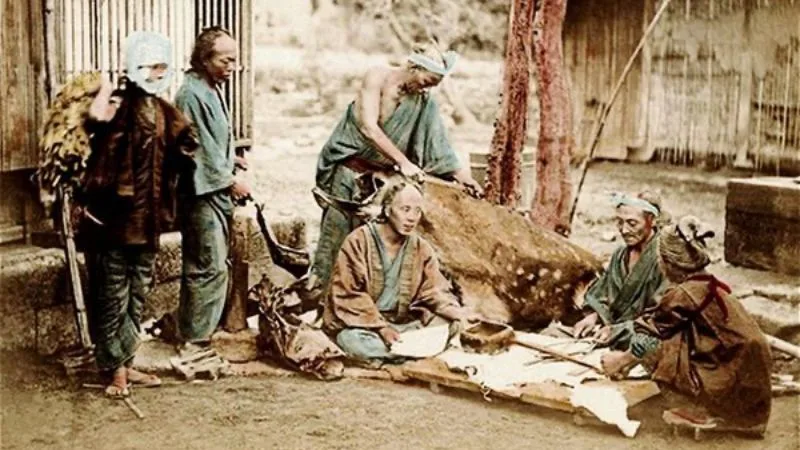
Burakumin [部落民] is a Japanese word used to refer to a class in Japan, approximately 3% of Japanese people who suffered intense prejudice due to their social class or lifestyle.
During the medieval period, the burakumin were the lowest class in the social hierarchy. They worked in roles considered impure, such as executioners of criminals, leather manufacturers, butchers, street cleaners, and grave diggers.
Traditionally, they lived in specific ghettos and were prohibited from attending temples of other social groups. The feudal system known as caste was also hereditary, which perpetuated the social stigma of the group.
The basis of discrimination against the burakumin comes from the Shinto precept of purity. With the introduction of Buddhism in Japan, the notion of impurity associated with death and the consumption of certain animals further separated the Burakumin.
Meaning of Caste – Any social group, or rigid system of social stratification, of hereditary nature.
Table of Contents
The Origin of the Burakumin
It is not known exactly how the Burakumin emerged, but historians say there are three different versions to explain their emergence:
The first says that they are descendants of the aborigines, primitive peoples of Japan, who were dominated by the peoples who arrived in the country later. The second says they are Filipino and Korean immigrants.
And the third version says that the burakumin are people who, a long time ago, were tasked with killing, cleaning, and preparing animals for consumption. After some time, they were also tasked with preparing the deceased for funerals.
In the mid-18th century, the reformer of Shintoism, Atsutane Hirata, wrote that the Burakumin were impure and inferior, and should remain separate from society and prohibited from entering the temples of other castes.
Only in 1871 could the burakumin live outside the ghettos, but social discrimination remained. To this day, a large part of the workers in dirty jobs such as landfills and meat processing plants are burakumin.

The Descendants of the Burakumin
Nowadays, it is not as easy to recognize a Burakumin as it was in the past, because, during the Tokugawa period, for example, they lived in ghettos and wore specific clothing that identified them.
But today it is no longer like that, so there is no certainty about who is or is not burakumin, although they are associated with people working in landfills, sewage systems, slaughterhouses, and with the preparation of corpses; others can do the same jobs.
Most descendants of the Burakumin prefer to hide their origins to avoid prejudice. Because if they reveal their origin, they may lose the opportunity to get a good job or even to marry. And a person already employed can even be fired if they reveal their origin.
Even today, Japanese companies buy lists made by private detectives indicating which families have Burakumin origins to avoid hiring people from those families, which greatly hinders the Burakumin from changing their economic and social situation.
There are also reports that some Japanese families use these lists to prevent descendants of the Burakumin from marrying any family member.
It is important to emphasize that some of the most important artists in the history of Japan are Burakumin. Among them, there were several artists and creators of noh theater, as well as kabuki and kyogen.

Has Prejudice Decreased?
Fortunately, this prejudice has been decreasing in Japan, evidenced by the decree of the Japanese government in 1871, which stated that the Burakumin would be considered common citizens, having the same rights before the law as other social classes in Japan.
But there are still many people who consider the burakumin to be a dirty and inferior class, and most descendants of the Burakumin still work in undervalued professions, likely inherited from their ancestors.
And since that decree of 1871 did not come with any financial or educational assistance, many Japanese continue to think the same way, and the burakumin remain Burakumin.
But it is worth mentioning again that there are many important Japanese artists who are descendants of the Burakumin. In the current scenario, there are some who are famous writers, entrepreneurs, or hold political positions.
For example, the former governor of Osaka and current mayor of the city of Osaka, Toru Hashimoto, is a burakumin, as are the writers Manabu Miyazaki and Kenji Nakagami, not to mention the founder and president of Uniqlo, Tadashi Yanai.
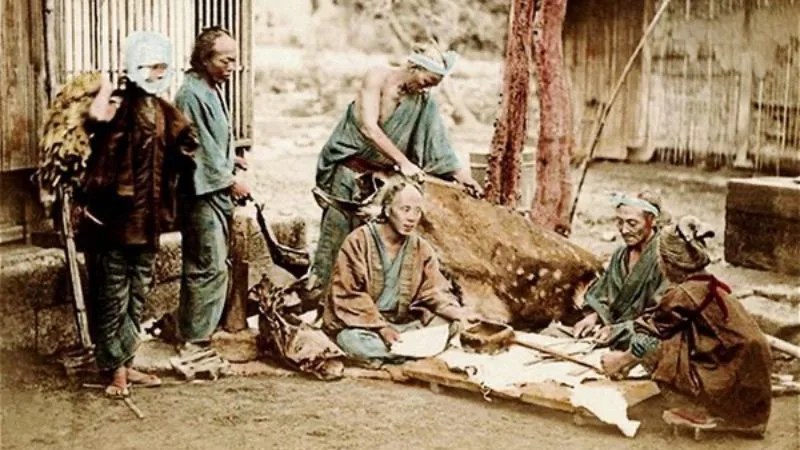
However, the vast majority of descendants of the Burakumin unfortunately still work in undervalued professions or even enter the world of crime. It is believed that about 70% of the members of Yamaguchi-gumi (the largest Yakuza faction in Japan) are of Burakumin origin.
But some important movements have been taking place to try to change the situation of the descendants of the Burakumin in Japan. From the early 20th century, these movements were divided into two fields: “assimilation,” which encouraged improvements in the living standards of buraku communities and integration with mainstream Japanese society, and the “levelers,” a movement that focused on confronting and criticizing alleged perpetrators of discrimination.
Leave a Reply