
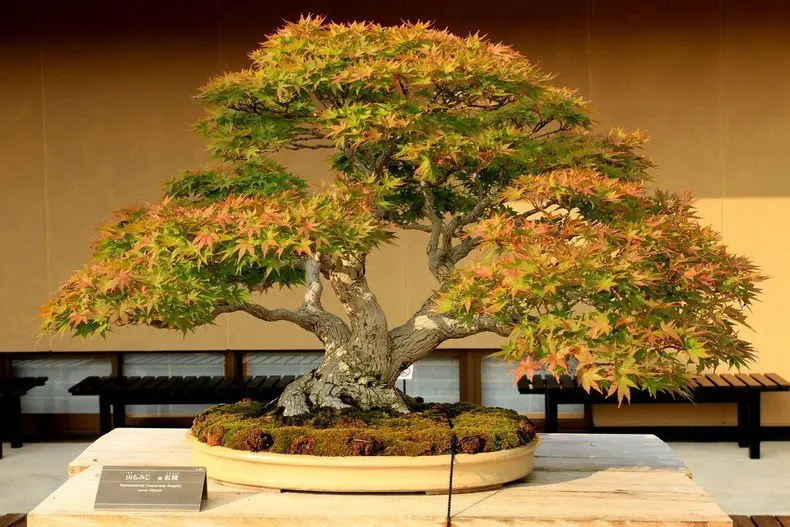
Bonsai [盆栽] is a form of Japanese art that produces miniature trees. Its name literally means “tree in a tray” or “tree in a pot.” In this article, we will talk a little about this Japanese art of cultivating miniature trees.
Bonsai trees are not genetically small; they are small because of their container, root growth restriction, and grafting. They also receive less fertilizer and nitrogen, and are watered moderately.
A bonsai needs to have other attributes besides simply being in a shallow pot. The plant must be a replica of a miniature tree from nature. This art is also cultivated by other cultures such as Chinese Penzai or Vietnamese Hon Non Bo.
It should simulate the growth patterns and the effects of gravity on the branches, as well as the marks of time and the overall structure of the branches. Essentially, it is a work of art produced by humans through specialized care.

Table of Contents
What is the purpose of Bonsai?
The purposes of bonsai are mainly contemplation for the viewer and the enjoyable exercise of effort and ingenuity for the cultivator.
In contrast to other plant cultivation practices, bonsai is not intended for the production of food or medicine. Instead, the practice of bonsai focuses on long-term cultivation and the shaping of one or more small trees in a pot.
Sometimes, the practice of bonsai is confused with dwarfism, but dwarfism generally refers to the research, discovery, or creation of plants that are permanent genetic miniatures of existing species.
Plant dwarfism typically uses selective breeding or genetic engineering to create dwarf cultivars. Bonsai does not require genetically dwarf trees but relies on cultivating small trees from regular stock and seeds.
Bonsai uses cultivation techniques such as pruning, root reduction, potting, defoliation, and grafting to produce small trees that mimic the shape and style of mature, full-sized trees.
What is the origin of Bonsai?
This art has been practiced for over 1000 years and is associated with a broad set of rituals, techniques, and terms. Despite the strong association between bonsai cultivation and Japanese culture, it was actually the Chinese who were the first to cultivate trees and shrubs in ceramic pots.
There is evidence that as early as 200 A.D., the Chinese were cultivating potted plants (better known as Penjing) as a regular practice in their gardening activities. The word Bonsai is derived from the Chinese Penzai.
The Japanese art of bonsai originated from the Chinese practice starting in the 6th century when officials from the imperial embassy and Buddhist students from Japan visited and returned from mainland China. They brought back many ideas and Chinese goods, including container plants.
Over time, these container plantings began to appear in Japanese writings and representative art. In the medieval period, recognizable bonsais were depicted in handscroll paintings such as the Ippen shonin eden (1299).
A close relationship between Zen Buddhism in Japan and potted trees began to shape the reputation and aesthetics of bonsai. During this period, Chinese Buddhist monks taught in Japanese monasteries.
One of the monks’ activities was to present various arts of miniature landscapes to political leaders as admirable achievements for men of good taste and knowledge. The arrangements from this period included miniature figures, in the Chinese style.

The history of Bonsai in Japan
Japanese artists eventually adopted a simpler style for bonsai, increasing the focus on the tree by removing miniatures and other decorations and using smaller, simpler pots. A long history of Bonsai in Japan began.
By the 14th century, the term for dwarf potted trees was Hachi no Ki [鉢の木], which literally means tree in a bowl. By the end of the 18th century, bonsai cultivation in Japan was spreading and began to interest the general public.
One of the oldest known bonsai trees, considered one of Japan’s national treasures, can be seen in the collection of the Imperial Palace in Tokyo. It is a five-needle pine over 500 years old called Sandai-Shogun-no-Matsu.
In Japan, after 1800, bonsai began to transition from the esoteric practice of a few specialists to a widely popular art form and hobby. Scholars gathered in the early 19th century to discuss recent styles in bonsai art.
The Japanese version of potted trees, which was previously called hachiue or other terms, was renamed bonsai in the 19th century. It took almost a century for this name to spread in Japan and to the West.
After World War II, various trends made the Japanese bonsai tradition increasingly accessible to the Western and global public. An important trend was the increase in the number, scope, and prominence of bonsai exhibitions.
Various events and world conventions began to emerge, gaining space and appreciation from the Western public. A third trend was the growing availability of specialized training in bonsai, followed by specialized stock of plants and components.

How to cultivate a Bonsai?
A bonsai is created starting with a sample of source material. It can be a cutting, seedling, or small tree of a species suitable for bonsai development. To cultivate a Bonsai, there are 3 known practices:
- Misho – Cultivated from seed;
- Yamadori – Cultivated from a seedling;
- Alporque – Asexual reproduction method of plants that causes the appearance of adventitious roots;
Bonsai can be created from almost any perennial species of trees or shrubs with woody trunks that produce true branches and can be cultivated to remain small through confinement in pots with crown and root pruning.
Some species are popular as bonsai because they have characteristics, such as small leaves or needles, that make them suitable for the compact visual scope of bonsai.
The source sample is shaped to be relatively small and to meet the aesthetic standards of bonsai. When the candidate bonsai approaches the planned final size, it is planted in a display pot.
From that moment on, its growth is restricted by the pot environment. Throughout the year, the bonsai is shaped to limit growth, redistribute leaf vigor to areas that require greater development, and meet the artist’s detailed design.
Care for the Bonsai
A bonsai must always be pruned for branch renewal and rejuvenation. Problematic, poorly positioned, or dead branches are removed, as well as less healthy foliage areas.
Pruning is fundamental for bonsai, establishing a basic structure, preventing problems, and balancing or redirecting the energies (strength) of growth.

Types, Sizes, and Styles of Bonsai
Bonsai can be categorized by styles, types of trees, and sizes. Below we will show the most common styles and sizes.
Sizes of Bonsai
Japanese bonsai exhibitions and catalogs often refer to the size of individual bonsai specimens. There are various techniques and specific styles associated with certain sizes.
| Wide Bonsai | ——- | ——- |
| Common Name | Classification | Tree Height |
| Imperial bonsai | Eight hands | 152–203 cm (60–80 in) |
| Hachi-uye | Six hands | 102–152 cm (40–60 in) |
| Dai | Four hands | 76–122 cm (30–48 in) |
| Omono | Four hands | 76–122 cm (30–48 in) |
| Medium Bonsai | ——- | ——- |
| Common Name | Classification | Tree Height |
| Chiu | Two hands | 41–91 cm (16–36 in) |
| Chumono | Two hands | 41–91 cm (16–36 in) |
| Katade-mochi | One hand | 25–46 cm (10–18 in) |
| Miniature Bonsai | ——- | ——- |
| Common Name | Classification | Tree Height |
| Komono | One hand | 15–25 cm (6–10 in) |
| Shohin | One hand | 13–20 cm (5–8 in) |
| Mame | Size of a palm | 5–15 cm (2–6 in) |
| Shito | Size of a fingertip | 5–10 cm (2–4 in) |
| Keshitsubo | Size of a poppy seed | 3–8 cm (1–3 in) |
Styles of Bonsai
See below the styles of Bonsai and what they have in common:
- Chokan: Formal upright style;
- Moyogi: Informal upright style;
- Shakan: Slanting style;
- Kengai: Cascade style;
- Han-kengai: Semi-cascade style;
- Fukinagashii: Wind-swept;
- Hokidashi: Broom style;
- Bunjingi: Literati style;
- Takosukuri: Tentacle style;
- Nejikan: Dragon style;
- Bankan: Spiral style;
- Sharimiki: Deadwood style;
- Sabamiki: Deadwood style;
- Sekijoju: Root over rock style;
- Ishisuki: Tree on rock style;
- Neagari: Exposed roots style;
- Soju: Mother and child style;
- Sokan: Twin trunk style;
- Tosho: Triple trunk style;
- Kabudashi: Interconnected trunks style;
- Netsunagari: Wavy raft style;
- Ikadabuki: Straight raft style;
- Yose Ue: Forest style;
- Penjing: Miniature landscape style;
Types of Bonsai – Trees
The types of trees used in Bonsai are endless, but here we have separated the most well-known to make a small list:
- Acer
- Acerola
- Mulberry
- Guava
- Brazilian Pepper
- Azaela
- Bertholletia excelsa
- Bougainvillea
- Buxus
- Callistemon
- Carmona (genus)
- Cherry Blossom
- Night Blooming Jasmine
- Eugenia
- False Erica
- Ficus
- Gabiroba
- Ilex
- Ipê
- Jabuticaba
- Lantana
- Privet
- Apple Tree
- Malpighia
- Nandina
- Ceiba
- Pau-mulato
- Pistachio
- Pitangueira
- Reseda
- Pomegranate
- Schefflera
- Serissa
- Taxodium
- Ulmus
Leave a Reply