
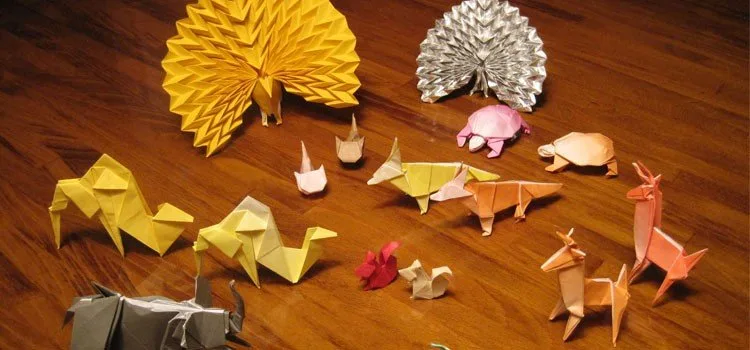
Origami [折り紙] is the famous Japanese art of folding paper, the word literally means [折る] to fold [紙] paper. With this art, people are able to transform a simple piece of paper into a crane (tsuru) in just 12 steps.
Origami has its mark in history and is known worldwide. Today it is used in many professional fields such as architecture, where professionals use the basic concepts of origami to develop their projects. Origami has also been used by health professionals as an effective rehabilitation exercise for the elderly and disabled.

Table of Contents
Origin of Origami
The origin of origami is somewhat unknown; it is said to come from ancient times when formal documents were folded and refolded in elaborate ways. It is believed that it was during the Edo Period (1603-1867) that origami became a form of leisure.
This art has been passed down from generation to generation by parents and grandparents, many children are amazed to see their parents transform a simple piece of paper into great goals.
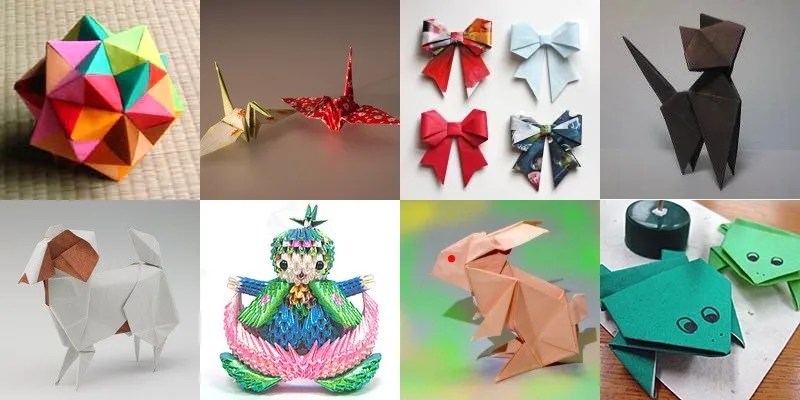
Origami can be divided into 2 categories: traditional and creative. Traditional origami involves folding paper into shapes of birds, frogs, balloons, boats, insects, and plants. Creative origami emerged in 1950 and was conceived by Akira Yoshizawa; it consists of creating more elaborate objects and animals using more than one piece of paper or other techniques.
There is also an art called Kirigami [切り紙] which means cutting paper. It is similar to origami, except that the paper can be cut to create more elaborate designs. Kirigami is made from a single piece of paper without glue.
The Legend of Tsuru
Sadako Sasaki is a girl who, in her childhood, was hit by radioactive rain from the atomic bomb in Hiroshima, resulting in leukemia. On August 3, 1955, Chizuko Hamamoto, a friend of Sadako, visited her in the hospital and made her an origami of a Tsuru.
Her friend told her the popular Japanese legend that whoever makes a thousand origami Tsurus is granted a wish by the gods. Since then, every day Sadako began to make her Tsurus always with the same wish: to heal and return to live normally. Since her illness was caused by the bomb, she also wished for peace for humanity.
Sadako managed to make 646 paper Tsurus, and after her death, her friends made another 354 so that she could be buried with a thousand Tsurus. Sadako died on October 15, 1955, and her friends erected a monument in her memory in the Peace Park (in Hiroshima), where they engraved the following words: “This is our cry, this is our prayer. Peace on Earth!” This legend and story moved and reached the whole world!
If you want to learn more about Tsuri, read our article: Tsuru the Japanese Origami Crane.
Do you want to learn how to make a Tsuru? Watch the video below:
Tips for Making Your Origami
Anyone can create their own traditional origami, without being a professional and without the need to take courses. You need to pay close attention and be observant. You need the right paper and knowledge of the folding rules which are:
- Work on a flat and smooth surface;
- Use thin paper if you are a beginner in this art or if you are making a model with many folds;
- Cut the paper accurately;
- Make the folds very carefully;
- To accentuate the creases, run the inner part of your index finger over them;
- Keep your hands clean so you don’t dirty your origami;
There are other rules, and you don’t have to use only origami paper. You can use any paper you have available, including newspapers, flyers, or wrapping paper. You decide the size, quality, and color of the paper according to what you want to make. If you want to make a professional art piece, we recommend the Japanese handmade paper called washi.

For most figures, it is essential that the paper is a perfect square; to know if it is perfect, just fold it into a triangle and check. To achieve a great result, you should fold in a way that aligns perfectly with the edges and corners, and don’t forget to press the folds well.
In some origamis, it is necessary to fold and unfold the paper, making a crease in it. Sometimes it is necessary to roll, twist, pleat, force, press, blow open, and turn the paper inside out to create different effects.
Making origami is very good and fun; you can do it anytime and anywhere, just have a piece of paper! You can see other Japanese arts by reading our other article by clicking here.
Origamis of Anime Characters
Origamis can even become anime characters. Some people end up making cuts in the paper to create their shape; this does not mean that the art has ceased to be origami, depending on the cut it can be called kirigami, the art of cutting paper.
One should not confuse the arts in this article with Papercraft or pepakura, which are printed sheets with definitions for cutting and folding to form three-dimensional objects. In this article, we will see some origami arts inspired by anime and manga.
Below we will appreciate the arts made of origami and mention the characters present in them:
- Kaede Nakamura from Rozen Maiden;
- Kinomoto Sakura from Cardcaptor Sakura;
- Hatsune Miku from Vocaloid;

- Suigintou from Rozen Maiden;
- Zero from Code Geass;
- Flandre Scarlet from Touhou Project;
To keep the art a little more traditional, some artists prefer to maintain a single color of paper, crumpling or folding it instead of resorting to cuts or other sheets to form parts of the hair, mouth, and eyes.

- Maid (servant);
- Chibi character dressed as Santa Claus;
- Kurumi Tokisaki from Date Alive;

- Doraemon;
- Pikachu from Pokemon;
- Luffy from One Piece;

The characters we just saw in the image above are entirely made from the combination of various origami. You can see high-quality other origami from anime, manga, and games on the site origami.me, which was the source of some images in this article.
Leave a Reply