

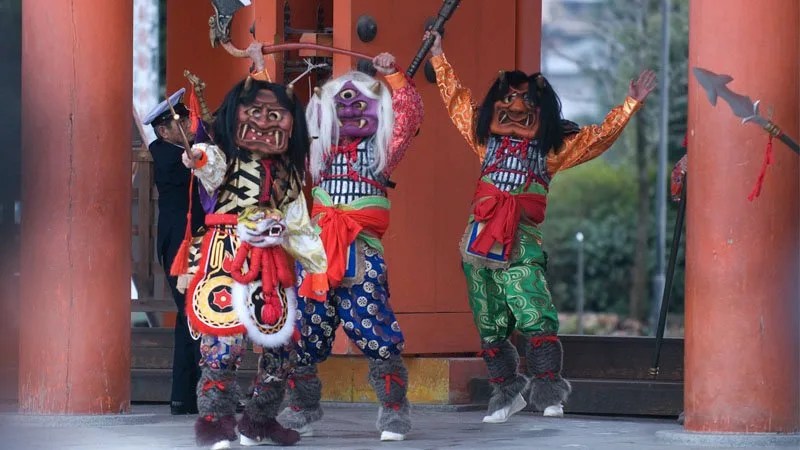
Did you know that in Japan there is a holiday where people dress up as oni (demons), while others throw soybeans at these people? Today we will talk about the spring festival called setsubun.
During this time, the change in weather often causes illnesses, for this reason, the Japanese believed that the cause could be demons, so they scared them away with soybeans shouting “Oni out! Good luck in!”
The change of seasons has names: Spring (risshun), Summer (rikka), Autumn (risshuu), and Winter (ritto);
Table of Contents
What is Setsubun?
Setsubun [節分] literally means “to divide or separate seasons”, it is a holiday celebrated at the beginning of February to say goodbye to winter and welcome spring (it usually falls between February 2 and 4).
On this day, the Mamemaki [豆撒き] takes place, a ritual conducted by the head of the family or a member who has the corresponding Chinese zodiac sign for the year. In this ritual, roasted soybeans are thrown at someone dressed in an Oni mask (ogre, demon).
During this ritual, the members shout: “Fukuwa Uchi” (Welcome happiness, luck, good things) “Oniwa soto” (Out with the demons, bad luck, bad things). This custom was introduced by the Chinese to Japan in the eighth century.
In Japanese, it is written: 鬼は外 福は内
Origin of Mamemaki Oni
Like most customs, this was introduced by the Chinese. In Japan, this ritual began in the ceremony called Tsuina or Oniyarai, which was held at the end of winter, at the emperor’s residence during the Heian period (794 to 1185).
In the story, the characters represented are an Oni and a woman. According to an ancient legend, an old lady tries to steal something from an old man. However, the figure of the old man was a disguise of the Oni (ogre) who has the power to disguise himself as a human.
When the old man saw the theft, he revealed his true ogre nature. Startled, the old lady grabbed the first thing she saw: soybeans and threw them at him. That is how the tradition of throwing soybeans mamemaki began.
This custom dates back to the year 706 when it was actually used “peach branch,” only after the mentioned story did they start using soybeans. The peach is related to the fable of momotarou who defeated onis.
Why Soybeans?
The Japanese believe that soybeans are a symbol for purifying the house and expelling all evil spirits and bad luck. And the spring setsubun was and perhaps still is considered by some the Lunar New Year in the calendar, that is, a kind of New Year’s Eve.
This date was accompanied by an extensive special ritual of purification from the evil of the previous year and the removal of demons that might bring illness in the following year.
Another custom is to eat soybean foods, preferably the amount of soybeans equivalent to your age to maintain good health. Among them, we have natto, misoshiru, and tofu; we even have an article on soy-derived foods.
People also eat a special sushi called Ehoomaki. This sushi cannot be sliced, as cutting it means ruptures, separation, and thus one can cut their luck.
At the festival, the temples are decorated in white and red, where the celebrations take place; it is customary to throw special beans to the visitors. Although Setusbun is celebrated throughout Japan, it is not considered a national holiday.
The video from the channel below shows a little more about this ritual Mamemaki practiced by students from a school:
Leave a Reply