
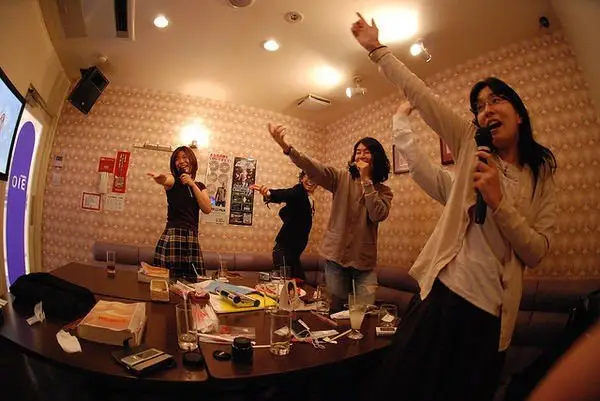
Walk into a Japanese karaoke booth on a Friday night and you will hear the same rituals over and over: friends ordering food, someone fighting for the remote, and a shortlist of songs that almost always end up on the queue. Those tracks are not random. They are the ones people trust when they want the room to join in.
This is not a real-time national chart. Charts move every year. What follows is a set of five Japanese karaoke staples that keep coming back in rooms, family parties, and company after-hours — songs that still make sense on the machine when the group is mixed, shy, or already loud.
Contents 8
Why these songs still fill the queue
Japan’s big karaoke systems — mainly JOYSOUND and DAM — track what people actually sing. Yearly lists change with new anime openings, ballads, and viral hits, but a handful of titles stay near the top for a long time. Some became fixtures through Oricon karaoke rankings; others live on because the chorus is easy to share, even if the verses are hard.
If you want the broader culture behind private rooms, food trays, and timed sessions, start with our guide to karaoke in Japan. Here, the focus is narrower: five songs you will still hear when someone finally hands you the mic.
1. 残酷な天使のテーゼ — “Zankoku na Tenshi no Thesis” by Yoko Takahashi
The opening theme of Neon Genesis Evangelion is still one of the safest anime picks in any booth. The brass intro is instant recognition, the chorus is pure group energy, and even people who never finished the series know the first line.
On long-running karaoke charts it shows up year after year, and it remains a top pick among both Japanese singers and visitors who only know a few Japanese songs. If you want the lyrics and meaning broken down in English, we have a full piece on Zankoku na Tenshi no Teeze.
Practical tip: the verses move quickly. Let one confident singer carry the start, then open the room on the chorus. That is usually when the whole booth wakes up.
2. 小さな恋のうた — “Chiisana Koi no Uta” by MONGOL800
MONGOL800’s Okinawan rock anthem is the opposite of a flashy performance number. It is warm, mid-tempo, and built for people who want to sing together without turning the night into a competition.
It spent years near the top of Japanese karaoke rankings for a simple reason: the melody is friendly, the emotion is clear, and the song works for mixed groups — students, coworkers, couples, old friends. You do not need to “win” the track. You need to keep the room in time and let the chorus do the rest.
If someone in your group is nervous, this is a better first song than a high-note anime opening. It leaves space for soft voices and still sounds complete.
3. 空も飛べるはず — “Sora mo Toberu Hazu” by Spitz
Spitz built a whole generation of karaoke ballads, and this one still sits in the classic pile. It is a 1990s rock-ballad with a clean guitar line and a chorus that feels bigger than the verses promise.
In a Japanese room, this is the song someone chooses when the night turns a little sentimental — after the funny tracks, after the drinks arrive, when the group wants one real sing-along instead of pure comedy. The pitch is manageable for many men and women if you drop the key a step or two on the machine.
Listen for the title line in the chorus: once that lands, the booth usually follows even if half the people are reading the screen for the first time.
4. ハナミズキ — “Hanamizuki” by Yo Hitoto
Yo Hitoto’s “Hanamizuki” is a long-running karaoke favorite for people who prefer ballads over shouts. The song has a gentle pace, a memorable title word, and the kind of melody that shows up on multi-year karaoke lists long after the original chart run.
It is especially common in mixed-age groups. Younger singers may bring anime tracks; someone older often answers with a ballad like this. That contrast is part of Japanese karaoke culture: one remote, many decades of songs, no need to agree on a single genre.
If your Japanese is limited, watch the furigana or romaji display on the machine. The chorus is the part worth memorizing first — the rest becomes easier once the room is already humming along.
5. 女々しくて — “Memeshikute” by Golden Bomber
Golden Bomber turned “Memeshikute” into a karaoke phenomenon. The band is famous for visual-kei theatrics and for not always playing their own instruments on stage, but the song itself is pure crowd fuel: bright, ridiculous in a good way, and built for call-and-response energy.
On the Oricon karaoke chart it once held the top spot for dozens of consecutive weeks — a record-level run that only later big hits managed to challenge. In the room, it works because people recognize it fast and nobody is expected to sound “cool” while singing it. Embarrassment is part of the joke, and that lowers the pressure.
Good for groups that already know each other. If the booth is still stiff, warm up with something softer, then drop this when people are ready to clown a little.
How to pick Japanese karaoke songs as a visitor
You do not need a perfect top-five list. You need a short plan:
- One safe anime or J-pop anthem that half the room already knows (Evangelion still counts).
- One easy group song with a friendly chorus (MONGOL800 fits that role well).
- One ballad for when the night slows down (Spitz or Yo Hitoto).
- One chaotic fun track when the group is ready to get loud (Golden Bomber).
Modern machines also surface newer yearly favorites — Yoasobi, Kenshi Yonezu, LiSA, Ado, and the latest anime openings. Those change fast. The five above stay useful because they travel across ages and still sound “normal” when a mixed Japanese group is choosing together.
Search by Japanese title if you can. Romaji spellings vary a lot between machines, and a kanji or kana search is usually cleaner once you copy the title from your phone.
A small note on “best” songs
There is no single ranking that settles Japanese karaoke forever. Official yearly lists, app play data, and what your friends actually request can disagree in the same week. Treat any top five as a starting set, not a law.
What matters in the booth is simpler: can the room sing it, does the chorus land, and does the person holding the mic look less scared after the first thirty seconds? If the answer is yes, you picked well — even if the song never sat at number one on a national chart.
Next time the remote comes your way, try one of these classics, leave room for the group on the chorus, and save the ultra-high note flex for the second hour. That is how Japanese karaoke nights usually stay fun past the first song.




Community
Comments
0 comments
There are no published comments in this language yet.
Send comment