

Japanese is a language full of peculiarities, and one of them is the markers called Dakuten (濁点) and Handakuten (半濁点). Although many Japanese learners use these signs daily, few know their names or the history behind them. Understanding how they work can facilitate language learning and improve pronunciation.
In this article, we will explore in detail what Dakuten and Handakuten are, how they originated, and how they influence the pronunciation of kana characters. We will also explain some curious situations in which these symbols appear and how they have shaped modern Japanese.

Table of Contents
What Are Dakuten and Handakuten?
Defining the Concept
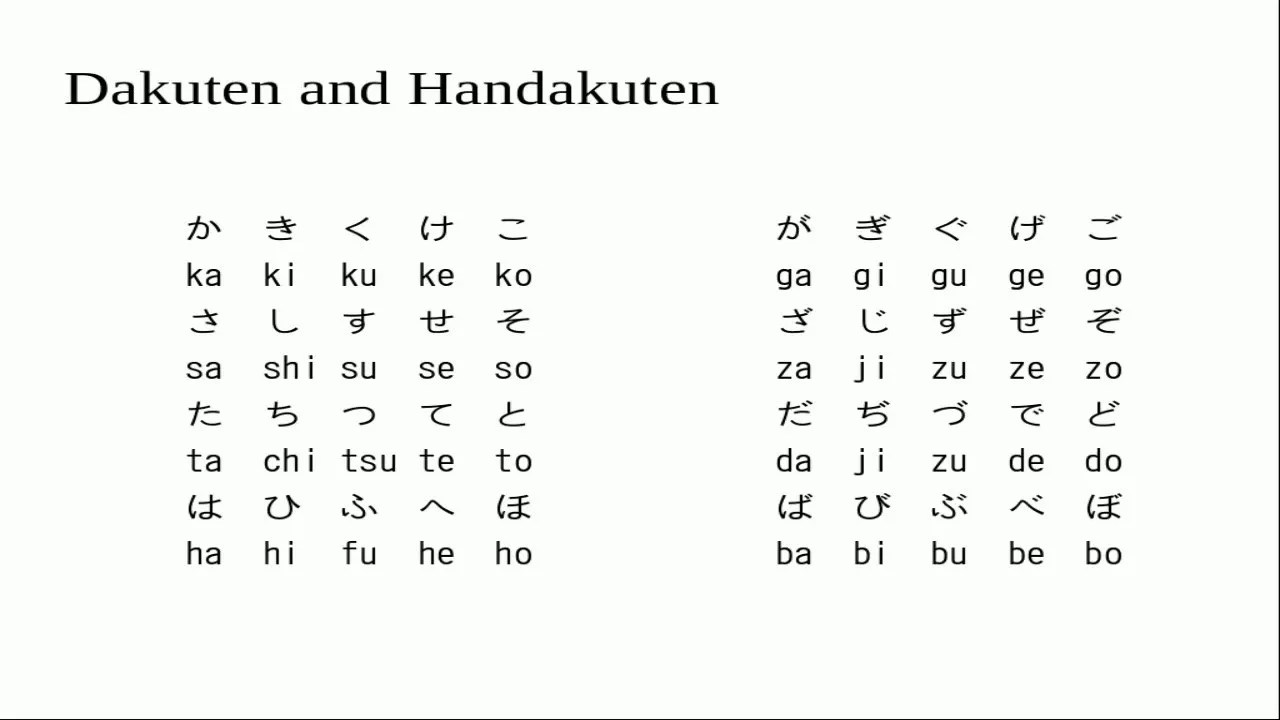
The Dakuten, also known as “tenten,” are those two small quotation marks (゛) that appear in the upper right corner of a kana character to indicate that the sound has changed. For example, the syllable “ka” (か) transforms into “ga” (が) with the addition of Dakuten, changing the way the sound is produced, from voiceless to voiced.
The Handakuten is a small circle (゜) that modifies the syllables that begin with “H,” turning them into syllables that begin with “P.” Thus, “ha” (は) becomes “pa” (ぱ). The introduction of this symbol came in the 16th century when Portuguese missionaries, confused by the absence of signs indicating sound changes, suggested the adoption of a differentiation system to make the language more practical.

Example Table
Below we have the example of all the families of Hiragana and Katakana that support Dakuten and Handakuten:
| KANA | DAKUTEN | HANDAKUTEN |
|---|---|---|
| か (ka) | が (ga) | か゚ (nga) – rarely used |
| さ (sa) | ざ (za) | – |
| た (ta) | だ (da) | – |
| は (ha) | ば (ba) | ぱ (pa) |
The Dakuten and Handakuten are always positioned in the upper right corner of the characters, as shown above.
The Sound of V in Japanese
In katakana, Dakuten plays an interesting role in representing the sound of “V,” something that is non-existent in traditional Japanese. To create this sound, the character ウ (u) receives a Dakuten, forming the symbol ヴ (vu). This character can be combined with small vowels to form syllables like ヴァ (va) and ヴィ (vi).
However, the use of the “V” sound is still rare, and many Japanese prefer to substitute it with “B” when pronouncing foreign words, as “V” does not fit naturally into the phonetics of the language. It is common to hear “beer” instead of “veer” when it comes to borrowed words.
Curious Uses and Distinct Sounds
The Mystery of Uncommon Dakuten Kana
If you have studied Japanese for a while, you may have come across strange combinations like ま゛ (ma゛), い゛ (i゛), or な゛ (na゛). These symbols do not alter the original sound but are used in very specific contexts to indicate distorted sounds or vocal expressions.
Why does this happen? These Dakuten can symbolize emotions or changes in voice, such as:
- Crying or lamenting: A distorted sound that represents someone’s sobbing.
- Screaming or being in pain: An indication of a voice that trembles or breaks due to effort.
- Being drunk or sleepy: Shows that the voice is slurred or irregular.

How Does This Affect Pronunciation?
The pronunciation of kana with mysterious Dakuten remains the same, but the context in which they are used changes the tone of speech. For example, the use of these markers in manga and anime indicates that the character is in an extreme emotional or physical situation. It is a stylistic device to bring more life to the narrative.
Cultural and Historical Importance
The existence of Dakuten and Handakuten is a testament to how the Japanese language has evolved to become more understandable and functional. They have simplified the way sounds are distinguished and facilitated the integration of foreign words into the language. Today, these signs are a fundamental part of writing and learning Japanese.
Did you enjoy learning more about Dakuten and Handakuten? If you have any experience with these markers or want to share fun examples, leave a comment below! This is an excellent way to connect with other students of the Japanese language and expand your knowledge.
Leave a Reply